
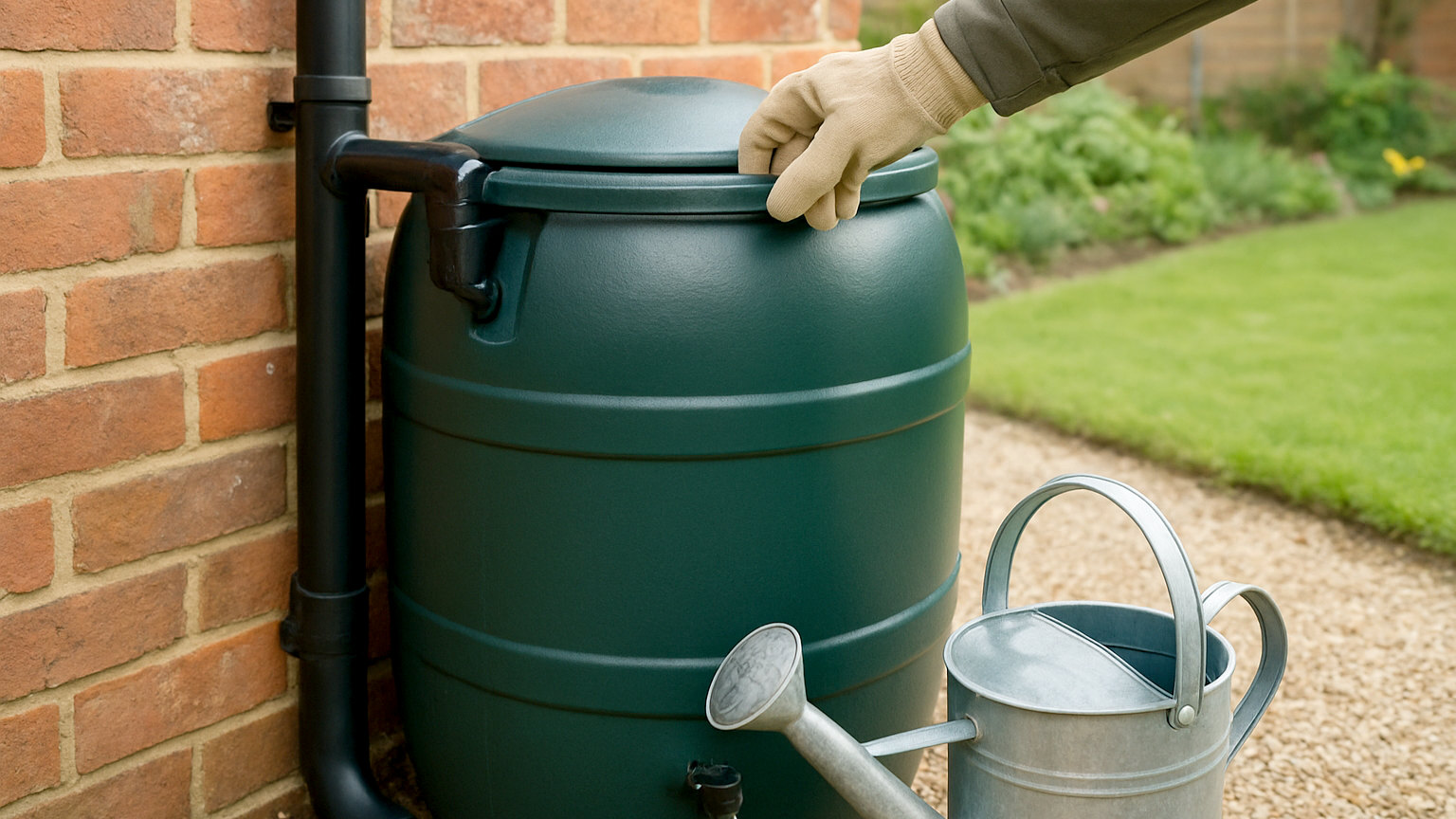
An average house roof sheds tens of thousands of litres a year, almost all of it straight into the drain. Capturing even a fraction of that covers a good share of a garden's needs, and rainwater is better for several plants than anything from a tap.
Why rainwater is worth collecting
Beyond the obvious saving, rainwater is slightly acidic and free of the calcium found in hard tap water. That matters for ericaceous plants such as rhododendrons, camellias, blueberries and pieris, which develop yellowing leaves when watered with hard water over time.
It is also at ambient temperature rather than cold from the mains, which seedlings and greenhouse plants prefer, and it costs nothing on a metered supply.
Sizing a butt
A standard butt holds around two hundred litres, which sounds a lot and is roughly ten full watering cans. In a dry fortnight with containers to keep going, that disappears quickly.
Bigger is better if you have room, and linking two or three butts together with a connector kit is the usual approach. Water fills the first, then flows into the next, and you draw from the tap on the last.
Collect from every downpipe you can, including the shed, greenhouse and garage, since these are often the most convenient sources for the parts of the garden that need water most.
Fitting one
The butt must stand on a firm, level base raised high enough to get a watering can under the tap. Blocks or a proprietary stand both work.
Water is heavier than people expect. Two hundred litres weighs two hundred kilograms, so the base needs to be solid and level. A butt on soft ground will tilt as the soil compresses, and a full one can topple.
Fit a rain diverter into the downpipe, which is a simple cut-and-insert job requiring a saw and about twenty minutes. Most diverters overflow back into the downpipe automatically once the butt is full, which avoids flooding the base of the house.
Keeping the water usable
Keep the lid on at all times. It excludes light, which prevents algae, keeps out leaves and debris, stops mosquitoes breeding, and is an important safety measure where children are around.
Fit a leaf strainer or mesh at the inlet, and clean the gutters that feed it. Empty and rinse the butt annually, ideally in late winter before the growing season starts.
Stored rainwater can harbour bacteria and fungal spores, so use mains water for seedlings, cuttings and anything vulnerable to damping off. For established plants, rainwater is fine and preferable.
Grey water
Water from washing up, baths and showers can be used on ornamental plants, and it makes a real difference during a hosepipe ban.
Use it the same day rather than storing it, since it turns quickly. Avoid water containing bleach, disinfectant, dishwasher salt or strong detergents. Do not use it on edible crops, on seedlings, or repeatedly on the same patch, since salts and residues accumulate in the soil.
Bath water with ordinary soap in it is the most useful source, and a siphon over the windowsill saves carrying it.
The other ways to save
Mulching does more than any amount of collection, cutting evaporation from bare soil substantially. Improving soil with organic matter raises how much water it can hold, and that improvement lasts.
Watering at the base rather than over foliage, in the morning rather than the middle of the day, and thoroughly rather than frequently, all reduce the total needed.
A watering can wastes far less than a hose, simply because it makes you place the water deliberately. If you use a hose, a trigger nozzle stops it running while you walk between plants.
Irrigation on a timer
A simple drip or soaker system on a tap timer uses considerably less water than hand watering, because it delivers slowly at the base rather than spraying across a bed. It suits greenhouses, containers and vegetable beds particularly well, and it removes the problem of a fortnight away in August.
Set it to run early in the morning and check periodically that emitters have not blocked, which is the usual failure.
Designing the need out
The most effective long-term saving is choosing plants that suit your conditions. A sunny free-draining border planted with lavender, cistus, euphorbia, sedum and ornamental grasses needs no watering at all once established.
Similarly, permeable surfaces, rain gardens and directing downpipe overflow into a planted area rather than a drain keep water on site where it does some good.


