
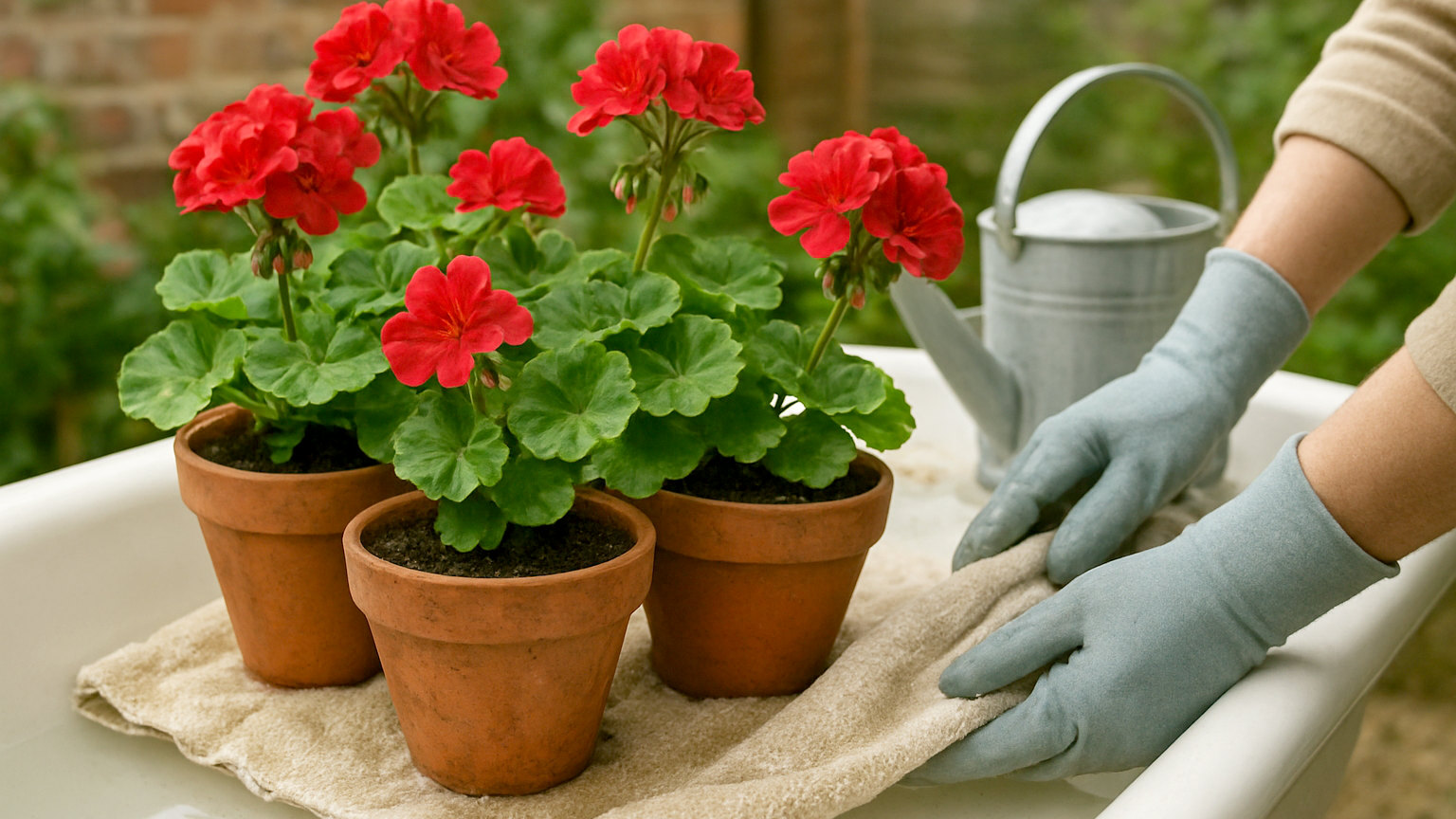
Capillary matting is absorbent fabric that wicks water sideways from a reservoir and holds it available across its whole surface. Pots stand on it and draw water up through their drainage holes as they need it. It is what commercial nurseries use, and it scales from one plant to fifty.
Setting it up properly
- Lay the matting on a flat, level, waterproof surface – a draining board, a tray, a table with plastic sheeting.
- Run one end into a reservoir of water: a washing-up bowl, a bucket, or the sink itself.
- Soak the matting thoroughly before you start, or it will not begin wicking.
- Stand the pots on it, pressing each down slightly so the compost is in contact through the drainage holes.
- Test it for a few days before you leave and watch the water level fall.
The two conditions that make or break it
The reservoir must be below the level of the pots, and the matting must be continuously wet along its whole length. If the reservoir is higher, water siphons rather than wicks and the pots flood. If any section of matting dries, the capillary chain breaks and nothing beyond that point receives anything.
The other requirement is contact. A pot with a raised base, feet, or a crock sitting over the drainage hole may not touch the matting at all. Remove pot feet, and press each pot down firmly.
The bath method
The improvised version, and it works well. Lay an old towel in the bath, run one end into a few centimetres of water at the plug end, and stand the pots on the wet towel. The towel does exactly what matting does.
A bath is a good location for other reasons: bathrooms are humid, the surface is waterproof, and light is usually moderate rather than direct. Leave the curtain or blind open, since a fortnight in the dark causes leaf drop.
The same arrangement works in a shower tray, a large baking tray, or a plastic storage box lid.
Which plants suit it
Anything that likes consistent moisture: ferns, calatheas, peace lilies, marantas, seedlings and cuttings. It is ideal for exactly the group that struggles most with absence.
Keep succulents, cacti, sansevieria and ZZ plants off it entirely. Two weeks of continuous moisture will rot them, and those are the plants that needed no help in the first place.
How long it lasts
Depends on reservoir size and evaporation. A washing-up bowl supporting a dozen small pots typically lasts two to three weeks. Covering the reservoir with a lid or cling film with a slot cut in it substantially reduces evaporation and extends the run.


