
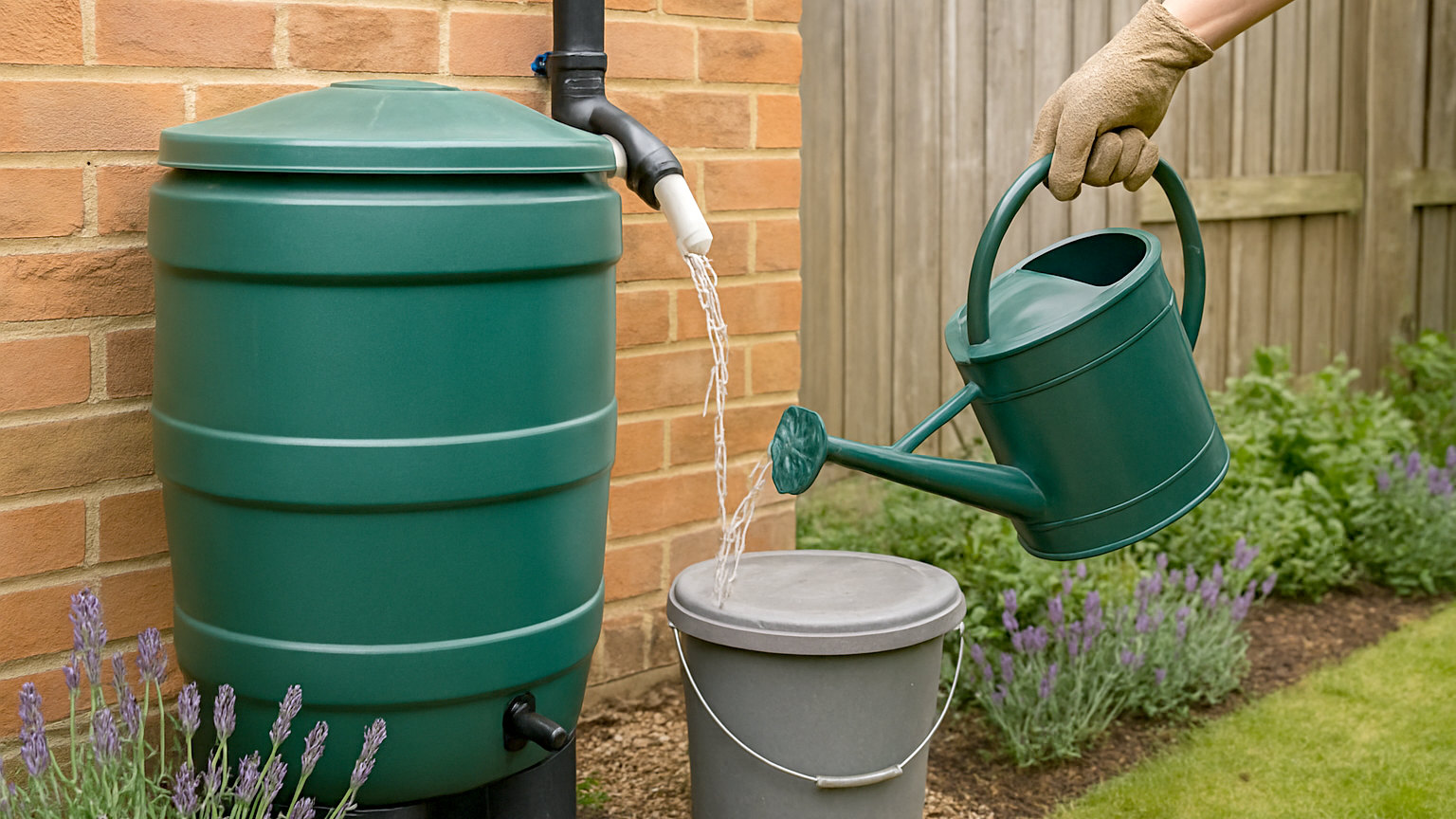
Rain falling on a roof is free, better for plants than tap water, and unaffected by hosepipe restrictions. Most gardens collect a fraction of what is available.
How much a roof yields
Roughly speaking, every square metre of roof collects about a litre from each millimetre of rainfall.
A modest garage or shed roof therefore delivers hundreds of litres from a single wet week, which is far more than a single butt holds.
The limit is nearly always storage rather than supply.
Setting up butts
Fit a butt to every downpipe you can: house, garage, shed, greenhouse.
Use a rain diverter, which fits into the downpipe and directs water into the butt while allowing overflow to continue down the pipe once full.
Raise the butt on a firm level stand. Height gives pressure at the tap and room to get a watering can underneath, and a full butt is extremely heavy, so the base must be solid and level.
Link several butts together with connector kits so they fill in sequence, which multiplies storage cheaply.
Consider a slimline butt where space is tight, or an underground tank for serious storage.
Keeping stored water usable
Always fit a secure lid. This keeps out leaves and debris, stops algae by excluding light, prevents mosquitoes breeding, and is a safety matter where children have access.
Fit a filter or a leaf trap at the diverter.
Clean the butt out annually, in autumn, removing sediment from the base.
Water from a butt is not drinking water and should not be treated as such. Avoid creating fine sprays or mists from stored water, since aerosols carry a small legionella risk.
Use rainwater rather than storing it indefinitely. Water that has stood for months develops an anaerobic smell and is less pleasant to handle.
Where rainwater is better than tap water
For ericaceous plants such as camellias, rhododendrons, blueberries and pieris, particularly in containers. Hard tap water is alkaline and gradually raises the pH of the compost until the plant cannot take up iron.
For seedlings and young plants, which prefer water at ambient temperature rather than cold from a tap.
For ponds, where tap water introduces chlorine and nutrients that encourage algae.
Plumbing regulations
Any permanent connection between a garden water supply and the mains needs a backflow preventer, since contaminated water must not be able to enter the mains supply.
A rainwater system must never be cross-connected to the mains. Anything beyond a butt and a tap is worth discussing with a qualified plumber.
Greywater
Water from baths, showers, hand basins and washing up can be reused on the garden with sensible limits.
Use it the same day. Greywater contains organic matter and bacteria multiply rapidly, so it should not be stored for more than about twenty-four hours.
Do not use it on edible crops, particularly anything eaten raw or where the water would touch the part you eat.
Avoid water containing bleach, disinfectant, strong detergent, water softener or dishwasher salt. Sodium in particular damages soil structure over time.
Apply it to the soil around ornamental plants rather than over foliage.
Rotate where you use it rather than applying it repeatedly to the same area, since salts and residues accumulate.
Do not use greywater on lawns repeatedly, and do not put it in a pond.
What not to reuse
Water from nappies, from washing soiled items, or from a washing machine using biological detergent and softener.
Water from a dishwasher, which contains high levels of salt and alkaline detergent.
Water that has been standing for more than a day, or that smells.
Water used to clean anything that has been in contact with raw meat, pet bedding or garden chemicals.
Reducing demand
Storage is only part of it. Mulching annually, improving soil with organic matter, choosing drought-tolerant plants and watering thoroughly rather than often all reduce how much is needed in the first place.
Using stored water
A butt provides very little pressure, so a hose from one delivers slowly. Raising the butt as high as practical helps, and a small pump makes a hose or a drip system workable.
Filter rainwater thoroughly before running it through any drip system, since debris blocks the emitters within days.


