
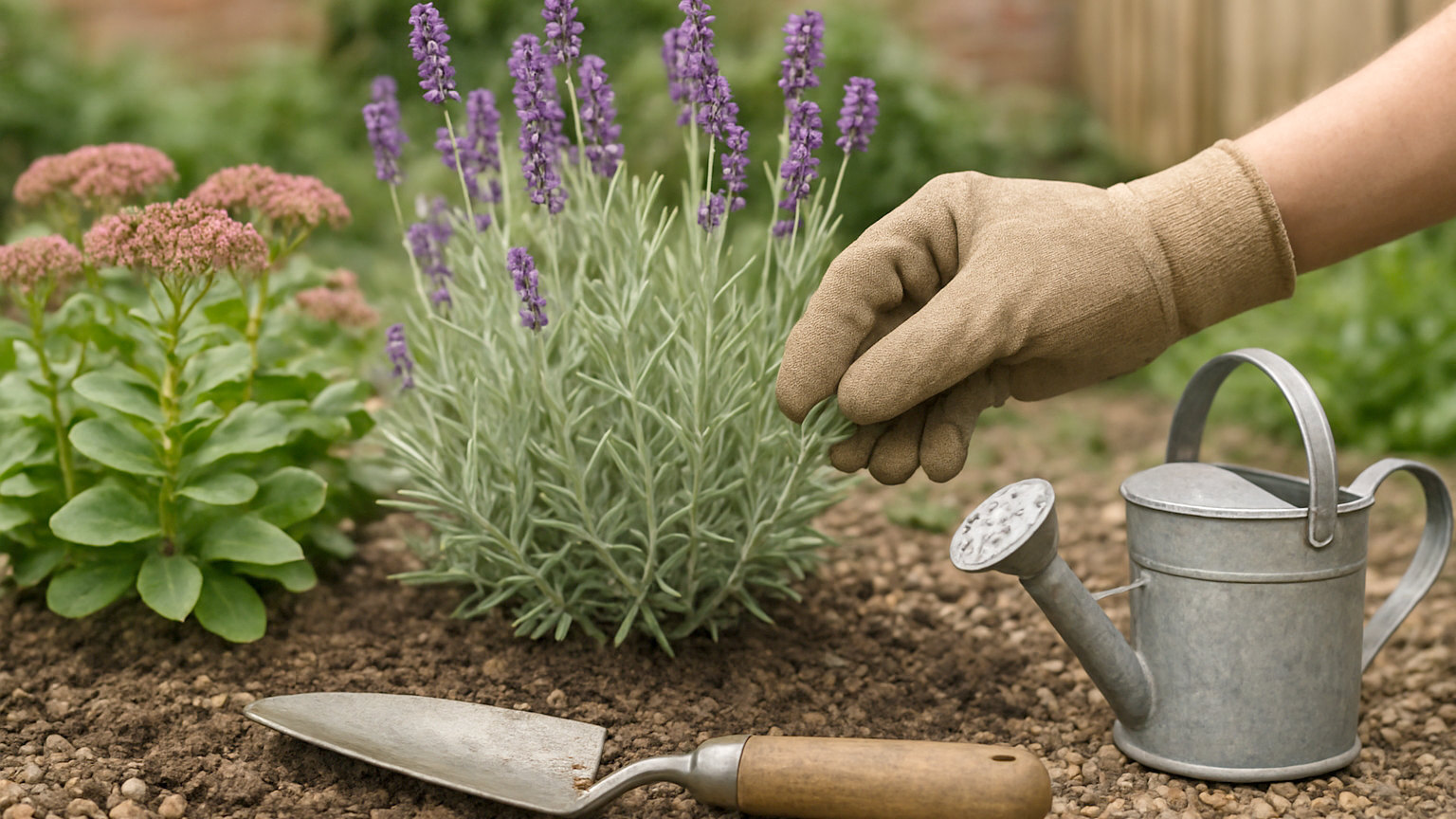
A border planted with species adapted to dry conditions needs almost no watering once established, looks good through a hot summer, and asks for less attention than almost any other planting.
Recognising an adapted plant
Plants from dry climates share visible features, and learning them lets you assess an unfamiliar plant in a nursery.
Silver or grey foliage reflects light and reduces heat load.
Hairy or felted leaves trap a layer of humid air at the surface, slowing water loss.
Small, narrow or needle-like leaves present less surface area.
Waxy or leathery surfaces reduce evaporation.
Aromatic foliage is common among Mediterranean plants, where volatile oils help.
Succulent leaves store water.
Deep taproots reach moisture well below the surface, which is why many of these plants resent transplanting.
Reliable choices
Shrubs and sub-shrubs: lavender, rosemary, cistus, santolina, phlomis, perovskia, caryopteris, hebe, ceanothus, cytisus, helianthemum, artemisia.
Perennials: eryngium, echinops, achillea, sedum and hylotelephium, euphorbia, nepeta, salvia, verbascum, stachys, gaura, dianthus, kniphofia, agapanthus.
Grasses: stipa, festuca, miscanthus, pennisetum.
Bulbs: alliums, nerines, tulip species, agapanthus.
Annuals: Californian poppy, nasturtium, cosmos, calendula.
Many of these also flower for long periods and are excellent for pollinators, so the planting does more than survive.
They need drainage more than anything
Most drought-tolerant plants are killed by winter wet rather than by cold.
Roots sitting in cold saturated soil through January rot, and the plant dies in spring just as everything else starts growing.
Add grit generously at planting, plant slightly proud of the surrounding soil, and mulch with gravel rather than bark so the crown stays dry.
On clay, use raised beds or containers rather than fighting the ground.
Do not feed them
Rich soil produces soft sappy growth with less scent, fewer flowers, reduced hardiness and a shorter life.
These plants evolved on poor stony ground. Adding compost and fertiliser works against them.
This is one of the few situations where a gravel mulch is better than an organic one, since it does not feed the soil.
They still need establishing
Drought tolerance applies to an established plant with a developed root system, not to something planted last month.
Water thoroughly and regularly through the first growing season, and in dry spells during the second.
Then stop, which is the part people find difficult. Continuing to water produces shallow roots and a plant that never becomes independent.
Autumn or spring planting is better than summer, giving the plant time to root before facing heat.
Gravel gardens
The natural setting for this planting. A deep gravel mulch over free-draining soil suppresses weeds, keeps crowns dry, retains moisture beneath and looks appropriate.
Plant through the gravel into the soil beneath rather than into the gravel itself, and avoid laying membrane underneath, which prevents the self-seeding that makes these plantings look natural over time and causes problems of its own within a few years.
Aim for five to seven centimetres of gravel, which suppresses weeds effectively and keeps the crowns of plants dry through winter.
What they are not
Drought tolerant does not mean indestructible. Extended drought in a container, or a plant in genuinely poor health, will still fail.
Nor does it mean suitable for shade. Almost all of these want full sun, and in shade they become drawn, flower poorly and rot over winter.
Lifespan
Many Mediterranean shrubs are short-lived, at five to ten years, and become open and woody rather than dying outright.
Take semi-ripe cuttings in late summer every few years so replacements are ready, since these plants root very easily and cost nothing to renew.
Combining them
Drought-tolerant plants suit each other because they want the same conditions, so a hot dry border of them works as a coherent planting rather than a collection.
Silver foliage, grasses and strong flower shapes such as eryngium and allium combine particularly well, and the whole planting stands up in a hot summer when a conventional border is flagging.
Wildlife value
Many are outstanding for pollinators. Lavender, nepeta, salvia, echinops, eryngium and sedum are worked constantly through summer, and the seedheads feed birds through autumn if left standing.
Leaving the structure over winter also protects the crowns of borderline plants, and cutting back in February rather than autumn is better for both reasons.


