
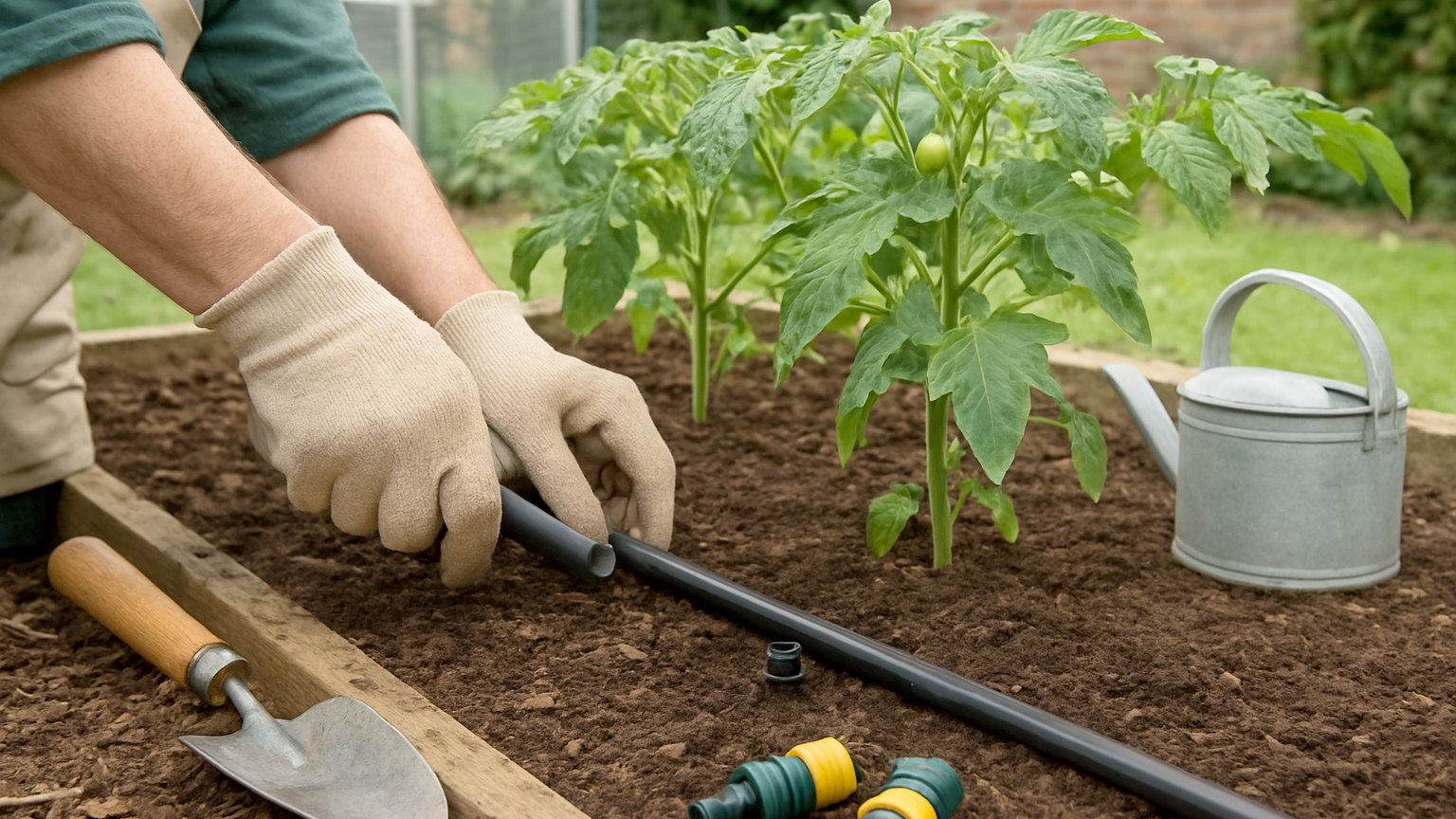
Drip and soaker systems deliver water slowly at soil level, where roots are. Almost nothing is lost to evaporation or run-off, foliage stays dry, and once set up they remove most of the daily work.
Soaker or leaky hose
Porous pipe that seeps water along its whole length. Cheap, simple, and ideal for rows and borders.
Lay it on the soil surface among plants, or bury it just beneath a mulch, and run it from a tap for an hour or so at a time.
It works best on level ground and over runs of up to about thirty metres, beyond which the far end receives noticeably less.
Excellent for vegetable rows, soft fruit, hedges and newly planted borders.
Drip systems
A network of small-bore tubing with individual emitters delivering measured quantities to specific plants.
More precise than soaker hose, more work to set up, and far better for containers, where each pot gets its own dripper.
Kits are widely sold and are assembled by pushing tubing into connectors, requiring no tools beyond a knife and a hole punch.
Planning a layout
Sketch the area first and mark what needs watering. Group plants with similar needs onto the same line.
Run a main supply line from the tap around the area, then take smaller feeder tubes off it to individual plants or pots.
Keep runs as short and level as possible, since pressure drops along the length and uphill.
Peg the tubing down so it does not move, and hide it under mulch, which also protects it from UV degradation and from being cut by a hoe.
What you need at the tap
A pressure reducer, since mains pressure will blow the fittings off a low-pressure system.
A filter, which is essential and often omitted. Emitters block with grit and debris, and a filter prevents most of the problems people have with these systems.
A backflow preventer or double check valve, which stops water from the garden being drawn back into the mains supply. This is a water regulations requirement for any permanent outdoor connection.
A timer if you want it automated.
Running from a water butt
Possible and it needs planning, since a butt provides very little pressure.
Raise the butt as high as practical, since the pressure depends entirely on the height difference. Even half a metre helps.
Use gravity-fed systems specifically designed for low pressure, or fit a small pump.
Filter thoroughly, since rainwater carries debris that blocks emitters quickly.
How long to run it
Longer than you expect. These systems deliver slowly, which is the point.
Run it, then dig down beside a plant and check how far the water has penetrated. Adjust the run time until the soil is moist to ten or fifteen centimetres.
Two or three long soaks a week is far better than a short run daily.
Maintenance
Flush the lines at the start of each season by removing the end caps and running water through.
Clean the filter regularly, which is the single most useful maintenance task.
Check for blocked emitters, visible as dry patches, and replace them.
Drain the system before winter and store timers and any exposed fittings indoors, since frost splits them.
Where it earns its keep
Containers and hanging baskets, which need daily watering and are the first thing to suffer when you are busy or away.
Greenhouse staging and growing bags.
Newly planted trees, shrubs and hedges through their first two seasons.
Vegetable beds, where consistent moisture prevents bolting, splitting and blossom end rot.
Where it does not
Established borders of drought-tolerant planting, which should not need routine watering at all.
Lawns, where the water is better saved and the grass recovers from dormancy on its own once rain returns.
Cost and effort
A basic soaker hose kit costs very little and takes an afternoon to lay. A full drip system for a patio of containers costs more and pays for itself in plants that survive August.
Neither is difficult, and the fittings push together without tools beyond a knife and a hole punch.
Combining with mulch
Run the tubing on the soil surface and mulch over it. The mulch hides the pipe, protects it from sunlight and hoe damage, and reduces evaporation from the wetted area.
Mark where the lines run so you do not spear them with a fork later.


