
How you deliver water matters as much as how much you deliver. The commonest watering mistake is wetting a large area lightly rather than a small area thoroughly, and the equipment encourages it.
Watering cans
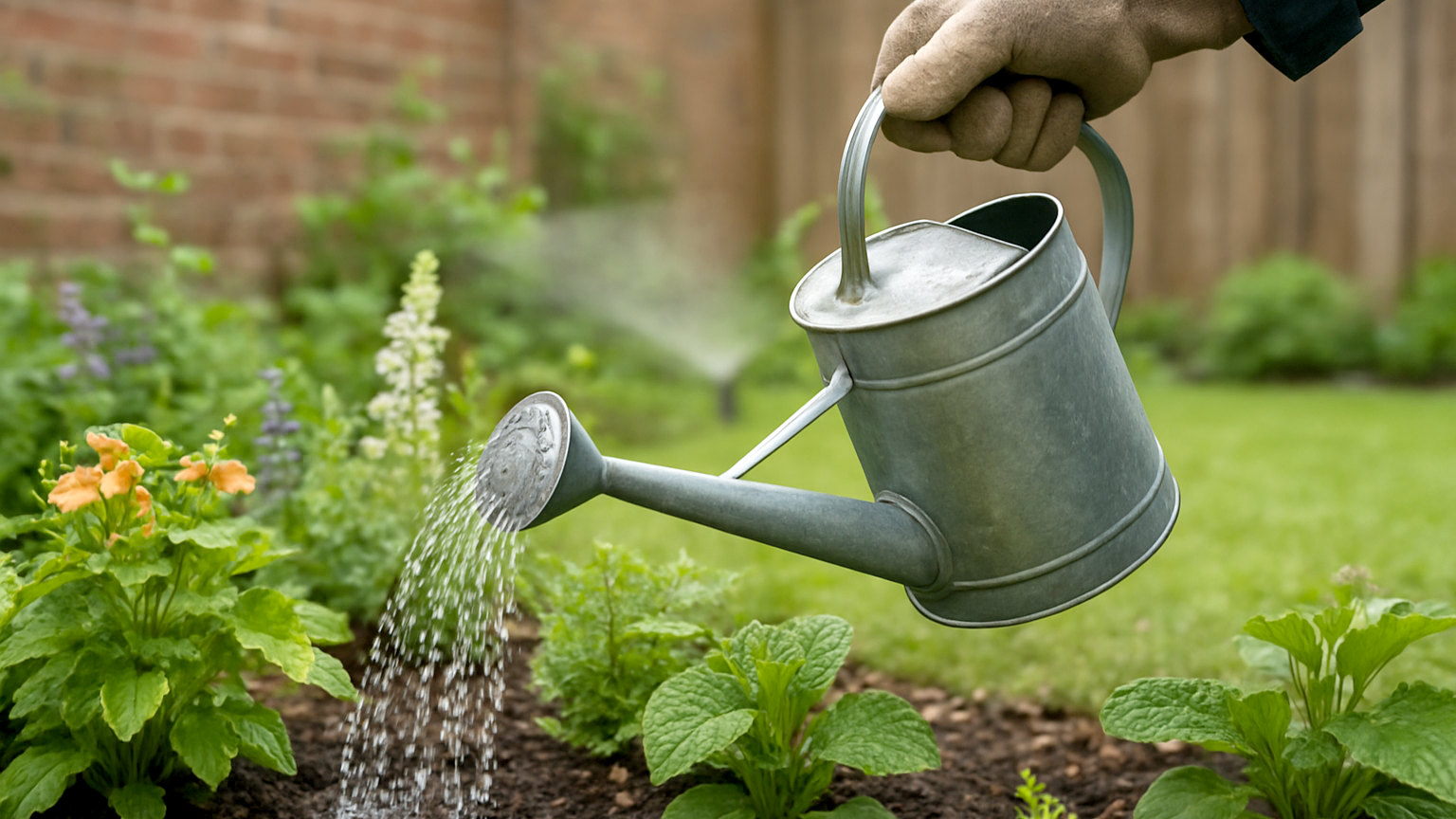
Slow, precise and better than they get credit for. A can delivers water exactly where it is needed, at the base of the plant, with none lost to foliage or paving.
A ten-litre can is about the largest most people can carry comfortably when full, and two smaller cans balance the load better than one large one.
Look for a long spout for reaching into borders and under foliage, a comfortable balanced handle, and a fitting that takes a rose.
Metal cans last decades and cost more; plastic ones are lighter and eventually crack.
Roses and fittings
The perforated head is called a rose, and having the right one changes what a can can do.
A fine rose, held face upwards, produces a gentle spray that will not disturb seeds or damage seedlings. Turning it face up rather than down is the trick most people miss.
A coarse rose delivers more water faster for established plants.
No rose at all, using the bare spout, delivers water straight to the base of a plant, which is what most established plants actually want.
Hoses
Necessary for anything beyond a small garden, and worth spending money on.
Reinforced hose resists kinking and lasts far longer than cheap unreinforced tube, which splits within a season or two.
Measure the distance to the furthest point and add a few metres. A hose that will not reach is worse than useless.
A reel keeps it tidy and stops the kinking that destroys hoses. Wall-mounted reels are the least trouble.
Store it drained and out of sunlight, since UV degrades the material, and drain it before frost.
Hose attachments
A lance or wand extends reach and lets you water at the base of plants and into hanging baskets without stretching.
A trigger gun with adjustable settings is useful, and a shut-off at the nozzle means you are not running water while walking between plants.
Quick-release connectors make changing attachments straightforward. Buy one brand and stay with it, since they are not always compatible.
A pressure-reducing setting or a fine rose matters when watering seedlings and containers, where a jet washes compost out.
Sprinklers
Useful for lawns and large open areas, and poor for borders.
They wet foliage, which encourages fungal disease on roses, phlox and vegetables. They water paths and gaps as well as plants. And a great deal evaporates before reaching the soil in hot weather.
They also encourage light frequent watering, which produces shallow rooting and less drought-tolerant plants.
If you use one, run it long enough to soak the ground properly rather than briefly, and use it early in the morning.
Check the pattern covers what you intend and not the fence or the path.
The principle behind all of it
Water thoroughly and less often rather than lightly and frequently.
A thorough soak reaches the depth where roots are, and encourages them to grow downwards where soil stays moist. Light sprinkling wets the top few centimetres, draws roots upwards into the layer that dries first, and leaves plants less able to cope.
Aim to wet the soil to ten or fifteen centimetres. Check by pushing a trowel in afterwards rather than assuming.
When to water
Early morning is best. Least is lost to evaporation, and foliage dries before nightfall.
Evening is the next best and leaves surfaces damp overnight, which suits slugs and encourages disease.
Avoid the middle of a hot day, when much is lost to evaporation before it soaks in.
Where to aim it
At the soil around the base of the plant, not over the leaves.
Wet foliage spreads blackspot, mildew and blight, and water sitting in the crown of some plants causes rot.
A shallow basin of soil around a new tree or shrub holds water where it is needed rather than letting it run off across the surface.
How much a plant needs
A newly planted shrub wants ten to twenty litres at a time, weekly, through dry spells in its first two seasons. A tree wants twenty to forty.
That is two full watering cans for a shrub, which is considerably more than most people give and explains a good many failures.


