
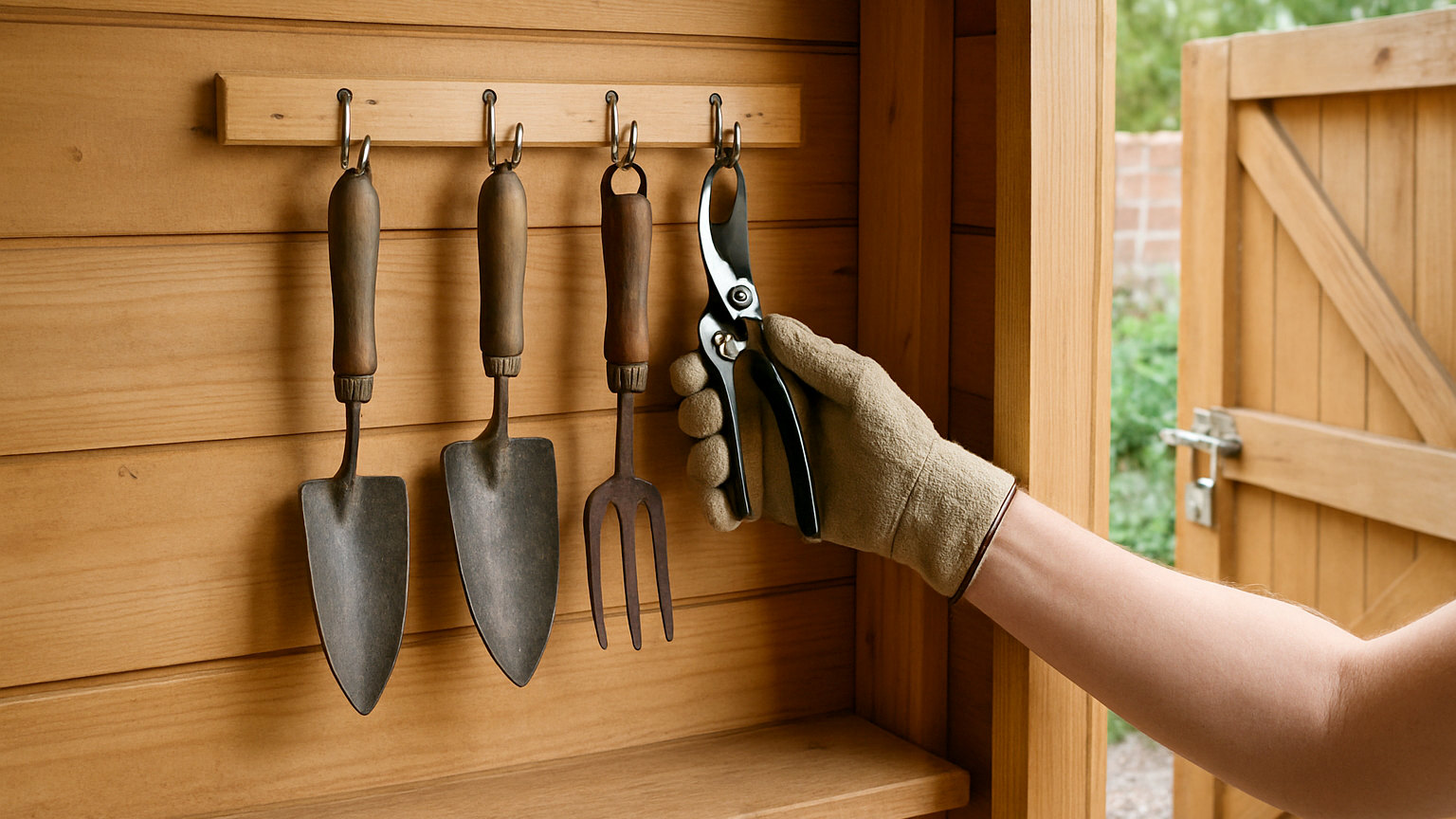
A shed that is organised gets used properly, and tools stored well last decades. A shed that is a heap on a damp floor produces rusted tools, rotted handles and half an hour of searching before every job.
Get things off the floor
The single most useful change. A concrete or timber floor holds moisture, wicks damp up into wooden handles and rusts anything standing on it.
Fit a rack, a length of batten with hooks, or a proprietary tool holder along one wall, and hang every long-handled tool.
Screw the fixings into the frame members rather than the thin cladding, which will not hold weight.
Hang hand tools on hooks or a pegboard, with an outline drawn round each so you can see at a glance what is missing.
Zones
Group things by how they are used rather than by size.
Hand tools and gloves near the door where you reach for them.
Bulky items, barrows and bags of compost at the back or under the bench.
Chemicals, fertilisers and anything hazardous in a locked cupboard, out of reach of children.
Seeds, string, labels and small items in labelled boxes or jars, since these are what disappear.
Keep a clear working space rather than filling every corner.
Damp and ventilation
Sheds get damp through the floor, through leaks and through condensation.
Check the roof covering annually and repair felt before it fails, since a leaking roof ruins everything beneath it.
Make sure the shed sits on a level base clear of the ground, with airflow underneath.
Leave a small vent or gap for air movement. A sealed shed condenses heavily.
Treat timber with preservative every few years on a dry day.
Keep organic material such as sacking and cardboard off the floor, since it holds damp.
Security
Sheds are frequently targeted, and the contents are often worth more than people realise.
The hinges are usually the weak point. Many sheds have hinges screwed on from the outside with short screws that can be removed in seconds. Replace them with coach bolts through the door, or fit hinge bolts.
Fit a closed-shackle padlock on a strong hasp and staple, bolted through rather than screwed.
Consider a bar or a second lock on a large door.
Fit window locks, or cover windows with mesh or a net curtain so the contents are not visible.
Anchor valuable items to the floor or a wall with a ground anchor and chain, particularly mowers and power tools.
Mark tools with your postcode using an ultraviolet pen or a proprietary marking kit, and photograph anything valuable.
Gravel around the shed makes an audible approach, and a security light is a deterrent.
Insurance
Check whether your home insurance covers outbuildings and what limit applies, since many policies cap shed contents at a modest figure.
Some policies require a specific standard of lock to pay out, so read the terms rather than assuming.
Keep a list of what is in there with serial numbers and photographs, stored somewhere other than the shed.
Safety in a shed
Store petrol in an approved container, in a cool ventilated place, away from the house and any ignition source.
Never run a petrol engine inside a shed or garage, because of carbon monoxide, which is odourless and can be fatal.
Store chemicals in original containers with labels intact, sealed, frost free and locked away. Never decant into unlabelled bottles.
Keep sharp tools with blades covered or catches closed.
Charge lithium batteries on a non-flammable surface away from combustible material, and not unattended overnight.
A yearly clear-out
In winter, empty it, sweep it, and put back only what you use.
Dispose of old chemicals through a household hazardous waste facility rather than the bin or the drain, and check what the council accepts.
Lighting and power
A shed with no light is a shed used only in summer. A battery lantern or a solar light costs very little and extends its usefulness considerably.
Any mains supply to an outbuilding must be installed by a qualified electrician and protected by an RCD, since it is notifiable work under the building regulations.
Never run an extension lead permanently from the house to a shed, which is neither safe nor weatherproof.


