
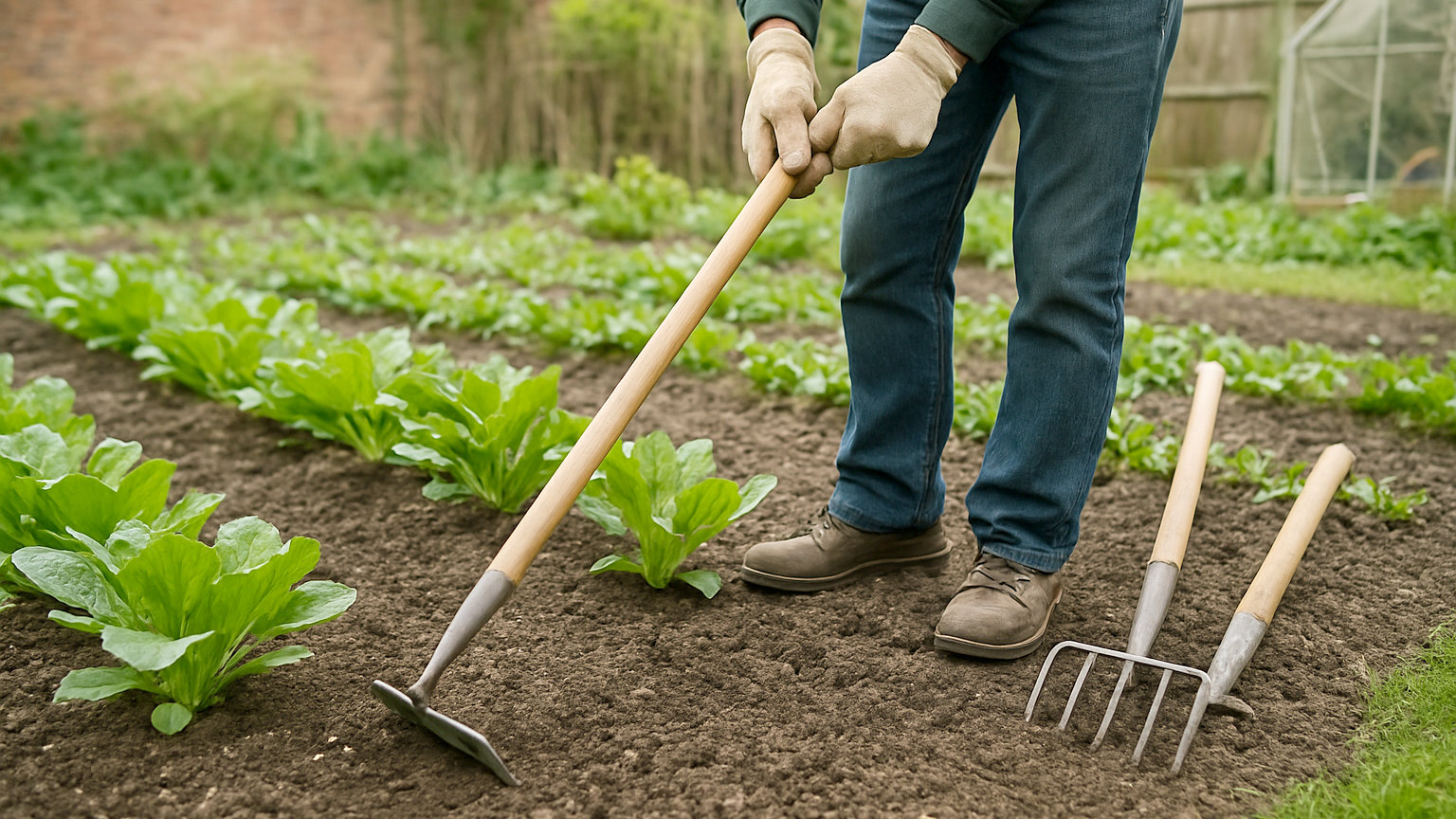
Long-handled tools let you work standing up, which is faster and considerably kinder to the back than kneeling. Several of them do jobs that have no comfortable alternative.
Soil rake
A rigid head with short metal teeth, for levelling soil, breaking clods into a fine tilth, clearing stones, and firming a seedbed with the back of the head.
Essential for preparing ground before sowing or turfing, since grass seed and small seeds cannot push through clods.
Use it in short strokes, working backwards so you do not tread on what you have levelled.
Lawn or springbok rake
A fan of long springy tines, for raking leaves off grass, pulling out moss and thatch, and gathering debris.
Quite different from a soil rake and not interchangeable with it.
Scarifying a lawn by hand with one of these is hard work and effective on a small area.
Plastic and rubber-tined versions are lighter and gentler, and suit clearing leaves from gravel and borders.
Hoes
The most efficient weeding tool there is, and the one most often missing from a shed.
Dutch or push hoe: used with a pushing and pulling action, sliding the blade just below the surface. The general-purpose choice and the fastest on open ground.
Draw hoe: used with a chopping and pulling action towards you, for heavier work, drawing seed drills and earthing up potatoes.
Oscillating or stirrup hoe: a hinged blade cutting on both push and pull, very efficient on loose soil.
Onion or short-handled hoe: for working between closely spaced plants.
Hoeing properly
Keep the blade shallow, one to two centimetres below the surface. You are severing stems from roots, not cultivating.
Deep hoeing damages the roots of plants you are keeping and brings buried weed seed to the surface, where it germinates.
Hoe on a dry sunny day, so severed seedlings shrivel and can be left where they fall.
Hoe before you can properly see the weeds. Seedlings at the two-leaf stage die immediately; the same plants a fortnight later regrow.
Keep the blade sharp with a file. A few strokes before starting transforms the tool, and most people have never sharpened a hoe.
Walk backwards so you are not treading on hoed ground.
Half-moon edging iron
A crescent blade on a long handle, for cutting a clean vertical edge to a lawn.
Far better than a spade, which leaves a scalloped line. Cut to a taut string line or a laid plank.
Keep it sharp with a file, since a blunt one tears rather than cuts.
Long-handled shears and edging shears
Edging shears trim the overhanging grass along a lawn edge after mowing, which takes two minutes a week and makes the whole lawn look properly maintained.
Long-handled versions let you do it standing up, which is far easier than working bent over.
Long-reach pruners
A pole pruner or long-reach lopper handles branches above head height from the ground, which is far safer than a ladder.
Wear eye protection, since everything falls towards you.
Border fork and rake
Smaller versions of the standard tools, for working among established plants without damaging them or the soil around their roots.
Many gardeners find they use border tools for most jobs and reach for the full-size ones only when preparing new ground.
Care
Clean soil off after use and wipe metal with an oily rag.
Sharpen hoes, edging irons and spades with a flat file, following the existing angle.
Check wooden handles for splits and rough patches, and rub them down with sandpaper and linseed oil once a year.
Hang tools up rather than standing them on a damp floor, which rots handles and rusts heads.
Handle length
Long-handled tools should let you work upright without stooping. Check the length against your height before buying, since a tool that is too short causes back pain over a season.
Where a handle can be replaced, fitting a longer one is a straightforward correction.
Working comfortably
Alternate tasks rather than doing one repetitive job for hours, and stop before you are tired, since most strains happen at the end of a session.
Long-handled tools exist precisely so that weeding, edging and raking need not be done kneeling, and using them saves a great deal of wear on knees and back over the years.


