
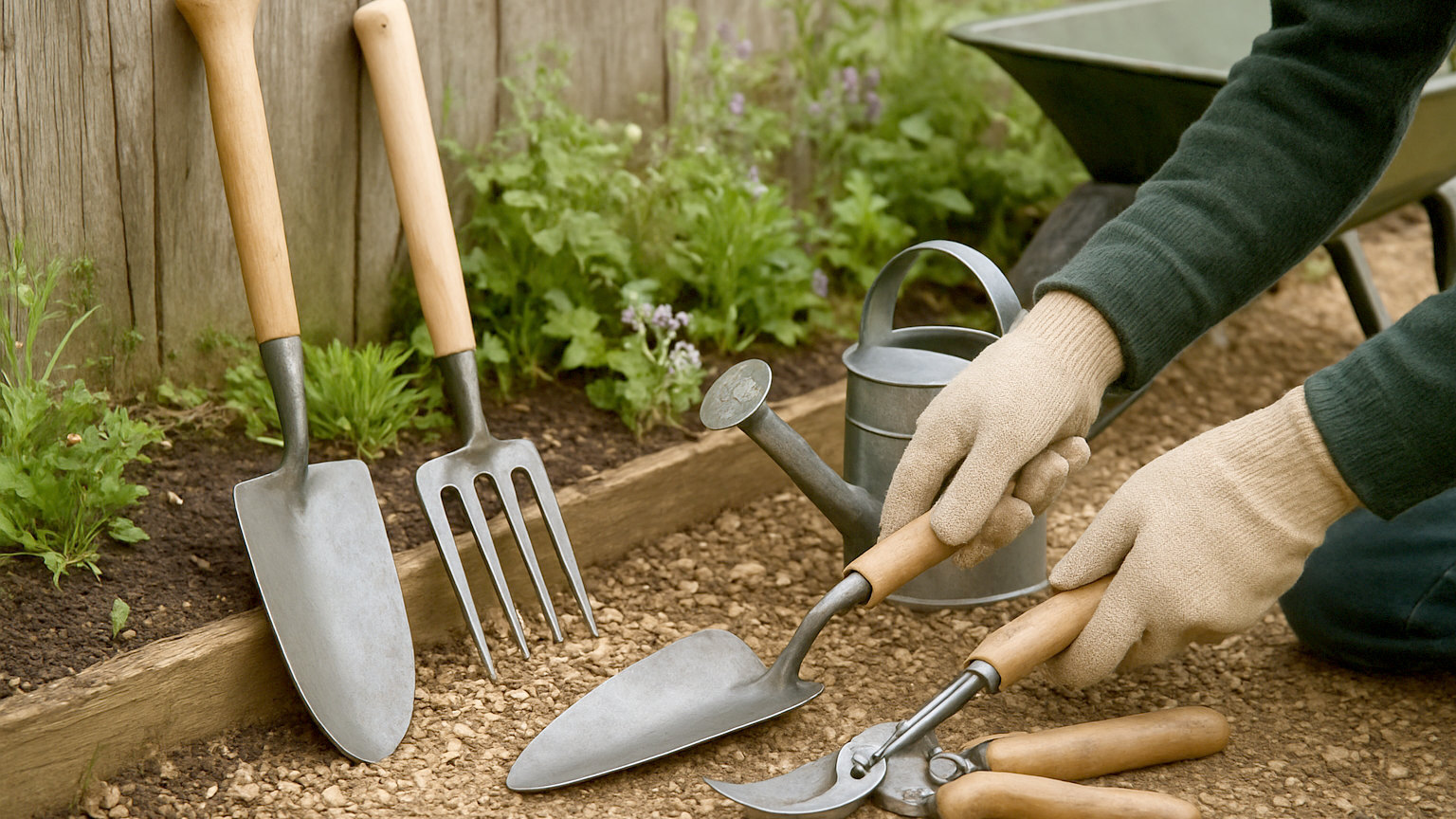
Garden centres sell an enormous range of tools and a new gardener needs very few of them. Around nine cover almost everything, and buying those properly is better than buying twenty cheaply.
The core kit
Spade. For digging, edging, planting and moving soil. The tool you will use most in the first year of any garden.
Garden fork. For breaking up soil, lifting plants, turning compost and working among roots where a spade would cut them.
Hand trowel. For planting anything small, from bulbs to bedding.
Hand fork. For weeding among plants and loosening soil in tight spaces.
Bypass secateurs. For all pruning up to about a centimetre and a half. Buy good ones; this is the tool you pick up hundreds of times a year.
Rake. A soil rake for levelling seedbeds and clearing debris. A springbok or lawn rake as well if you have grass.
Hoe. A Dutch hoe for weeding. The most efficient weeding tool there is, and the one most people are missing.
Watering can. With a rose that can be removed, and a long spout.
Wheelbarrow. Or at least a strong garden bag for anything beyond a small plot.
Add these fairly soon
Loppers for wood too thick for secateurs, up to about four centimetres.
Folding pruning saw for anything larger. Inexpensive and it handles surprisingly big branches.
Shears if you have a hedge or plants to clip.
Half-moon edging iron if you have a lawn, for cutting a crisp edge each spring.
Kneeler or knee pads, which you will appreciate more than any tool on the list.
Hose and reel for anything beyond a small garden.
Choosing a spade and fork
Handle them before buying. Weight, balance and handle height vary considerably, and a tool that suits one person is awkward for another.
Check the length suits your height. A tool that makes you stoop causes back pain over a season.
Handle shape matters: D, T and Y grips suit different hands, and it is worth trying each.
A border spade and fork are smaller and lighter than digging versions, and suit working among plants and anyone who finds full-size tools heavy.
Stainless steel cuts through soil more easily and does not rust, at a higher price. Carbon steel is cheaper, stronger and needs cleaning and oiling.
What to skip at first
Specialist gadgets sold for single jobs, most of which a trowel or a hand fork does adequately.
Bulb planters, which work poorly in most soils. A trowel or a spade is quicker.
Elaborate multi-tool systems with interchangeable heads, which are rarely as good as individual tools.
Anything powered, until you have established that the job comes up often enough to justify it. Hiring is usually better for occasional heavy work.
Where to spend
On the tools you use most: secateurs, spade and fork.
A well-made spade lasts thirty years. A cheap one bends at the neck the first time it meets a root, and the joint between blade and shaft is where failure happens.
Look for a solid socket or strapped connection rather than a thin welded joint.
Second hand
Old tools are frequently better than new budget ones. Car boot sales, auctions and house clearances produce forged spades and forks from a time when they were made to last.
Check the joint between head and handle, look for cracks in the wood, and be prepared to clean off rust and fit a new handle.
Looking after them
Clean soil off after every use, dry them, and wipe metal with an oily rag.
Keep cutting edges sharp, including the spade, which cuts through soil and roots far more easily with an edge on it.
Store dry and hang them up rather than standing them on a damp floor, which rots handles and rusts heads.
Safety basics
Never leave a rake or a fork lying tines upwards, which is how people are injured in gardens every year.
Keep your tetanus vaccination current, since garden wounds contaminated with soil are the classic route.
Wear stout footwear when digging, and eye protection whenever anything might spring back or fly up at you.
Store sharp tools with the blades covered or the catches closed, and out of reach of children.


