
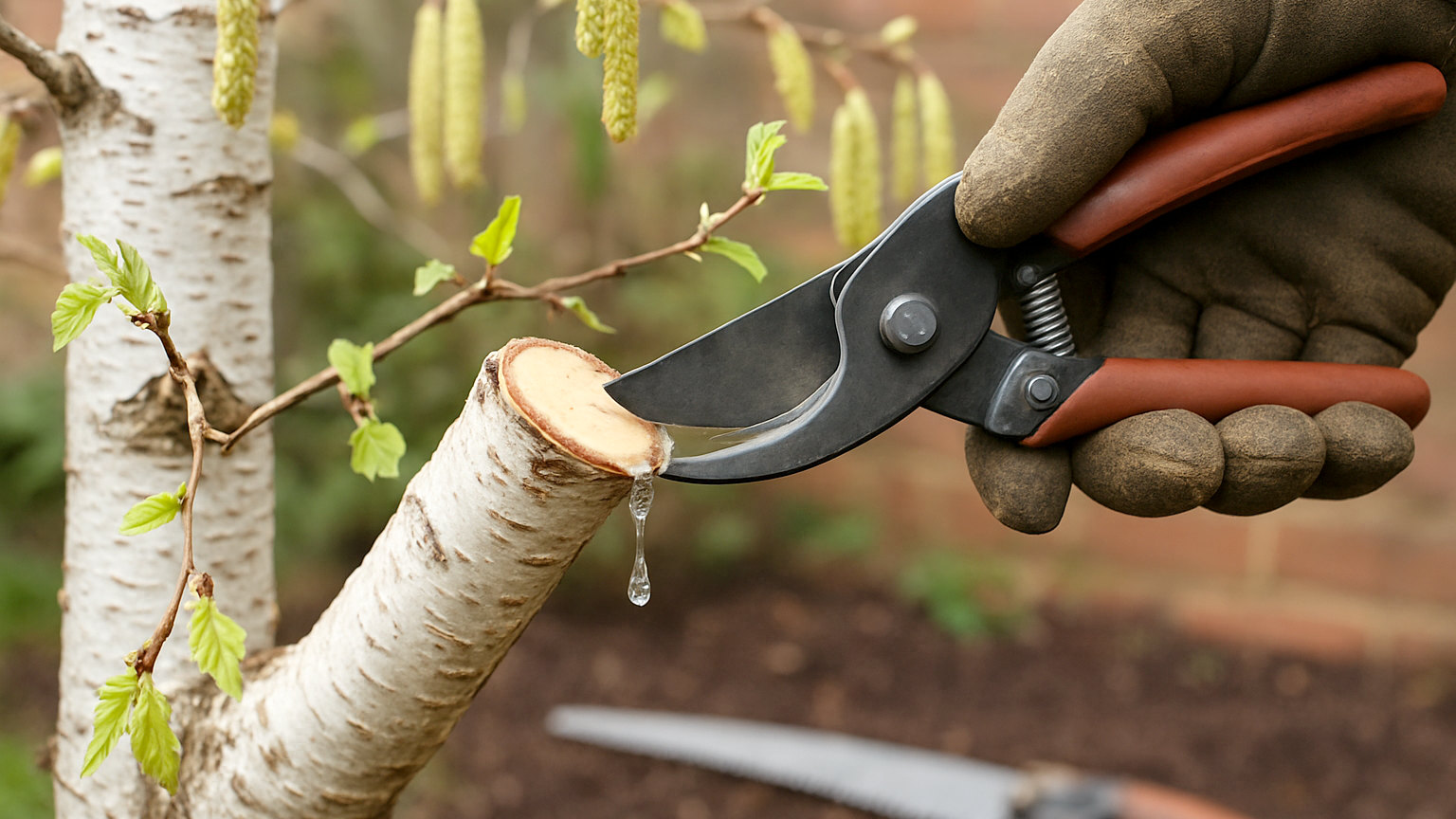
A small group of trees and shrubs lose sap heavily if pruned at the wrong time of year. The flow can be dramatic, running for days, and it is avoided entirely by cutting in the right months.
Which are affected
Birch, all species, which bleed copiously in late winter and spring.
Maples, including Japanese maples, Norway maple, field maple and sycamore.
Walnut, which bleeds heavily and is slow to compartmentalise wounds.
Grape vines, which are notorious for it and must be pruned in midwinter.
Hornbeam to a lesser extent, and laburnum and mulberry.
Why it happens
These species generate strong root pressure in late winter as the sap begins to move upwards, before the leaves open and start drawing water through the tree.
A wound made at that point releases the pressure and sap runs out, sometimes for several days, until the leaves emerge and the flow reverses.
Does it actually harm the tree
Opinions differ and the honest answer is that moderate bleeding on an established healthy tree is unlikely to kill it.
It does waste stored reserves, it can be very heavy from large cuts, and the wet surface encourages fungal growth and looks alarming.
On a young or already stressed plant it is more of a concern.
Since avoiding it costs nothing beyond timing, there is no reason to risk it.
The safe windows
Birch, maple, walnut and hornbeam: prune in late summer or early autumn, from July to September, once growth has slowed. Midsummer is generally safest.
Japanese maples: late summer, from July to early September, or midwinter in December and January while fully dormant. Avoid February to June.
Grape vines: midwinter only, in December or January, while completely dormant. A vine pruned in February or March bleeds badly.
The general principle is to avoid the period from about February to early June, when sap pressure is highest.
If a tree does start bleeding
Leave it alone. Do not attempt to seal the wound, bandage it or apply anything.
Wound paints and sealants trap moisture and spores against the cut and interfere with the tree's own response, and they do not stop the flow in any case.
The bleeding stops of its own accord once the leaves open and the tree begins drawing water upwards.
Do not make any further cuts on the same tree that season, and wait until the correct window before doing more.
Prune these species lightly
All of them are better with minimal pruning in any case.
Birch develops a natural form that is the reason for growing it, and it heals wounds poorly. Restrict pruning to dead wood and crown lifting while the tree is young.
Walnut compartmentalises slowly and large wounds may never close.
Japanese maples are spoiled by cutting and need almost nothing.
Where a large cut is genuinely needed on any of these, it is worth taking professional advice.
Formative pruning
The most valuable work on all these species is done in the first few years, establishing a single leader and well-spaced branches while the cuts are small enough to close within a season.
Do it in late summer rather than winter, and a birch or maple should need almost nothing for the rest of its life.
Other timing exceptions
It is worth remembering the two other groups that break the general winter-pruning rule.
Prunus, meaning cherries, plums, almonds and laurels, must be pruned in late spring or summer because of silver leaf disease.
Evergreens are best pruned in mid to late spring, since autumn cuts prompt growth that frost damages.
Between bleeders, Prunus and evergreens, a good deal of what gets pruned in a British garden should not be cut in winter at all.
Tapping birch sap
The same root pressure that causes bleeding is what allows birch sap to be tapped in early spring for drinking, which some people do deliberately.
If you try it, tap only a large established tree, take a modest quantity from a single small hole, and plug the hole properly afterwards. Repeatedly tapping the same tree, or drilling several holes, weakens it considerably.
Do not tap a tree you do not own, and be entirely certain of the identification before consuming anything gathered from a garden or hedgerow.


