
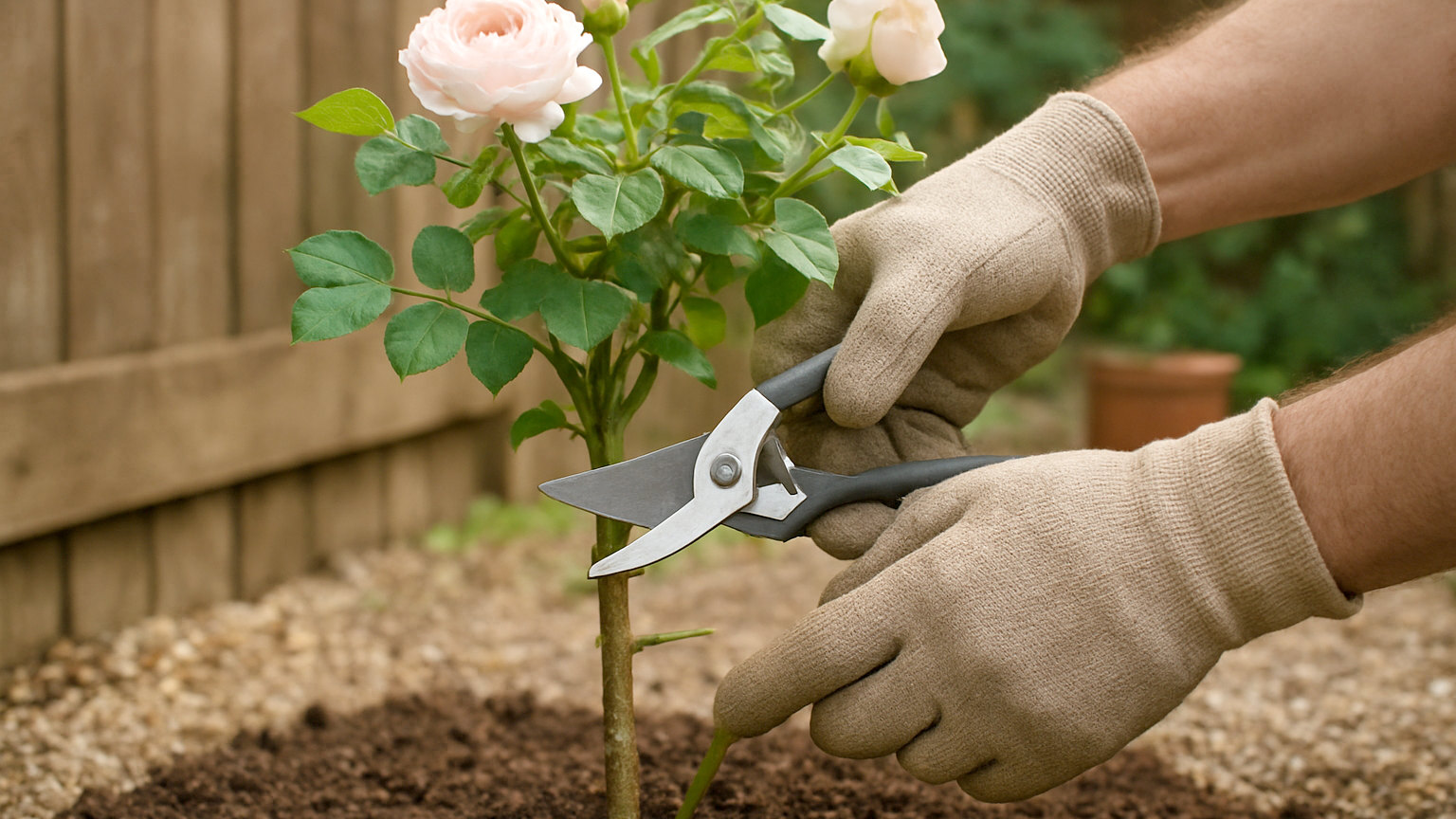
A standard is a plant with a clear stem and a head of growth on top. Some are grafted at the top of a tall rootstock, others are trained from a single stem. Either way, maintaining one is mostly about removing growth from where it should not be.
Types
Full standard: a clear stem of about a metre and a half or more.
Half standard: around eighty centimetres to a metre.
Quarter standard or patio standard: shorter still, suiting containers.
Common examples include standard roses, bay, wisteria, holly, photinia, hydrangea paniculata and many fruit trees.
Keeping the stem clear
The single ongoing job.
Rub off any shoots appearing along the trunk with a thumb while they are soft. This is far easier than cutting them once woody, and it removes the buds rather than leaving them to reshoot.
Check every few weeks through the growing season.
Growth from below the graft union, or from the ground, is a sucker from the rootstock and must be removed at its point of origin.
Pull suckers off with a downward tug rather than cutting, which leaves dormant buds behind and produces several shoots where there was one.
On a standard rose, sucker growth often has seven leaflets rather than five, and different-coloured stems.
Shaping the head
Prune the head as you would the equivalent shrub in the ground, following the timing for the species.
Standard roses are pruned in late winter, reducing the head by about a third and cutting to outward-facing buds so it opens outwards rather than inwards.
Bay and evergreen standards are clipped in late spring and again in late summer, using secateurs rather than shears on large-leaved types.
Hydrangea paniculata standards are cut back hard in early spring, since they flower on new wood.
Wisteria standards follow the usual wisteria regime: shorten side shoots in summer, then again in winter.
Keeping it balanced
Aim for a symmetrical head, cutting back stronger sides slightly harder than weaker ones, which evens the vigour out.
Turn a container-grown standard regularly so it does not lean towards the light.
Step back frequently while cutting and look from several angles.
Staking
Most standards need permanent staking, since the head is heavy and the stem is not thick enough to support it in wind.
Use a stout stake reaching to just below the head, with adjustable ties in a figure of eight and a spacer so the stem cannot rub.
Check ties every six months and loosen them as the stem thickens. A forgotten tie will girdle the trunk and kill everything above it.
Replace the stake when it rots rather than removing it.
Containers
Standards are frequently grown in pots, which suits bay, olive and photinia in particular.
Use a large soil-based container, water consistently, feed through the growing season, top dress each spring and repot every three or four years.
Wind is the main risk. Move pots to shelter over winter, and use a heavy container rather than a light one.
Other trained shapes
Espalier and fan shapes are trained flat against a wall or wires, with horizontal or radiating arms. Shorten side shoots in summer to keep the framework tidy and encourage flowering or fruiting spurs.
Pleached trees form a raised hedge on clear stems, clipped once or twice a year in late summer.
Cordons are single stems trained at an angle, used for apples and pears, and summer pruned.
All of them depend on regular light attention rather than occasional heavy cutting.
Where standards suit
Formal settings, small gardens where ground space is limited but height is wanted, and either side of a door or a path.
They are more work than the same plant grown naturally, and the effect is worth it where formality is the aim.
Making your own
A standard can be trained from a young plant rather than bought, which costs a fraction and takes two or three years.
Select a strong straight leading shoot, tie it to a cane, and remove all side shoots as they appear along the stem while leaving the leaves on for the first season, since they feed the plant.
Once the stem reaches the height you want, pinch out the tip to force branching and build the head.


