
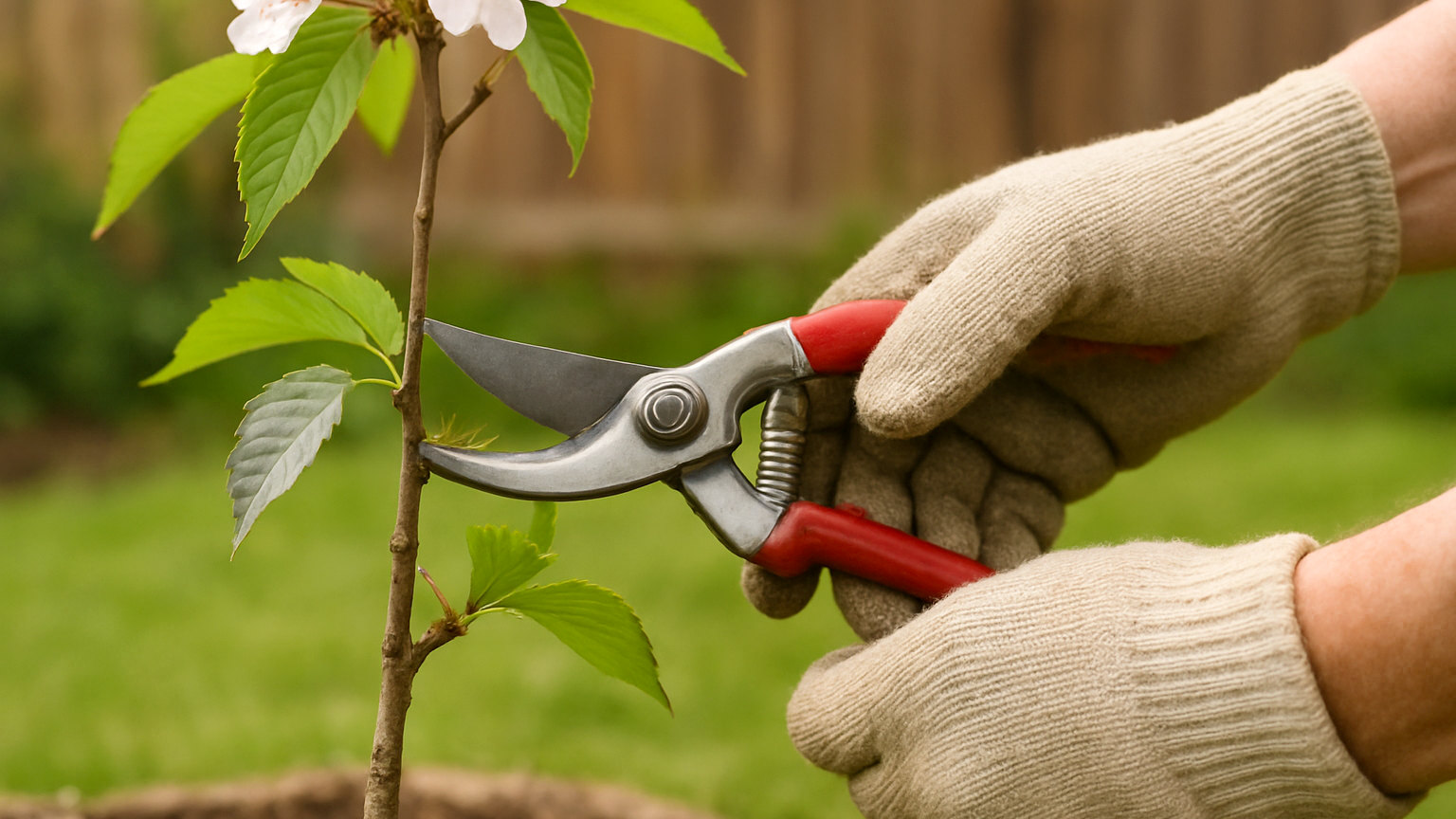
Everything in the genus Prunus follows one rule that overrides the usual pruning calendar, and ignoring it risks a disease that kills established trees.
Never prune in winter
Silver leaf disease infects Prunus through fresh wounds, and its spores are released mainly in autumn and winter.
Pruning a cherry, plum, almond, apricot or ornamental Prunus during the dormant season opens wounds at exactly the point when infection is most likely.
This covers ornamental flowering cherries, cherry laurel, blackthorn, Prunus lusitanica, purple-leaved plums and all fruiting stone fruit.
It is the clearest exception to the usual advice about winter pruning while the structure is visible.
The right window
Prune between late spring and midsummer, generally from May to July, when the tree is growing actively.
Spore levels are lowest, the tree is producing sap that helps seal the wound, and the cut compartmentalises quickly.
For flowering cherries, prune immediately after flowering if pruning is needed at all.
Prune as little as possible
Ornamental cherries need very little and are frequently spoiled by cutting.
Their value is the natural form and the flowering display, and heavy pruning produces vigorous vertical water shoots and an unbalanced shape.
Restrict yourself to removing dead, damaged and diseased wood, crossing branches, and anything obstructing a path or a window.
Formative pruning on a young tree, establishing a single leader and well-spaced branches, is worth doing and takes minutes.
Recognising silver leaf
A silvery sheen on the leaves of one branch or one side of the tree, caused by the fungus separating the leaf layers.
The affected branch dies back, and the disease progresses through the tree over several years.
The definitive test is to cut through an affected branch: a brown or purplish stain in the wood confirms it. Silvering alone can also be caused by drought or other stress, so the stain matters.
Purple bracket fungi on dead wood are the fruiting bodies.
What to do about it
Cut affected branches back to at least fifteen centimetres beyond where the staining stops, into clean wood, and remove and burn or bin the material.
Disinfect tools between every cut.
Do this in summer, not winter.
There is no chemical treatment. A vigorous well-fed tree may compartmentalise the infection and recover; a stressed one usually does not.
Remove and destroy dead wood from the garden, since it is where the fungus fruits.
Bacterial canker
The other major Prunus problem, showing as sunken patches on the bark, often with amber gum oozing from them, and small round holes in the leaves known as shothole.
Branches above the canker die back.
Prune out affected wood in summer, cutting well into healthy tissue and disinfecting between cuts.
The same timing rule applies, since the bacteria are most active in autumn and winter.
Gumming
Amber resin oozing from the bark is a general stress response rather than a disease in itself.
It follows wounds, pruning cuts, drought, waterlogging or infection. Investigate the cause rather than treating the gum.
Suckers
Most ornamental cherries are grafted, and growth from below the union belongs to the rootstock.
Pull suckers off with a downward tug rather than cutting, which removes the dormant buds at the base.
Wound paint
Not generally recommended, though some gardeners still paint Prunus cuts against silver leaf.
Pruning at the right time of year is far more effective than any sealant, and a clean summer cut on a healthy tree is the real protection.
Cherry laurel and Portuguese laurel
Both are Prunus and both are subject to the same rule, which is worth remembering when trimming a laurel hedge.
Cut them in late spring or summer rather than winter, and use secateurs rather than shears on cherry laurel, since sliced leaves turn brown.
Never transport or store laurel clippings in an enclosed space such as a car boot or a sealed sack, since they release cyanide compounds as they break down.
Formative pruning while young
The most useful pruning a Prunus receives is in its first few years, establishing one clear leader and well-spaced branches while the cuts are small.
Do it in early summer, remove competing leaders, and the tree should need almost nothing for the rest of its life.


