
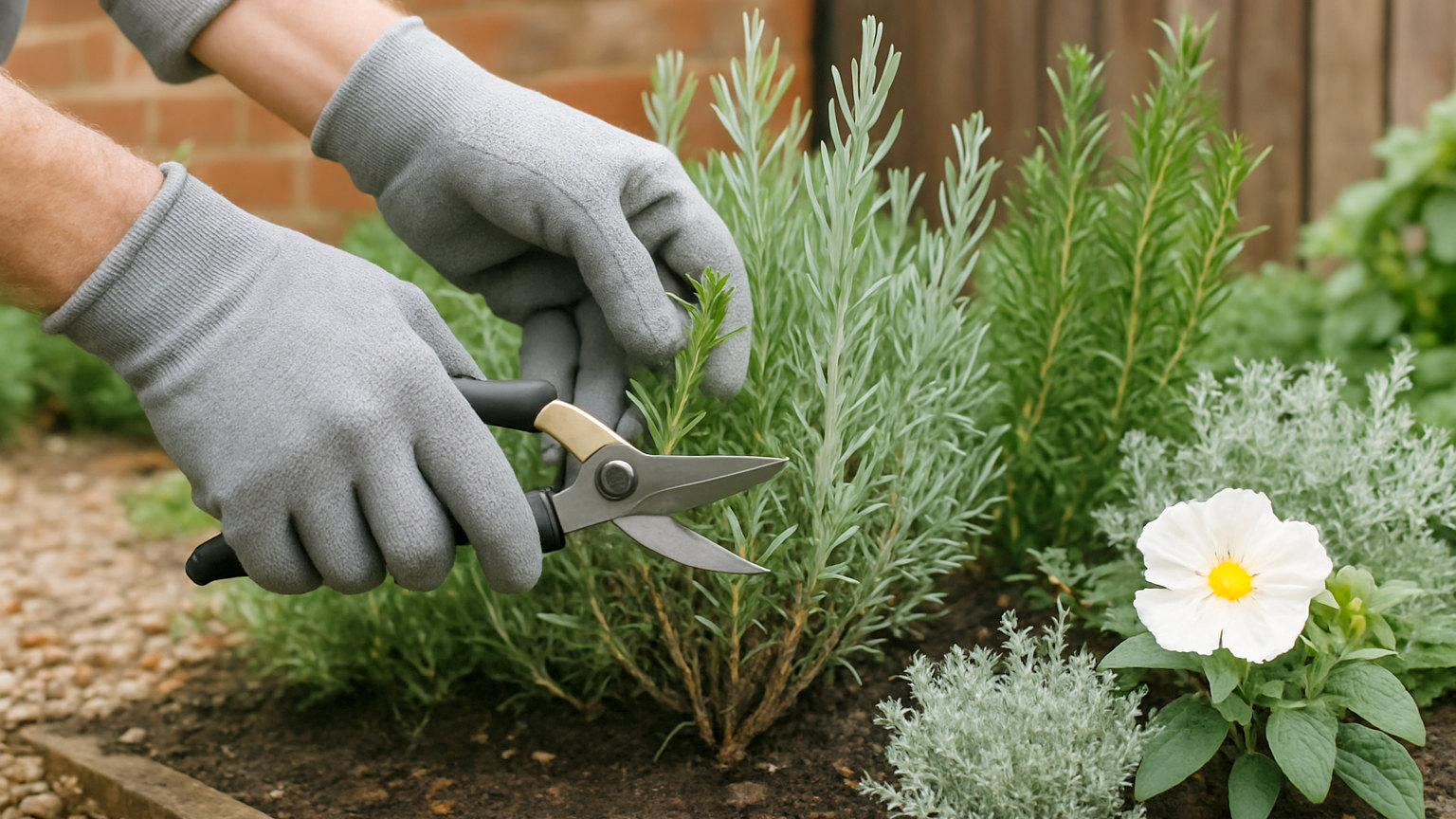
Lavender, rosemary, cistus, santolina, helianthemum and their relatives share a habit that governs how they are pruned, and getting it wrong kills them outright.
They will not reshoot from bare wood
Every cut must leave green growth below it. If you can see only brown woody stem where you intend to cut, move higher up.
These plants have no dormant buds in old wood. Cut into it and nothing regrows, leaving a permanent dead patch or a dead plant.
This is the single most common way Mediterranean shrubs are lost, usually when someone tries to rejuvenate a leggy specimen by cutting it back hard.
Trim little and often, from the start
The way to keep these plants compact is to trim them lightly every year from the moment they are planted, never letting them go woody in the first place.
A lavender trimmed annually from year one stays neat for a decade. One left for three seasons goes open and woody and cannot be brought back.
Trim after flowering, in late summer, cutting back the spent flower stems and two or three centimetres of the current season's leafy growth, shaping the plant into a neat mound.
A light tidy in spring, around April, removes winter damage and reshapes.
The individual plants
Lavender: trim after flowering in August and lightly again in April. Expect five to ten years before replacement.
Rosemary: trim lightly after flowering in spring, staying in green growth. It resents hard cutting and is best kept compact from the outset. Prostrate forms are more tender.
Cistus: trim only the soft current growth after flowering. It is short-lived, typically five to eight years, and replacement is the answer rather than renovation.
Santolina: trim after flowering, and it can be cut back slightly harder than lavender provided green growth remains. Some gardeners remove the flowers entirely to keep a tight silver mound.
Sage: trim lightly after flowering. Renew from cuttings every four or five years.
Helianthemum: shear over after the main flush in midsummer, which produces a second flowering.
Phlomis and perovskia: both tolerate harder spring pruning than the others, since they shoot from lower down.
Accept that they are short-lived
None of these is a long-term shrub. Five to ten years is a normal lifespan, after which the plant becomes open, woody and sparse.
This is not a failure of cultivation. Take cuttings every few years so replacements are ready, and remove old plants rather than attempting renovation.
Semi-ripe cuttings taken in late summer root very easily for all of them, and cost nothing.
Conditions matter as much as pruning
All of these want full sun and sharp drainage, and they die of winter wet rather than cold.
Add grit generously at planting, plant slightly proud of the surrounding soil, and mulch with gravel rather than bark so the crown stays dry.
Do not feed them. Rich soil produces soft sappy growth with less scent, fewer flowers and much reduced hardiness, and it shortens their life further.
On heavy clay, grow them in raised beds or containers rather than fighting the soil, since drainage is what determines whether they survive a winter.
If a plant has already gone woody
There is no reliable way back.
You can try cutting one or two stems back to just above the lowest green growth and seeing whether they respond, but the odds are poor and the plant will look worse meanwhile.
The realistic options are to accept the shape, or to take cuttings and replace it.
Layering sometimes works: pin a low flexible stem down into gritty compost and it may root within a season, giving a replacement plant at no cost.
Taking cuttings
Semi-ripe cuttings in late summer are the reliable method for all of these.
Take non-flowering shoots about eight to ten centimetres long, strip the lower leaves, insert several around the edge of a pot of gritty compost, and keep them somewhere sheltered and bright but out of direct sun.
Most root within six to eight weeks. Pot them on and plant out the following spring.
Taking a few cuttings every two or three years means you always have replacements coming, which is the practical way to manage a group of plants that will not last.


