
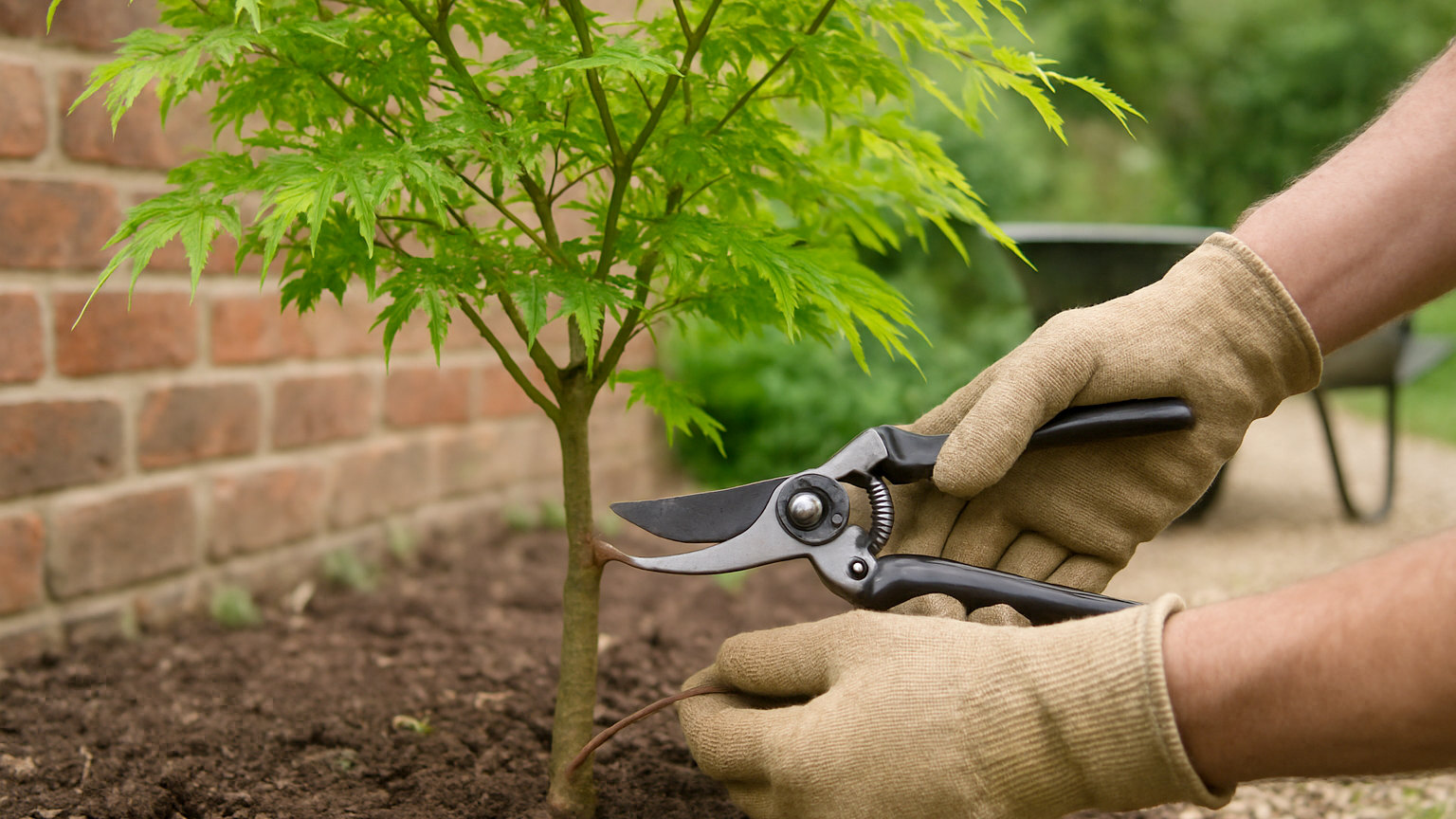
Japanese maples are among the plants most often spoiled by pruning. Their value is the elegant layered structure they develop naturally, and heavy-handed cutting destroys it permanently.
Prune as little as possible
A well-placed acer needs almost nothing. Removing dead wood and the occasional crossing branch is usually the whole job for the life of the plant.
Resist any temptation to reduce size by cutting back. Acers respond poorly, the natural form is lost, and the growth that follows is coarse and out of character.
If an acer is too large for its position, the plant is in the wrong place. Moving it while young is a better answer than annual cutting.
Timing matters, because they bleed
Acers bleed sap heavily if cut in late winter or spring, when the sap is rising. The flow can be substantial and weakens the plant.
There are two safe windows.
Late summer, from July to early September, once growth has slowed and before autumn. This is generally the best time.
Midwinter, in December and January, while fully dormant and before the sap starts moving.
Avoid February through to June entirely.
What to remove
Dead, damaged and diseased wood, at any time you notice it.
Branches crossing or rubbing against others.
Growth heading into the centre of the plant, which congests it.
Any shoot spoiling the layered structure by growing straight up through the canopy.
Reverted growth on a variegated form, which is more vigorous and will dominate.
How to thin one properly
The aim is to reveal the structure rather than to reduce the size.
Stand back and look at the plant from several angles first, and identify what is obscuring the layered form.
Remove whole small branches at their point of origin rather than shortening them. Shortening produces a cluster of new shoots at the cut and destroys the fine tracery.
Work from the inside outwards, opening up the spaces between the layers so light passes through and the shape is visible.
Take very little at a time and step back after every cut. Removing more than about a tenth of the growth in a year is too much.
Use sharp clean tools
The wood is thin and the cuts should be small. Sharp bypass secateurs for most work, and a fine pruning saw for anything larger.
Disinfect blades between plants, since acers are susceptible to verticillium wilt and other diseases that spread on tools.
Cut where the wound will not show
Cut back to a junction with another branch, so the removal is invisible.
Never leave stubs, which die back and spoil the appearance of a plant grown for its fine structure.
Growing conditions matter more than pruning
Most acer problems are positional rather than pruning-related.
They want dappled shade, shelter from cold drying winds and from early morning sun, moisture-retentive but well-drained soil, and neutral to slightly acid conditions.
Scorched brown leaf margins in summer indicate wind exposure or drought rather than anything requiring the secateurs.
Mulch generously each spring with leaf mould or composted bark, keeping it clear of the stem, and water in dry spells.
Container-grown acers
They grow well in pots and this is a good way to manage them in an exposed or alkaline garden.
Use a soil-based compost with added grit, water consistently with rainwater where possible, and top dress each spring.
Pruning is still minimal. Root pruning every three or four years when repotting controls size more sympathetically than cutting the top.
Dieback
Branches dying back progressively usually indicate verticillium wilt, drought stress or waterlogging rather than a pruning problem.
Cut back to clean healthy wood, disinfecting between cuts, and address the growing conditions rather than continuing to prune.
Coral spot
Pink-orange pustules on dead twigs are coral spot, a common fungus that enters through wounds and dead stubs.
It is a further reason to make clean cuts at a junction rather than leaving stubs, and to remove dead wood promptly rather than leaving it in the plant to fruit.
Autumn colour
The autumn display depends on the growing conditions rather than on pruning. Consistent moisture through summer, shelter from wind and a position with some sun produce the best colour.
A drought-stressed acer browns and drops its leaves early rather than colouring.


