
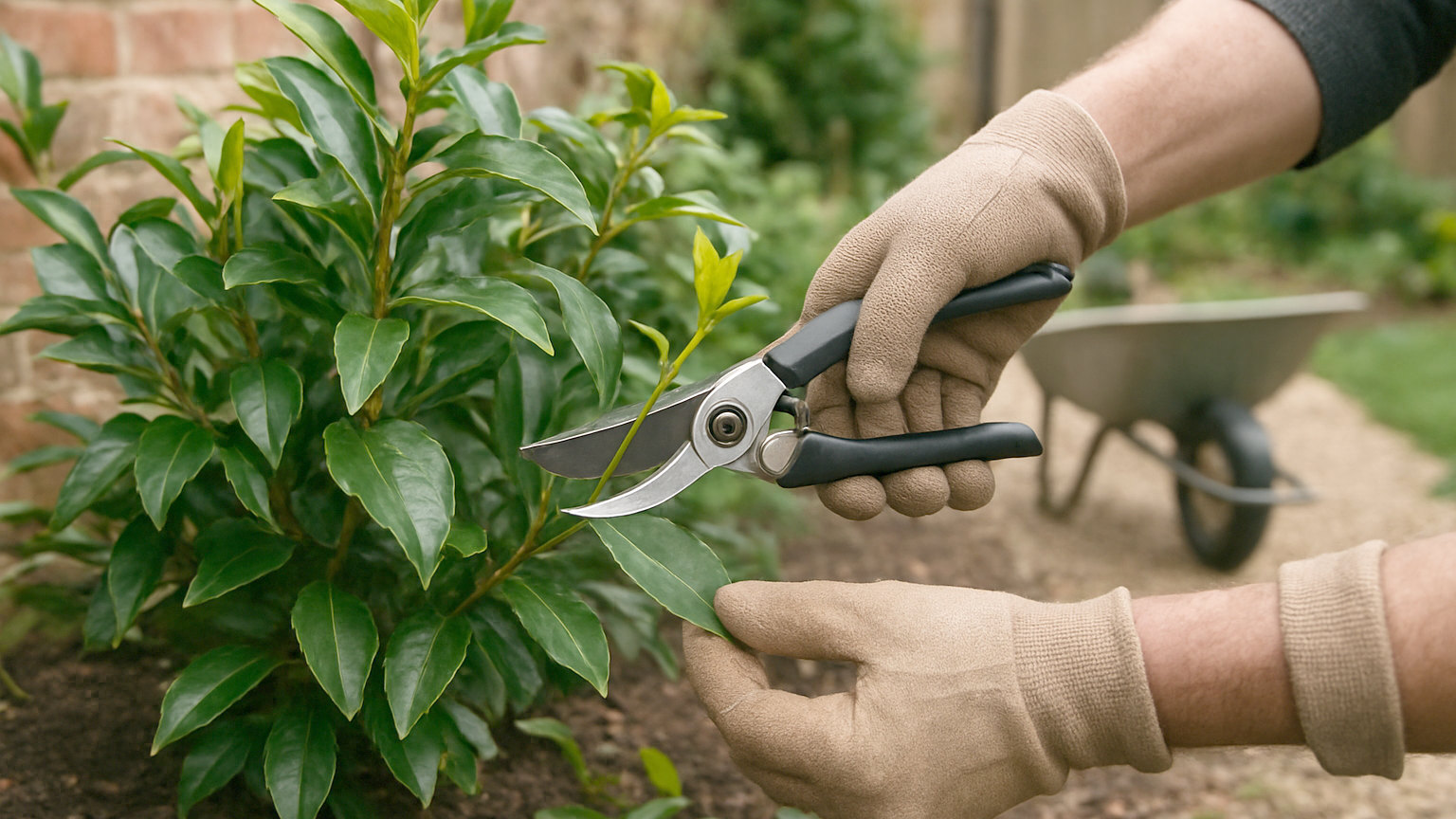
Evergreens keep their leaves all year, so they never have a period when the framework is visible and they never shed the growth they have made. Both facts change how and when they are pruned.
Prune in mid to late spring
The main window is April and May, after the risk of hard frost has passed and as growth is beginning.
The reasoning is straightforward. Pruning stimulates new growth, and evergreens produce soft shoots that are easily damaged by frost. A cut made in autumn or early winter prompts growth just as the cold arrives.
Spring pruning gives the plant the whole growing season to replace what has been removed and to harden it before winter.
A second light trim in late summer, around August, tidies anything that has grown out of shape, and there should be time for the resulting growth to firm up.
Avoid pruning evergreens between about September and March.
Large-leaved evergreens need secateurs
Cherry laurel, aucuba, fatsia and other big-leaved evergreens look poor when cut with shears or a powered trimmer, because the blades slice through the leaves and the cut halves turn brown and hang there for months.
Cut these with secateurs, removing whole shoots back into the plant. It takes considerably longer and the result is entirely different.
Small-leaved evergreens such as box, privet, Lonicera nitida and yew are fine with shears, since the leaves are small enough that any damage does not show.
How much they tolerate
This varies enormously and matters more than anything else.
Regenerate readily from old wood: yew, box, holly, cherry laurel, Portuguese laurel, privet, escallonia, viburnum tinus, euonymus, choisya, aucuba.
These can be cut back hard and will produce new shoots from apparently bare wood, which makes renovation possible.
Will not regenerate from bare wood: most conifers other than yew, lavender, rosemary, santolina, cistus, hebe in many cases, and ceanothus among the evergreen forms.
Cut into bare wood on these and it stays bare permanently. Always leave green growth below every cut.
Technique
Remove dead, damaged and diseased wood first, which is often most of what is needed.
Thin by removing whole stems at their point of origin rather than shortening everything, which preserves the natural shape and lets light into the centre.
Shorten anything spoiling the outline, cutting back to a side shoot within the body of the plant so the cut is hidden.
Take no more than about a quarter of the growth in one year unless you are renovating deliberately.
Renovating an overgrown evergreen
Only attempt this on a species from the first list.
Work over two or three years, cutting one side or a third of the plant back hard each spring, so the remainder can keep feeding the plant.
Feed with a general fertiliser and mulch generously after cutting, and water through the first summer. A renovated evergreen is producing a great deal of new growth from reserves.
Expect it to look poor for a season, and to be furnished again within three or four years.
Variegated evergreens
Check for reverted plain green shoots, which are more vigorous than the variegated growth and will take the plant over within a few years.
Remove them back to a point where the variegation resumes, or to the main stem, as soon as you see them.
Wind and cold damage
Evergreens lose water through their leaves all year and suffer in cold drying winds, which produces brown scorched foliage.
Do not cut damaged growth off in winter. Wait until spring, when you can see what has survived and what has not, and prune to healthy tissue then.
Much of what looks dead in February recovers by May.
Newly planted evergreens
Prune very little for the first two or three years while the plant establishes, beyond removing damaged growth and light shaping.
An evergreen needs its foliage to build a root system, and removing too much early slows establishment considerably.
After clipping
Feed with a general fertiliser and mulch after any substantial cut, since the plant is being asked to replace what has been removed.
Water through the following summer, particularly on anything recently renovated or growing in a container, where the roots cannot forage for moisture.


