
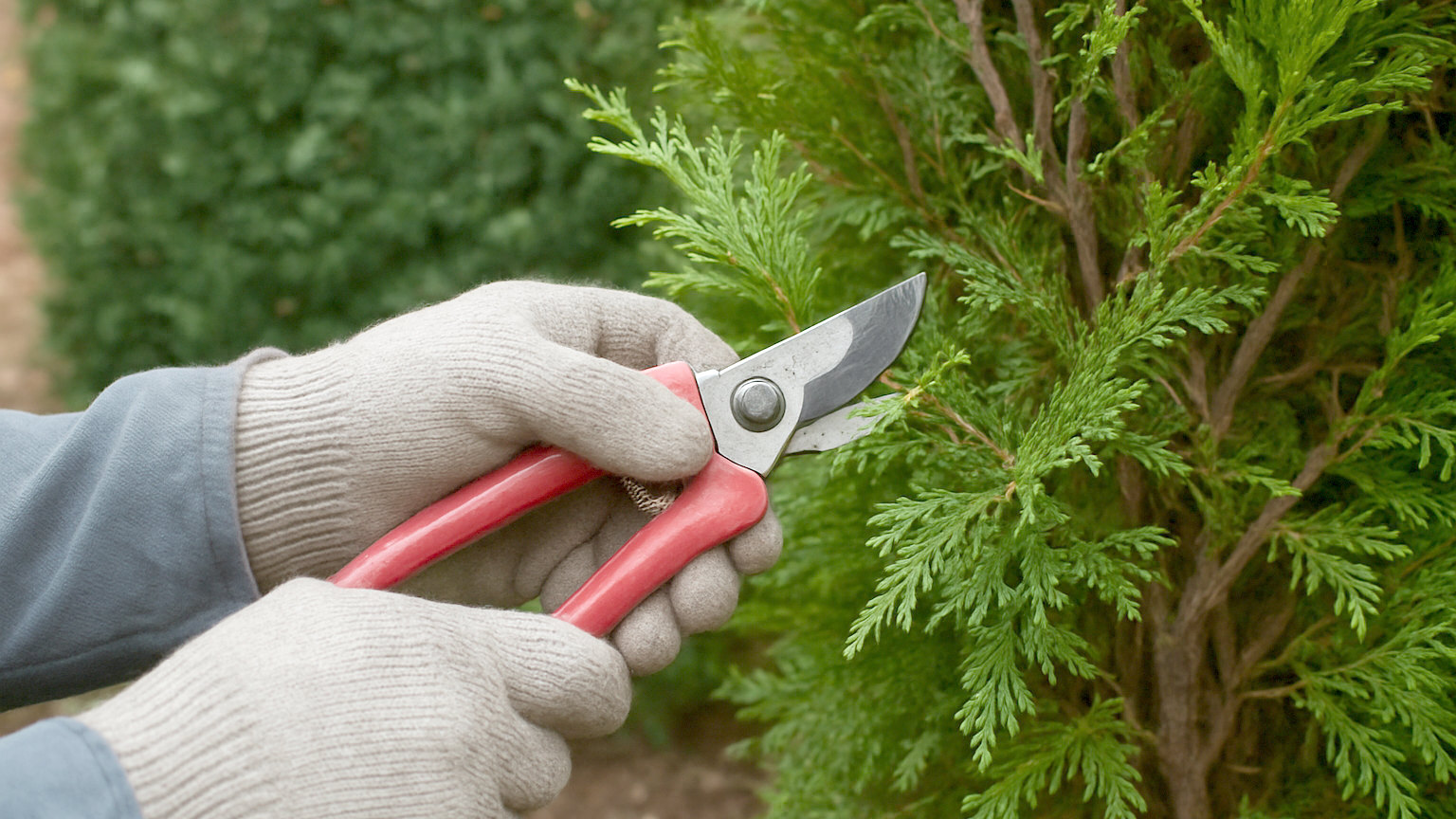
Conifers follow one rule that overrides everything else, and getting it wrong produces damage that never grows out.
The rule
Most conifers will not produce new growth from bare brown wood. Cut back into the dead interior of a conifer and it stays brown permanently.
This applies to Leyland cypress, Lawson cypress, thuja, juniper, chamaecyparis, pine, spruce and fir.
Every cut must leave green foliage below it. If you can only see brown wood where you intend to cut, move higher up or accept that the plant cannot be reduced further.
This single fact is why so many gardens contain a conifer hedge with a permanently bare brown side.
Yew is the exception
Taxus baccata regenerates completely from old wood. It can be cut back to a bare trunk and will reshoot, which is why ancient yew hedges survive centuries of management and why it is the finest formal hedging plant available in Britain.
Renovate yew over two years, cutting one side back hard in April or May and the other the following year, with feeding, mulching and watering afterwards.
Expect a full season before much happens, and then vigorous regrowth.
Trimming conifer hedges
Trim two or three times a year for Leyland cypress and once or twice for slower species, always staying within the green outer growth.
Late spring and late summer are the usual times, avoiding the bird nesting season from March to August where possible and checking thoroughly for nests before any cut in that period.
Cut with a batter, meaning sloping sides wider at the base than the top, so light reaches the bottom of the hedge and it stays furnished.
Start trimming from the year of planting rather than letting a hedge reach its intended size first. A conifer hedge that has been allowed to run cannot be brought back.
Reducing height
The one cut a conifer hedge tolerates reasonably well is having its top removed, since the sides remain clothed in green.
Cut the leader out at the height you want, slightly below the final level so the top fills in. The plant will not grow taller from that point.
Doing this early, before the hedge has exceeded the height you want, is far better than trying to reduce an established one.
Specimen conifers
Most need no pruning at all and are spoiled by it. Their form is the reason for growing them.
Remove dead, damaged and diseased branches, and remove one of two competing leaders on a young tree so a single strong leader develops.
If a leader is lost, train the strongest side shoot upright with a cane to replace it.
Dwarf and slow-growing conifers occasionally throw a vigorous reverted shoot of the original species, which should be removed at its base at once or it takes the plant over.
Pines
Pines can be shaped by candling: snapping or cutting the new soft extension growth in late spring by about half, before the needles open.
This produces a denser, more compact plant and is the technique used in ornamental training. It works only on the current season's soft growth.
Timing
Late spring, from April to early June, is the main window, after frost risk and during active growth.
Avoid autumn and winter pruning, which prompts growth that is then damaged.
Avoid pruning in hot dry weather, which scorches newly exposed foliage.
The overgrown conifer
Where a conifer or a conifer hedge has outgrown its position and cannot be reduced without cutting into brown wood, there is no pruning solution.
The choices are to live with it, to reduce only the height, or to remove and replace it with something that can be managed, such as yew, hornbeam or beech.
Check for a Tree Preservation Order before removing anything substantial, and note that evergreen hedges over two metres can be the subject of a High Hedges complaint under anti-social behaviour legislation.
Brown patches
Brown areas within a conifer can be caused by drought, waterlogging, honey fungus, aphid damage or simply the natural dieback of shaded interior foliage.
Establish the cause before acting, since none of them is corrected by cutting, and the affected area will not regreen in any case on most conifers.


