
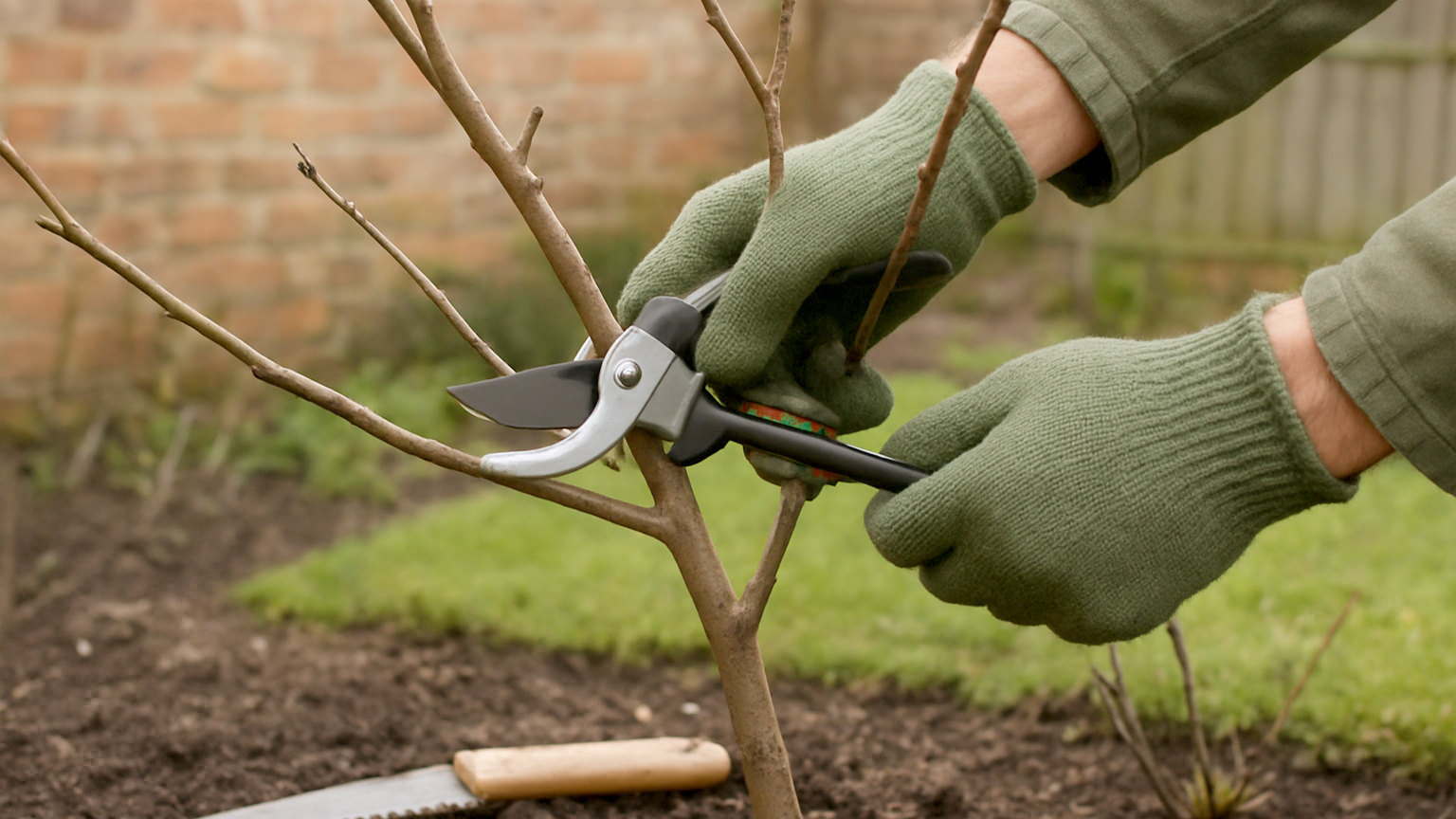
Apple and pear trees are pruned when fully dormant, between November and February, and the aim is an open framework that lets light and air into the middle. A tree pruned well crops more heavily, ripens better and suffers less disease than one left to become congested.
The shape to aim for
The traditional target is an open goblet: a short trunk, four or five main branches radiating outwards and upwards, and a clear centre.
The open middle is the point. Light reaching the inner branches ripens fruit properly and encourages fruit buds to form, and air moving through dries the foliage and reduces scab and mildew.
Aim also to keep the tree at a height you can reach from the ground. Fruit you cannot pick is fruit for the birds, and ladder work in a tree is where accidents happen.
Order of work
Start with the three Ds, removing dead, damaged and diseased wood. That alone often accounts for a good share of what needs doing.
Next take out branches crossing or rubbing, choosing the better placed of each pair, and anything growing straight into the centre of the tree.
Then remove vertical water shoots, the whippy stems that shoot up from the main branches, unless one is well placed to replace an ageing branch.
Only then start shaping, shortening leaders and thinning where growth is congested.
How much to take
Never remove more than about a fifth of the canopy in one winter. Hard pruning provokes a mass of vigorous vertical growth the following season as the tree tries to restore its balance, which leaves you with more work and less fruit.
An overgrown or neglected tree should be renovated over three or four winters, taking out one or two large branches each year. This is slower and produces a far better result than a single drastic reduction.
Spur bearers and tip bearers
Most apples are spur bearers, producing fruit on short stubby spurs along wood two years old and older. These are pruned by shortening the previous summer's side shoots to about four or five buds, which encourages spur formation.
A minority are tip bearers, fruiting mainly at the tips of shoots made the previous year. Bramley, Worcester Pearmain and Discovery are among them. Pruning a tip bearer as if it were a spur bearer removes most of the crop.
Tip bearers need lighter handling: thin out crowded and older branches, and leave the majority of the young shoots unshortened. Check which type a variety is before the first winter prune, as it is not obvious from looking.
Telling fruit buds from growth buds
Fruit buds are fat, rounded and slightly furry. Growth buds are small, flat and pointed, lying close to the stem.
Learning to see the difference in winter is what turns pruning from guesswork into a decision. Once you can spot them, you know what you are removing.
Summer pruning
Trained forms, meaning cordons, espaliers and fans, are pruned mainly in summer rather than winter, in August. Shorten the current season's side shoots to about three leaves above the basal cluster.
Summer pruning restricts growth, whereas winter pruning stimulates it, which is why restricted forms rely on it. Free-standing trees can also have a light summer thin to let light onto ripening fruit.
Thinning the fruit
Not pruning as such, but part of the same job. In June the tree sheds a proportion of its fruitlets naturally, the so-called June drop. After that, thin the remainder to one or two fruits per cluster, spaced about ten to fifteen centimetres apart.
This feels wasteful and produces larger, better fruit, reduces branch breakage, and helps prevent biennial bearing, where a tree crops heavily one year and not at all the next.
Feeding and mulching afterwards
Follow winter pruning with a mulch of well-rotted manure or compost spread over the root area in early spring, kept clear of the trunk itself. Apples respond well to potassium, so sulphate of potash in late winter helps fruiting, while high-nitrogen feeds produce leafy growth at the expense of a crop.
Plums are different
Everything above concerns apples and pears. Plums, cherries, apricots and other stone fruit must never be pruned in winter, because of the risk of silver leaf disease entering the wounds. Prune them in summer, when the tree is growing actively and can seal cuts quickly.


