
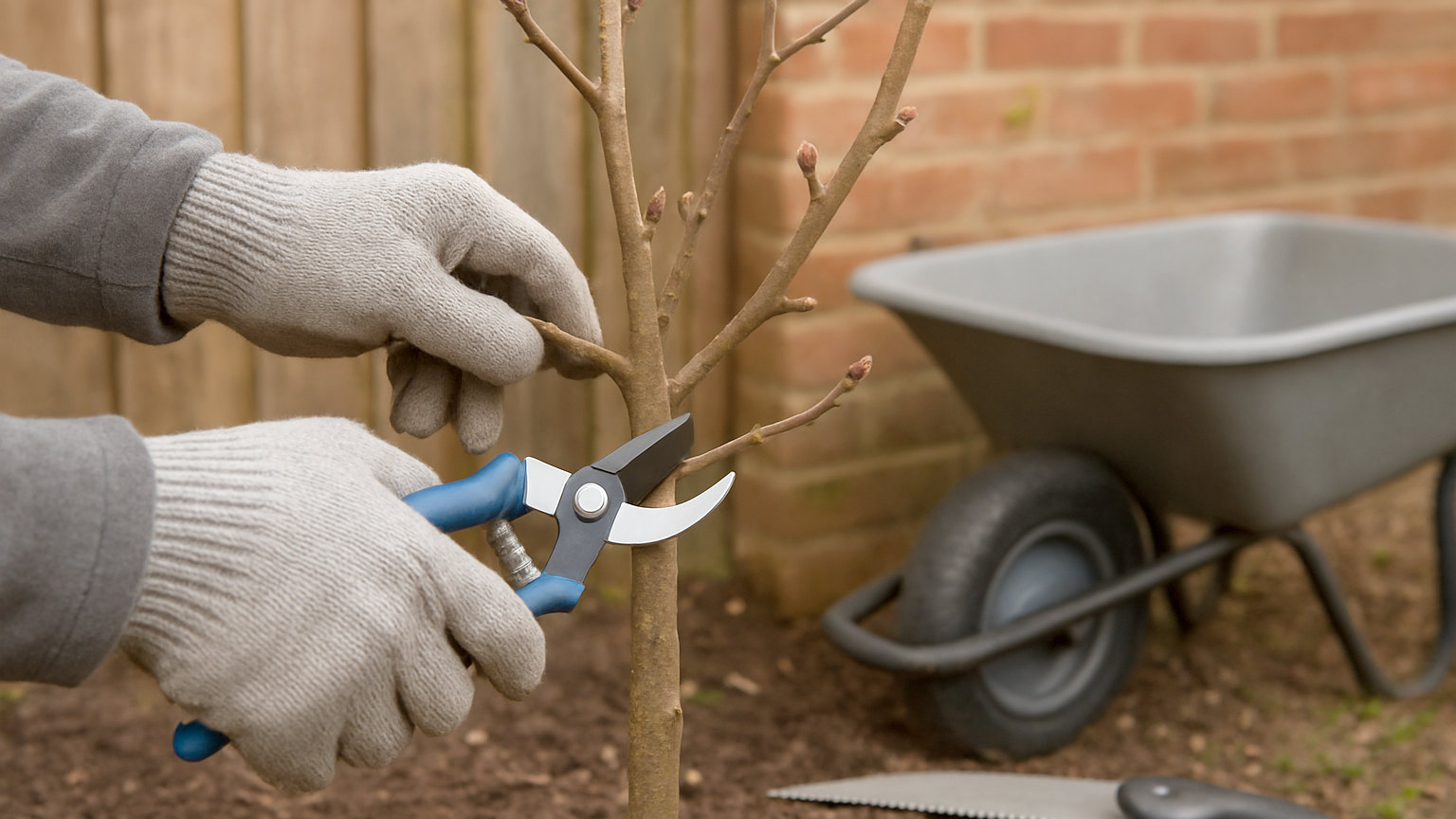
Pruning is the garden job people worry about most, usually because they are not sure what they are trying to achieve. Once the purpose is clear, where and when to cut follows from it.
Health
Removing dead, damaged and diseased wood is the one form of pruning that is never wrong and can be done at any time of year on any plant.
Dead wood harbours disease and provides an entry point for infection. Damaged branches tear further and admit rot. Diseased material spreads.
Crossing and rubbing branches also belong here, since the wound they create by chafing is where problems begin.
If you do nothing else, do this.
Shape and structure
Building a plant with a sound framework, particularly in its first few years.
A young tree or shrub given a few minutes of thought each winter develops a balanced structure that needs very little intervention for the rest of its life. The same plant left alone may develop competing leaders, narrow weak forks and a congested centre that are difficult to correct later.
This is called formative pruning and it is the most valuable pruning there is, precisely because it is done when the cuts are small.
Flowers and fruit
Most flowering shrubs produce their best display on wood of a particular age, and pruning maintains a supply of it.
Removing some of the oldest stems each year keeps a shrub producing young growth rather than declining into a woody thicket.
With fruit, pruning balances growth against cropping, lets light into the centre so fruit ripens, and keeps the crop within reach.
Size and position
Keeping a plant within the space available, off a path, clear of a window, or trained against a wall.
This is the reason people prune most often and it is worth noting that it is frequently a symptom of the wrong plant in the wrong place.
A plant needing cutting back three times a year to fit its position is the wrong plant for that position. Replacing it is less work over a decade than fighting it.
Renewal
Bringing an old, overgrown or neglected plant back into productive condition, usually by removing a proportion of the oldest wood each year over three years.
Some plants respond to this and some do not, and knowing which is the critical distinction. Yew, beech, holly, hazel and most deciduous shrubs regenerate from old wood. Conifers, lavender, rosemary and santolina do not.
When not to prune
A great deal of pruning is unnecessary. Many shrubs need nothing beyond the removal of dead wood, and some are actively spoiled by cutting.
Plants with a naturally elegant habit lose it when clipped into a dome. Magnolias, witch hazel, daphne and many others are better left alone.
Pruning also stimulates growth, so cutting back a shrub that has outgrown its space often produces a vigorous response and a larger plant than before.
If you cannot say what a cut is for, do not make it.
The two questions
Before cutting anything, ask what the plant flowers on and when it flowers.
Shrubs flowering before midsummer bloom on last year's wood and are pruned immediately after flowering. Those flowering later bloom on the current season's growth and are pruned in late winter.
That single rule covers the great majority of ornamental shrubs.
Start small
Stand back and look at the plant before making any cut, and again after every few cuts.
You can always take more off. You cannot put it back.
The three questions before any cut
What am I trying to achieve? Does this plant flower on old or new wood? Will it regrow from where I am cutting?
Those three between them prevent nearly every serious pruning mistake, including the two that cannot be undone: removing a whole season's flowers, and cutting a conifer or a lavender back into bare wood it will never reshoot from.
Doing nothing is a decision
Many gardens are over-pruned rather than under-pruned. A shrub left alone for a year while you watch when it flowers is a perfectly sensible plan, and nothing is lost by the delay.
Meanwhile you can safely remove anything dead, damaged or diseased, which is never the wrong decision on any plant at any time of year.


