
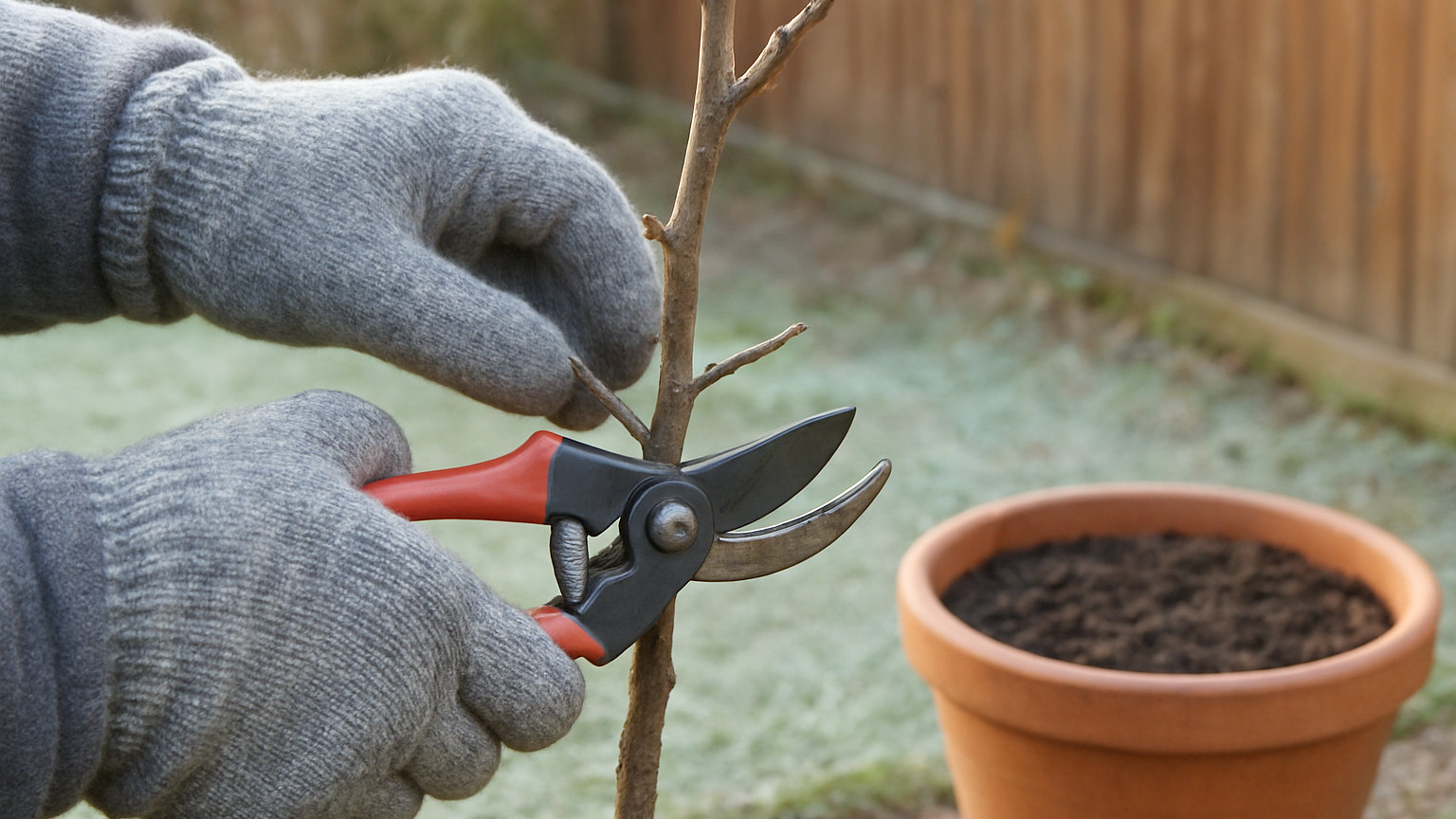
Pruning looks like an arcane skill and is really a set of small decisions about which bud grows next. Once you understand what a cut does, most of the rest follows, and the plant is generally far more forgiving than the anxiety suggests.
What a cut actually does
The bud at the tip of a shoot suppresses the buds below it, a phenomenon called apical dominance. Remove the tip and that suppression goes, so the buds below burst into growth.
Two consequences follow. Pruning stimulates growth rather than restricting it, which surprises people expecting the opposite. And the bud immediately below your cut becomes the new leading shoot, so the direction it faces determines where the new growth goes.
That is why the standard advice is to cut to an outward-facing bud. New growth then heads away from the centre of the plant, keeping it open rather than congested.
Where to place the cut
Cut about five millimetres above a healthy bud. Closer and you risk damaging it or letting it dry out; further and you leave a stub that dies back and can rot into the stem.
Slope the cut gently away from the bud so water runs off rather than sitting on it. On plants with buds in opposite pairs, such as maples and dogwoods, cut straight across just above the pair.
Make the cut clean in one movement. Sawing back and forth with blunt secateurs crushes the stem and leaves a wound that heals badly.
Cutting a whole branch back to the trunk
Never cut flush with the trunk. Where a branch joins a stem there is a slightly swollen ring called the branch collar, containing the tissue that seals the wound. Cut outside it, leaving the collar intact, and the tree closes the wound within a season or two. Cut through it and the tree cannot, and the wound stays open to decay for years.
For anything thicker than a couple of centimetres, use the three-cut method. Make an undercut about thirty centimetres out from the trunk, cutting a third of the way up. Make a second cut from above, slightly further out, and let the branch fall. Then remove the remaining stub with a clean cut just outside the collar.
Without the undercut, the falling branch tears a long strip of bark down the trunk, which is a serious wound and entirely avoidable.
Do not paint the wound
Wound paints and sealants were standard practice and are no longer recommended. They trap moisture against the cut and can seal in decay organisms. A clean cut made in the right place seals itself.
The three Ds, which need no timing
Dead, damaged and diseased wood can be removed at any time of year, and doing so is maintenance rather than pruning proper. Add crossing branches that rub against one another, since the wound created by constant rubbing lets disease in.
Cut back into healthy tissue, which you can identify by the colour of the wood: brown or hollow is dead, green or white is live. When removing diseased material, clean the blades between cuts with disinfectant to avoid spreading it.
How much to take
As a rule, do not remove more than about a quarter of a plant's growth in one year, and a fifth is safer for a tree. Taking too much triggers a mass of vigorous vertical water shoots as the plant tries to replace what it lost, which is worse than the original problem.
Renovation of an overgrown shrub is better done over three years, taking a third of the oldest stems to the base each year, than in one drastic session.
Timing in one line
Prune spring-flowering shrubs immediately after they flower, and summer-flowering ones in late winter. That single rule covers most ornamental shrubs and prevents the commonest error, which is cutting off this year's flowers before they open.
Stone fruit, meaning plums and cherries, is the important exception and must be pruned in summer, never in winter, because of silver leaf disease.
Tools and safety
Secateurs for anything up to about a centimetre and a half, loppers to about four centimetres, a pruning saw beyond that. Forcing secateurs through something too thick ruins both the tool and the cut.
Bypass secateurs, which cut like scissors, are better for live wood than anvil types, which crush.
Anything requiring a ladder, a chainsaw, or work near overhead cables is a job for a qualified arborist. Check too whether a tree is covered by a preservation order or sits in a conservation area, since work on either needs consent from the local authority before it starts.


