
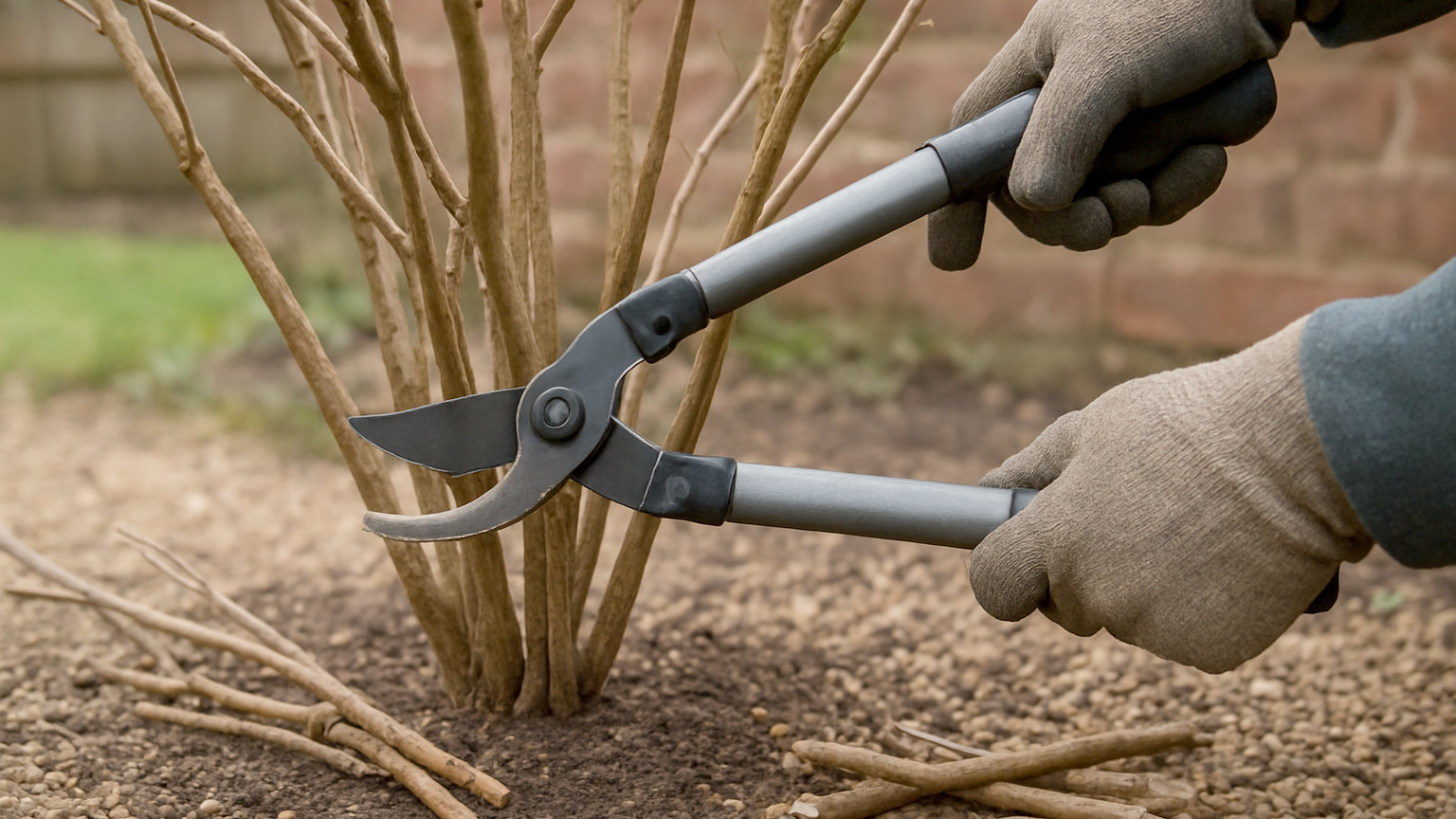
There are two fundamentally different ways to make a plant smaller, and confusing them is why so many pruned shrubs end up as dense shapeless domes.
Thinning
Removing whole stems or branches at their point of origin, either at the base of the plant or where they join a larger branch.
Nothing is left behind. The plant becomes less dense and the remaining framework keeps its natural shape and proportions.
Thinning lets light and air into the centre, which reduces disease, and it does not stimulate the mass of vigorous regrowth that shortening does.
It is the more skilled of the two and almost always the better one.
Reducing
Shortening stems rather than removing them, cutting back to a bud or a side shoot.
Every cut removes a growing tip and releases the buds below it, so several new shoots break where there was one. The plant becomes denser and often larger.
Done all over a shrub, this produces the characteristic dome of dense twiggy growth with a congested, unproductive centre.
Reducing has its place, particularly on plants that flower on new wood and are cut hard each spring, and on hedges where density is the point.
Which to use
To keep a shrub's natural habit while controlling its size, thin.
To open a congested plant and improve airflow, thin.
To rejuvenate an old shrub, thin by removing the oldest stems over several years.
To create a dense hedge or topiary, reduce.
To manage a plant that flowers on the current season's growth, such as buddleja or a late clematis, reduce hard.
For most ornamental shrubs, thinning is what is wanted and reducing is what people do.
Renewal pruning
The standard method for most flowering shrubs, and it is thinning applied on a cycle.
Each year, remove about a quarter to a third of the oldest stems at the base, choosing the thickest, darkest and least productive.
Over three or four years the whole plant is renewed, and it never becomes an old woody thicket.
Combine it with shortening the flowered growth of the remaining stems back to a strong new shoot lower down.
This keeps a shrub the same size indefinitely while continually producing the young wood that flowers best.
How to thin properly
Stand back and look at the plant first, and identify what you intend to remove before cutting anything.
Remove dead, damaged and diseased wood first, which often clarifies what remains.
Take out stems crossing the centre, rubbing against others, or growing inwards.
Then remove the oldest and least productive stems at the base or at a junction, cutting cleanly without leaving a stub.
Work slowly and step back frequently. Take out one stem, look, then decide on the next.
Where to cut when reducing
Always to a bud or a side shoot, never into a blank length of stem, which leaves a stub that dies back.
Cut about five millimetres above an outward-facing bud, sloping away from it so water runs off.
Choose the bud that points where you want the new growth to go.
How much in one year
No more than about a quarter of a shrub's growth annually, unless it belongs to the group that tolerates hard cutting.
Renovating an overgrown shrub is better done over three years, removing a third of the oldest stems each winter, than in one drastic session.
Shearing
Cutting over the whole surface with shears is reducing taken to its extreme.
It suits hedges, topiary, lavender and some low mound-forming shrubs. On most flowering shrubs it destroys the habit and produces a dense shell of growth over a dead centre.
Reading a shrub before cutting
Look at where the stems arise. A shrub producing new shoots from the base each year is a candidate for renewal thinning; one with a permanent woody framework is not.
Look at the age of the wood. Old stems are thick, dark and often flaking; young ones are smooth and greener. The oldest are what you remove when thinning.
Look at the overall shape and decide what you want it to be, since thinning preserves the habit and reducing changes it.
Look at where the flowers were, which tells you what age of wood the plant flowers on and therefore when it should be pruned.


