
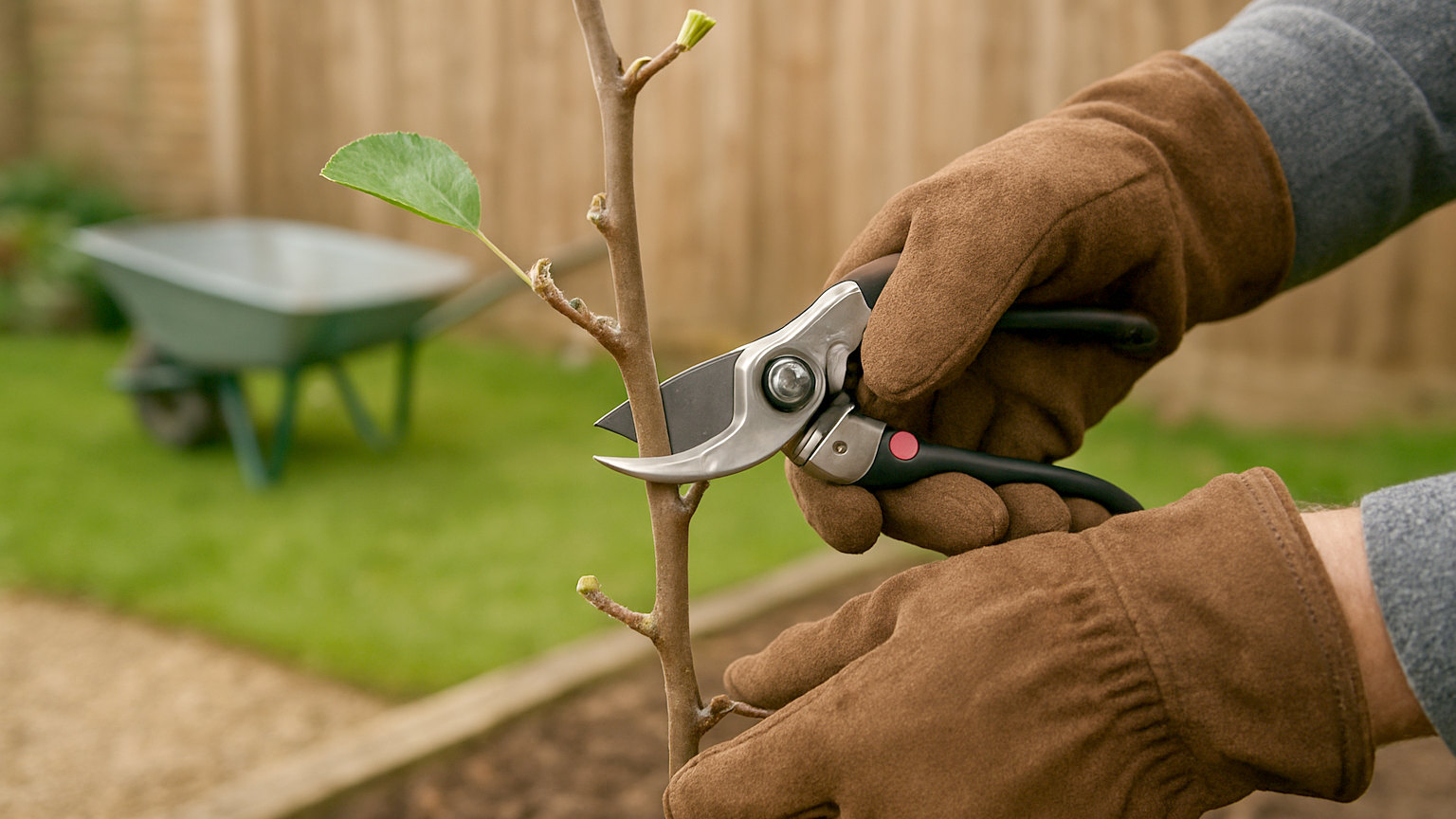
Formative pruning is the most valuable pruning there is, and the most often skipped. Ten minutes on a young plant prevents structural problems that are difficult, expensive or impossible to correct thirty years later.
Why early matters
A cut made on a young plant is a few millimetres across and closes within a season.
The equivalent correction on a mature tree means removing a large limb, leaving a wound that may never close, and possibly destabilising the whole structure.
Everything about formative pruning follows from that: intervene early, cut small, and think about what the plant will look like in twenty years.
Establish one leader
On a tree with a single central trunk, there should be one dominant leading shoot.
Where two shoots compete for the lead, choose the stronger and better-placed one and remove or shorten the other.
A tree with two competing leaders develops a narrow fork, and narrow forks split. The bark of the two stems grows against itself rather than knitting together, forming a weak union known as included bark that can fail catastrophically decades later, usually in a gale.
Look for wide, open, U-shaped unions rather than narrow V-shaped ones.
Some trees are naturally multi-stemmed and that is fine. The problem is two stems of equal size competing on a tree that should have one.
Spacing the branches
Aim for branches well spaced up the trunk and around it, rather than several arising at the same point, which creates a weak whorl.
Remove branches that cross the centre, rub against others, or grow inwards.
Leave lower branches on a young tree for the first few years, since they help the trunk thicken. Remove them gradually over several seasons to lift the crown to the height you want.
Shrubs
The aim is a balanced, open-centred plant with well-spaced stems.
In the first two or three years, remove weak, spindly and badly placed shoots, and shorten anything unbalancing the shape.
On shrubs grown for their stems, such as dogwoods, allow a season or two of establishment before starting the annual hard cut, so the root system can support the regrowth.
On shrubs that renew from the base, encourage strong basal shoots and remove the weakest.
How much to take
Little. Formative pruning is a matter of a few well-chosen cuts each year, not a reshaping.
Removing too much from a young plant slows establishment, since it needs its leaves to build a root system.
As a rule, no more than a quarter of the growth in any one year on a young plant.
Timing
Late winter for most deciduous trees and shrubs, while dormant and while the structure is clearly visible without leaves.
Summer for stone fruit and ornamental cherries and plums, which must not be cut in winter because of silver leaf disease.
After flowering for spring-flowering shrubs, so the display is not removed.
What to look for
- Two shoots competing for the lead
- Narrow V-shaped forks with bark pinched between the stems
- Branches crossing or rubbing
- Growth heading into the centre of the plant
- Several branches arising at the same point
- Dead, damaged or diseased wood
- Suckers from below a graft union
Standing back
Walk round the plant and look at it from several angles before cutting, and again after every few cuts.
Formative pruning is mostly deciding what to remove rather than removing it, and the deciding is where the time should go.
The habit worth forming
Look at every young tree and shrub once each winter, for a few minutes, and make two or three cuts.
Done for five years, that produces a plant that needs almost nothing for the rest of its life.
When it is too late
On an established tree with a narrow fork and included bark, removing one stem may leave a wound too large to close and destabilise the tree.
That is a job for a qualified arborist to assess rather than a decision to make with a saw in hand, and bracing is sometimes the better answer than removal.
Check also whether the tree is covered by a Tree Preservation Order or sits within a conservation area, since work on either requires consent from the local authority before starting.


