
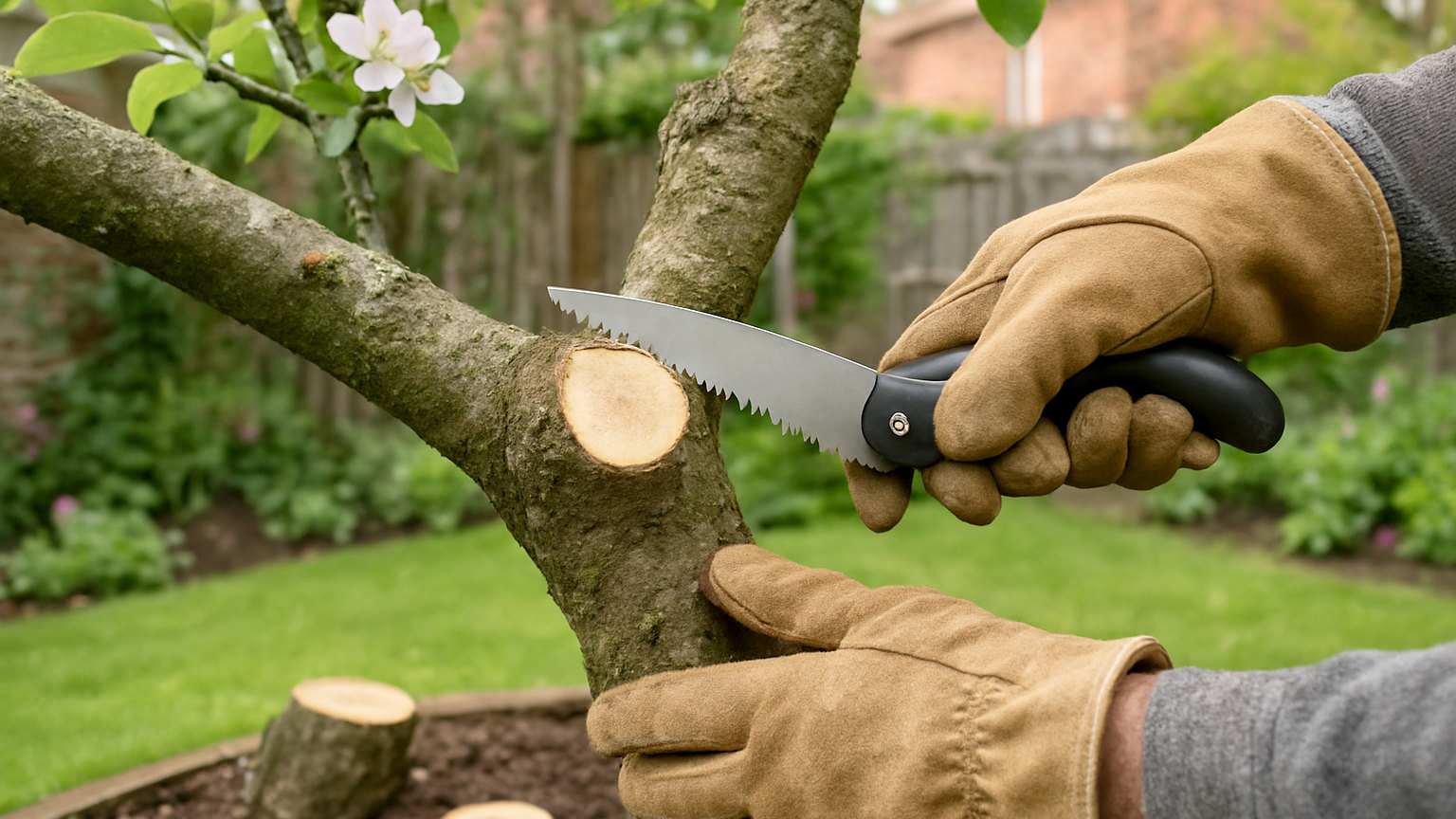
Removing a branch more than about five centimetres across needs a specific technique. Cut it in one go and the weight tears the bark away down the trunk as it falls, leaving a wound far larger than the cut you intended.
The three-cut method
First cut: an undercut on the underside of the branch, about thirty centimetres out from the trunk, going a quarter to a third of the way through. Stop there.
Second cut: from above, a few centimetres further out from the first cut. The branch breaks and falls, and the undercut stops the bark tearing beyond it.
Third cut: remove the remaining stub cleanly, with no weight left on it to cause tearing.
The whole point of the first two cuts is to get the weight off before making the cut that matters.
Where the final cut goes
At the branch collar: the slightly swollen ring of tissue where the branch meets the trunk.
The collar contains the chemistry the tree uses to wall off the wound and grow over it. Cut just outside it, angling the cut so the collar is left intact.
Look also for the branch bark ridge, the raised line in the bark on the upper side of the junction. The correct cut runs from just outside the ridge down to just outside the collar.
Two ways to get it wrong
Flush cutting removes the collar along with the branch. It looks tidy and it removes the tissue the tree needs to compartmentalise the wound, producing a large wound that decays inwards and may never close.
This was standard practice for decades and is now firmly discouraged.
Leaving a stub is the opposite error. The stub has no growing tip, dies back, and the decay travels into the trunk. A stub cannot be grown over.
The correct cut is neither flush nor stubbed, but just outside the collar.
No wound paint
Wound sealants and pruning paints are no longer recommended.
They seal moisture and fungal spores in, interfere with the tree's own compartmentalisation, and do not prevent decay. A clean cut left open is the better outcome.
Timing
Late winter for most deciduous trees, while dormant and while the structure is visible.
Summer for plums, cherries and other stone fruit, which must not be cut in winter because of silver leaf disease.
Avoid pruning birch, maple, walnut and vines in late winter and spring, since they bleed sap heavily. Prune those in late summer or autumn instead.
Before you start
Check whether the tree is covered by a Tree Preservation Order, or sits within a conservation area. Both require consent from the local authority before work, and unauthorised work carries substantial penalties.
Check who owns the tree. You may cut growth overhanging your side of a boundary back to the line, and the cuttings remain the neighbour's property.
Look up for overhead power lines. Never work on any branch near a line, and never assume a line is insulated.
Avoid March to August where birds may be nesting.
When to call an arborist
Anything requiring a ladder or working above shoulder height with a saw.
Anything near power lines, buildings or a boundary.
Anything requiring a chainsaw, which is not a tool for the untrained and causes severe injuries.
Large limbs, where the weight and the fall are difficult to control.
Any tree showing signs of instability, decay or fungal brackets, which needs assessment rather than pruning.
Use an arborist who is qualified and insured, and ask to see both.
How much to remove
No more than about a fifth of a mature tree's live crown in one year.
Removing more stresses the tree and provokes a mass of vigorous water shoots, which is the opposite of what most reductions are meant to achieve.
Afterwards
Do not apply wound paint. Leave the cut open and let the tree compartmentalise it.
Clear the debris rather than leaving it piled against the trunk, where it holds moisture and encourages rot.
Chip or shred the material if you can, since it makes excellent mulch once composted, though fresh woodchip should stay on the surface rather than being dug into the soil.
Burn or bin anything diseased rather than composting it.


