
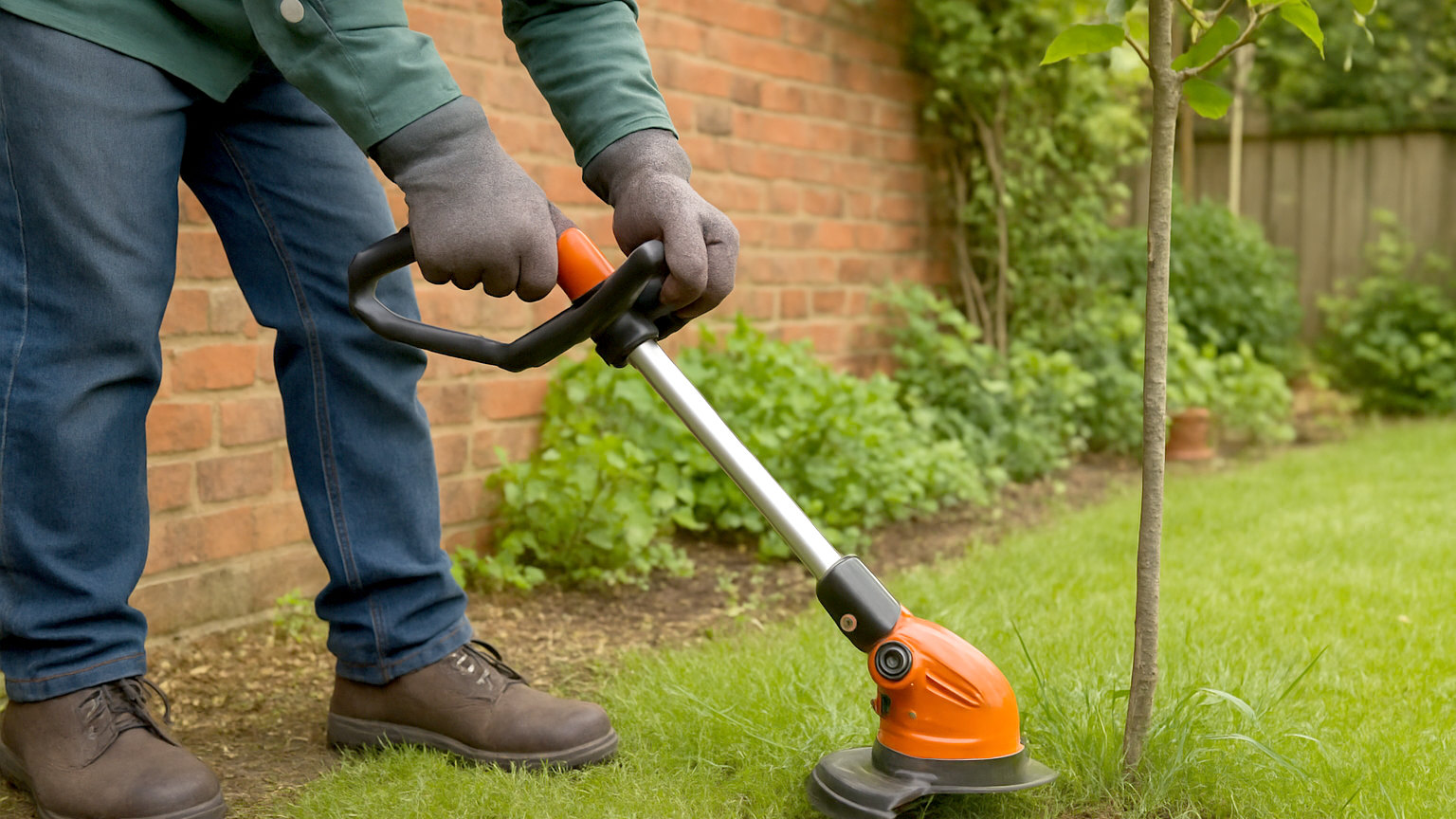
A strimmer does the jobs a mower cannot: edges, banks, around obstacles, under fences and in rough grass. It is also the garden tool most likely to cause an eye injury and the one that kills the most trees.
Strimmer or brushcutter
A strimmer, or line trimmer, uses a spinning nylon line to cut grass and soft growth. It is light, suits domestic work and copes with grass and weeds.
A brushcutter is a heavier machine, usually petrol, with a harness and a rigid metal blade as well as a line head. It cuts brambles, scrub and woody growth that would defeat a strimmer.
For most gardens a strimmer is what is wanted. A brushcutter is for clearing land rather than maintaining a garden.
Power source
Battery strimmers now handle domestic work comfortably and are quiet, light and require no maintenance beyond line replacement. For most gardens they are the sensible choice.
Corded electric is cheap and effective near the house, with the cable being the obvious limitation. Always use an RCD.
Petrol gives the most power and unlimited running for large or rough areas, at the cost of weight, noise, vibration and maintenance.
Line and heads
Line comes in different diameters and shapes. Thicker line cuts tougher growth and uses more power; square or twisted profiles cut more aggressively than round.
Use the diameter the manufacturer specifies. Fitting thicker line than the machine is designed for strains the motor.
Bump-feed heads release more line when tapped on the ground; automatic heads do it themselves. Both jam occasionally and both are easily cleared.
Soaking a spool of line in water overnight before fitting reduces breakage, since dry line becomes brittle.
Metal blades belong on brushcutters designed for them and should never be fitted to a machine not rated for a blade.
Safety
Eye protection is essential, not optional. A strimmer throws stones, grit and debris at high speed in unpredictable directions, and eye injuries from strimmers are common and serious.
Use goggles or a full face visor. Ordinary glasses are not adequate.
Wear long trousers, stout boots and gloves. Hearing protection with a petrol machine.
Keep the guard fitted. It sets the working distance and stops debris coming back at you.
Keep other people and pets well away, at least fifteen metres.
Work with the machine below waist height and to your side, moving the head in a gentle arc, cutting with the tip of the line.
Disconnect the power before changing line or clearing a blockage.
Bark damage
A strimmer will ring-bark a young tree in seconds, and a ring-barked tree dies.
The line removes bark from the base of trunks and shrub stems, cutting through the layer that transports sugars. Partial damage weakens the tree; a complete ring around it kills it.
This is one of the commonest causes of death in young garden trees and it is entirely avoidable.
Keep a mulched circle at least a metre across around every young tree, so no strimming is needed near the trunk. Fit a plastic tree guard or a spiral to the base as physical protection.
The same applies to shrub stems, plastic irrigation pipe, cables and lighting.
Wildlife
Long grass shelters hedgehogs, frogs, toads, slow worms and nesting birds, and a strimmer does terrible damage to all of them.
Check the area before starting, and work from the centre outwards or in one direction so animals can escape.
Avoid rough grass and hedge bases between March and August because of nesting birds, which is a legal matter as well as good practice.
Cutting rough areas in stages rather than all at once leaves refuge.
Getting a tidy result
Hold the head parallel to the ground for grass, and turn it vertical for a lawn edge, working slowly along the line.
Do not scalp down to bare soil, which is easily done and leaves brown patches that take weeks to recover.
Cut in several light passes rather than trying to take everything in one, and keep the head moving rather than holding it in one spot.
Maintenance
Clean grass and sap off the head and guard after use, since it sets hard. Check the guard is intact and the line-cutting blade on it is present, since without it the line runs too long and strains the motor.


