
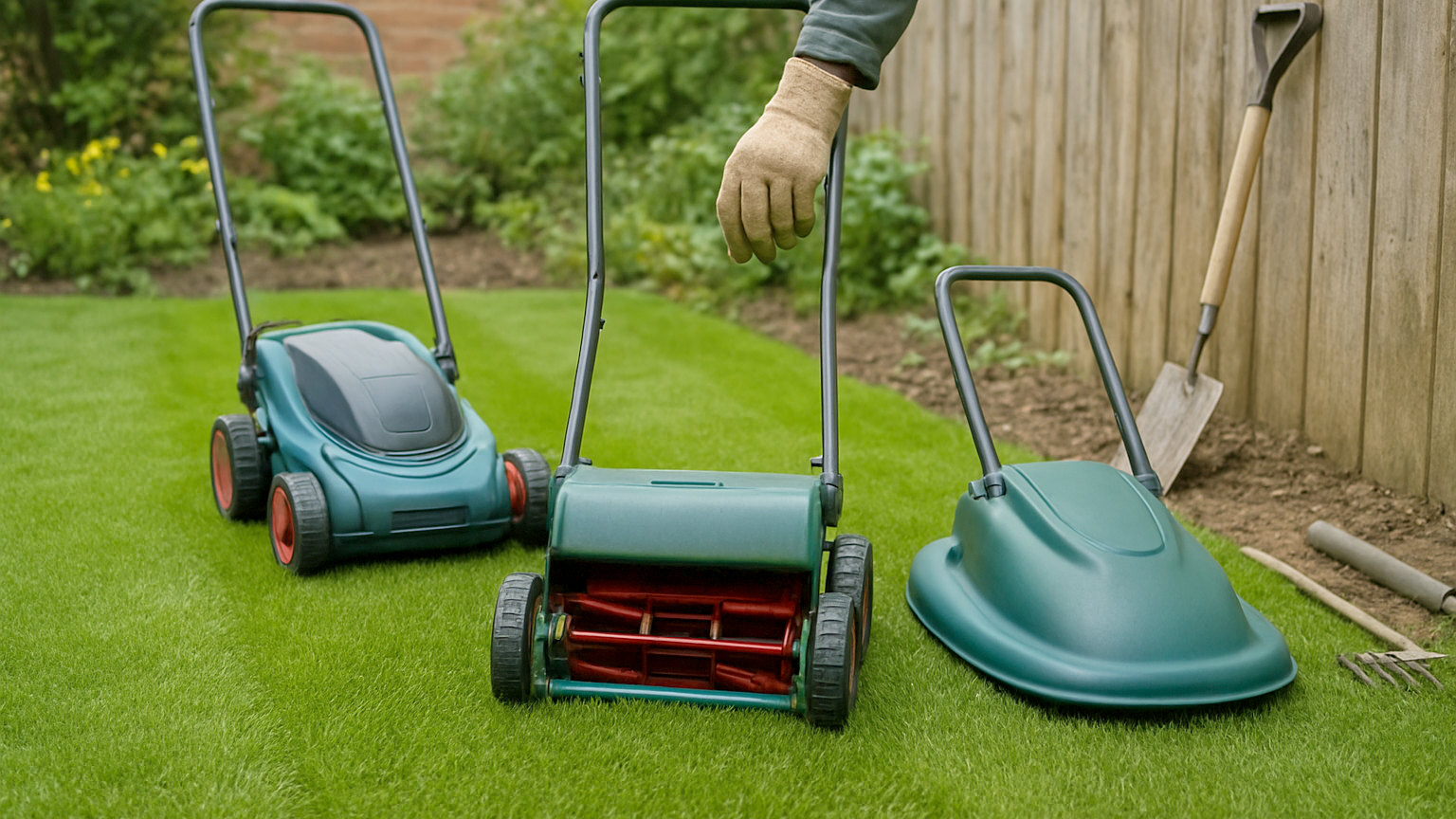
The three main mower types cut grass in fundamentally different ways, and that mechanism determines the finish, the maintenance and the sort of lawn each suits.
Rotary mowers
A single horizontal blade spins at high speed beneath the deck, cutting by impact. This is what the great majority of domestic mowers are.
They are versatile, tolerant of long grass, uneven ground and slightly damp conditions, and they cut at a wide range of heights including the high settings that matter in summer and shade.
They cope with rough ground and orchard grass that would defeat a cylinder machine, and they are cheaper to buy and simpler to maintain.
The trade is the quality of cut. A rotary blade tears the grass rather than slicing it cleanly, and a blunt blade tears badly, leaving ragged whitened tips that brown within a day.
Keeping the blade sharp largely addresses this. For virtually every domestic lawn, a rotary mower is the right choice.
Cylinder mowers
A rotating cylinder of helical blades carries the grass against a fixed bottom blade, cutting it like a pair of scissors.
This produces a genuinely superior cut: clean, precise, and less damaging to the grass plant. It is what produces proper stripes and the fine finish of a bowling green or a cricket square.
The demands are real. A cylinder mower needs a level lawn, since it scalps on bumps. It needs regular mowing, because it cannot handle long grass. It needs a fine grass mixture to show its advantage. And it will not cut wet grass or rough ground at all.
Maintenance is more involved, since the cylinder and bottom blade must be correctly adjusted and periodically reground, which is a job for a specialist.
Most cylinder mowers also cut only at low heights, which is a limitation during drought.
Choose one only if you want a fine lawn and are prepared for what that entails.
Hover mowers
A rotary blade with no wheels, riding on a cushion of air generated by the blade itself.
They are light, cheap and manoeuvrable, and they float over uneven ground, banks and awkward corners in a way wheeled machines cannot. On a steep bank they can be swung on their cable from above, which is the job they do best.
The disadvantages are that the cutting height is imprecise and hard to control, many models do not collect the clippings, and they are less comfortable to use for any length of time.
They suit small lawns, banks and awkward areas, and they are not the right machine for a main lawn of any size.
Mulching mowers
Not a separate type so much as a rotary mower with a specific blade and deck design that chops clippings finely and forces them back down into the sward.
The clippings decompose quickly, returning nitrogen and moisture and reducing the need to feed. There is nothing to empty, which on a large lawn saves most of the labour.
They need the grass to be dry and cut regularly, since long or wet clippings clump on the surface.
Many rotary mowers include a mulching plug, giving both options.
Ride-on and lawn tractors
Worth considering above about a thousand square metres, where a walk-behind machine becomes a serious time commitment.
They need storage space, room to turn, and access without steps or narrow gates. The cut quality is adequate rather than fine, and they compact the ground over time on heavy soil.
Mow up and down a slope on a ride-on rather than across it, which is the opposite of the advice for a walk-behind machine, since a ride-on can tip sideways.
Which to choose
Rotary for almost every domestic garden, and particularly for family lawns, rough ground and anywhere the high cutting settings matter.
Cylinder only for a fine ornamental lawn on level ground where appearance is the object.
Hover for banks, small awkward areas and as a second machine rather than a first.
Blade sharpness matters more than type
Whichever mechanism you choose, the sharpness of the cutting edge determines the quality of the cut more than the design does.
A sharp rotary blade produces a far better lawn than a blunt cylinder, and sharpening or replacing a rotary blade once or twice a season costs very little.


