
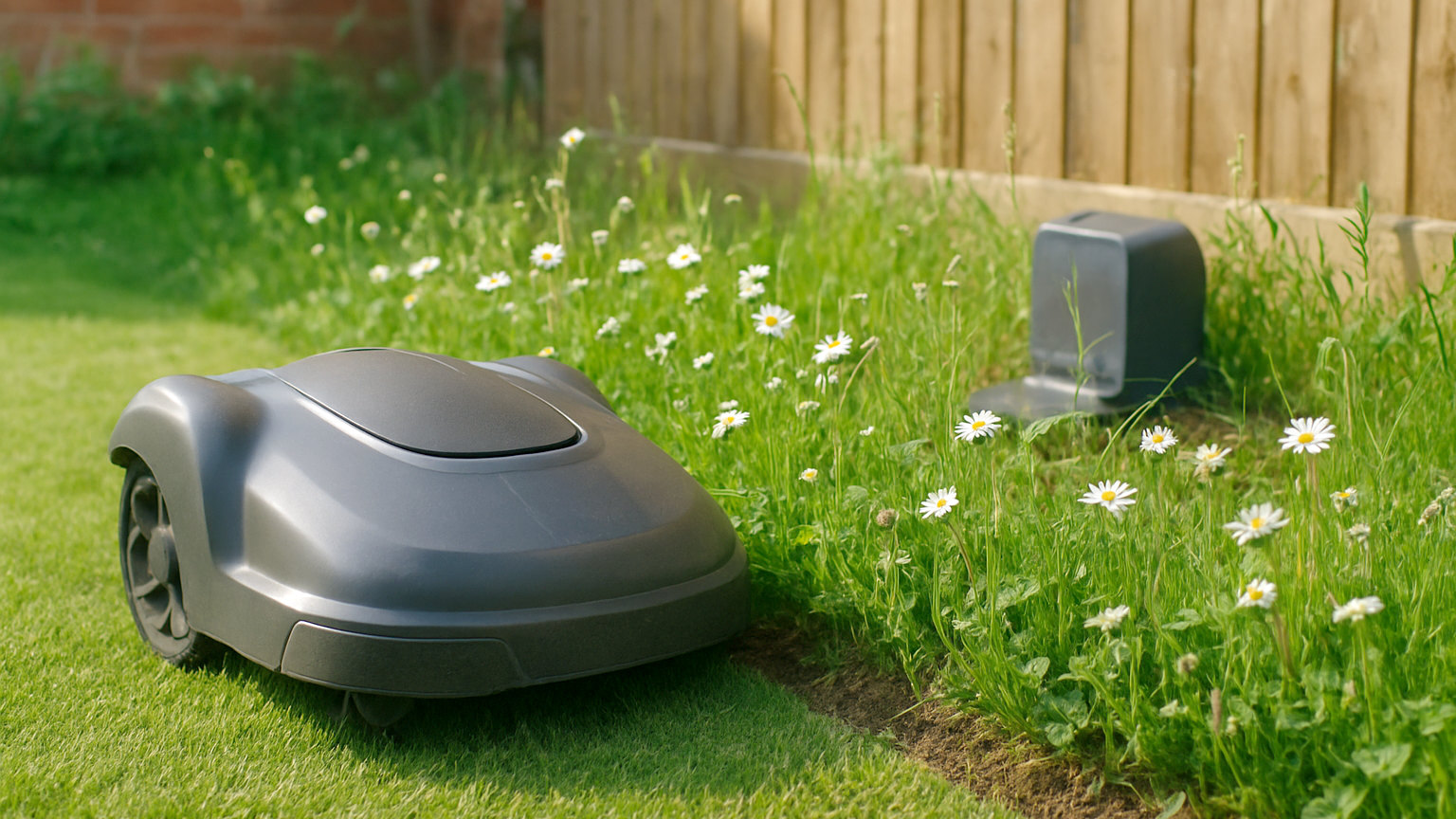
Robot mowers cut a little grass very often, returning to a charging station between runs, and they keep a lawn permanently short with no weekly effort. They also carry a wildlife problem that is well documented and largely avoidable.
How they work
The mower moves across the lawn in a semi-random or systematic pattern, cutting a few millimetres at a time with small pivoting blades, then returns to its dock to recharge.
Because they cut so little so often, the clippings are tiny and drop back into the sward as a mulch. There is nothing to collect.
Most are contained by a boundary wire pegged or buried around the perimeter, which the machine detects and turns away from. Newer models use satellite positioning or cameras instead, avoiding the wire entirely.
Installation
Laying the boundary wire is the main work, and it must go around the perimeter and around any obstacle the mower should avoid: ponds, beds, trees with exposed roots.
The wire can be pegged on the surface, where the grass grows over it within weeks, or buried a few centimetres down, which is more durable and considerably more work.
The dock needs a power supply and a sheltered position with clear access.
Allow time to get the boundaries right. Most installations need adjustment over the first few weeks.
What they suit
Reasonably level lawns of simple shape, without steps between areas, and within the slope limit for the model, typically around twenty to thirty-five per cent.
They handle a lawn far better than they handle a garden full of narrow passages, and separate lawn areas usually need either a passage the machine can navigate or a second unit.
They are at their best on medium to large lawns where weekly mowing is a chore, and they are poor value on a small lawn that takes fifteen minutes by hand.
The wildlife problem
Robot mowers injure and kill hedgehogs, and the evidence for this is clear. A hedgehog's instinct when threatened is to curl up rather than flee, which is exactly the wrong response to a machine that keeps coming.
Frogs, toads, slow worms and young birds are also at risk.
The measures that address it are straightforward.
Run the mower only during daylight hours. Hedgehogs are nocturnal, and confining mowing to the day removes most of the risk. Many machines allow a schedule to be set, and doing so is the single most useful thing you can do.
Check the lawn before each run in the season, particularly if you know hedgehogs visit.
Leave part of the garden outside the boundary wire as unmown habitat, with a log pile and access gaps under fences.
Some newer models include obstacle detection that recognises small animals. It is worth asking about and is not a substitute for daytime-only operation.
Other safety points
Keep children and pets away from a machine in operation. The blades are small and they are still blades.
Most models have lift and tilt sensors that stop the blades, and a PIN or app lock to prevent unauthorised use or theft.
Turn the machine off and isolate it completely before lifting, cleaning or inspecting the underside, and wear gloves when handling the blades.
What to expect from the lawn
A permanently short, dense, even sward with no clippings and no stripes, since the machine does not roll the grass.
The constant light mulching returns nitrogen and reduces the need to feed.
The lawn still needs the annual work: scarifying, aerating and top dressing in early autumn. A robot mower replaces the mowing, not the maintenance.
Wheel marks can appear on the same routes over time, which is reduced by machines that vary their pattern.
Practicalities
Blades are small and need replacing every one to three months depending on use, which is cheap and takes a few minutes.
Clean the underside regularly, since clippings build up.
Bring the machine indoors over winter, following the manufacturer's advice on battery storage, which usually means a partial charge rather than full or empty.
Cost and value
Robot mowers are expensive compared with a conventional machine, and the case for one is the time saved rather than the money.
On a medium or large lawn mown weekly for thirty weeks a year, the hours add up quickly, and that is where they earn their keep.


