
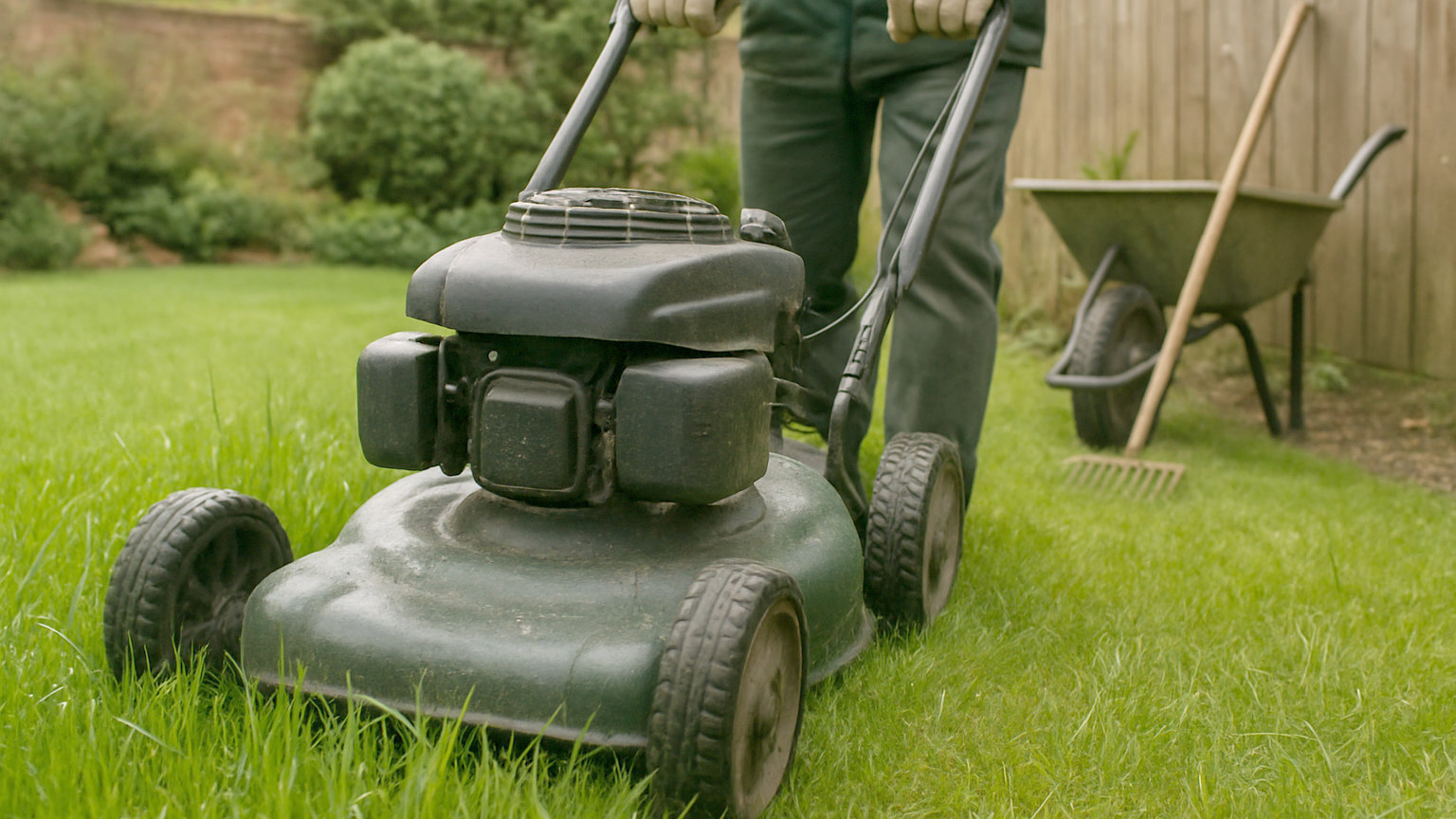
Wet grass and long grass are the two conditions every guide tells you to avoid, and both happen anyway. A fortnight of rain, a holiday, or simply a busy spring leaves a lawn that has to be dealt with as it is.
The one-third rule
Never remove more than a third of the leaf length in a single cut. This is the principle that governs everything about mowing overgrown grass.
Removing more shocks the plant, since it loses most of the leaf area it depends on. The grass yellows, growth stops for a fortnight, the roots die back to match the reduced top, and the lawn is more vulnerable to drought and weeds afterwards.
Scalping also exposes the pale stem bases, which is why a badly overgrown lawn cut short looks yellow rather than green.
Cutting long grass properly
Set the mower to its highest setting and cut. Accept that it will look untidy.
Wait three or four days, then lower the height one setting and cut again.
Repeat every few days until you reach the height you want, which usually takes three cuts over ten days or so.
This is slower and produces a green lawn rather than a yellow one, and the difference is obvious within a fortnight.
Collect the clippings from each of these cuts, since long clippings lie on the surface in rows and smother the grass beneath.
Very overgrown grass
Where grass is knee-high, a mower will not cope at all.
Cut it down first with a strimmer, shears or a scythe, rake off the material, and then start the staged mowing process on what remains.
Check for wildlife before cutting long grass. Hedgehogs, frogs, toads and slow worms shelter in it, and hedgehogs curl up rather than running. Work from the centre outwards so animals have a route away.
Avoid cutting long grass and rough areas between March and August where birds may be nesting, which is a legal matter as well as good practice.
Mowing wet grass
Best avoided, and sometimes the only option in a wet British summer.
Never use a corded electric mower on wet grass or in the rain. This is a safety matter rather than a lawn one.
Wet grass clogs the deck and the discharge chute, clumps into rows on the surface, and does not feed cleanly into the blade, which produces a ragged tear rather than a cut.
The mower also works considerably harder, and wet clippings pack into the deck and rot there.
Wheels on wet ground compact the soil and can rut it, particularly on clay, and turning tears the turf.
If you must mow wet grass
Wait for the surface water to dry even if the ground is still damp, which makes a surprising difference.
Set the mower higher than usual, take a narrower cut by overlapping passes more, and go slowly.
Collect the clippings rather than mulching, since wet clippings clump badly.
Make sure the blade is sharp, since a blunt blade on wet grass tears very visibly.
Clear the deck frequently, with the power disconnected and using a scraper rather than your hands.
Do not mow saturated or waterlogged ground at all, which does damage that takes a season to correct.
Afterwards
Clean the mower thoroughly, since wet grass packed under a deck rots, corrodes steel and is unpleasant to remove once dry.
Disconnect the power or the spark plug lead first, tip the machine according to the manufacturer's instructions, and scrape the underside.
Dry a petrol machine before storing it.
Preventing the problem
Mow more often rather than lower. Cutting weekly at forty millimetres removes far less leaf each time than cutting fortnightly at the same height, and produces a better lawn.
Before a holiday, mow just before leaving and raise the height slightly, rather than cutting short in the hope of buying time. Cutting short does not slow growth and leaves the lawn stressed while you are away.
Protecting the machine
Long and wet grass both strain a mower considerably. Take narrower cuts by overlapping passes, go slowly, and stop to clear the deck rather than forcing the machine through.
Listen to the engine or motor. If it is labouring, you are asking too much of it, and either the height or the pace needs adjusting.


