
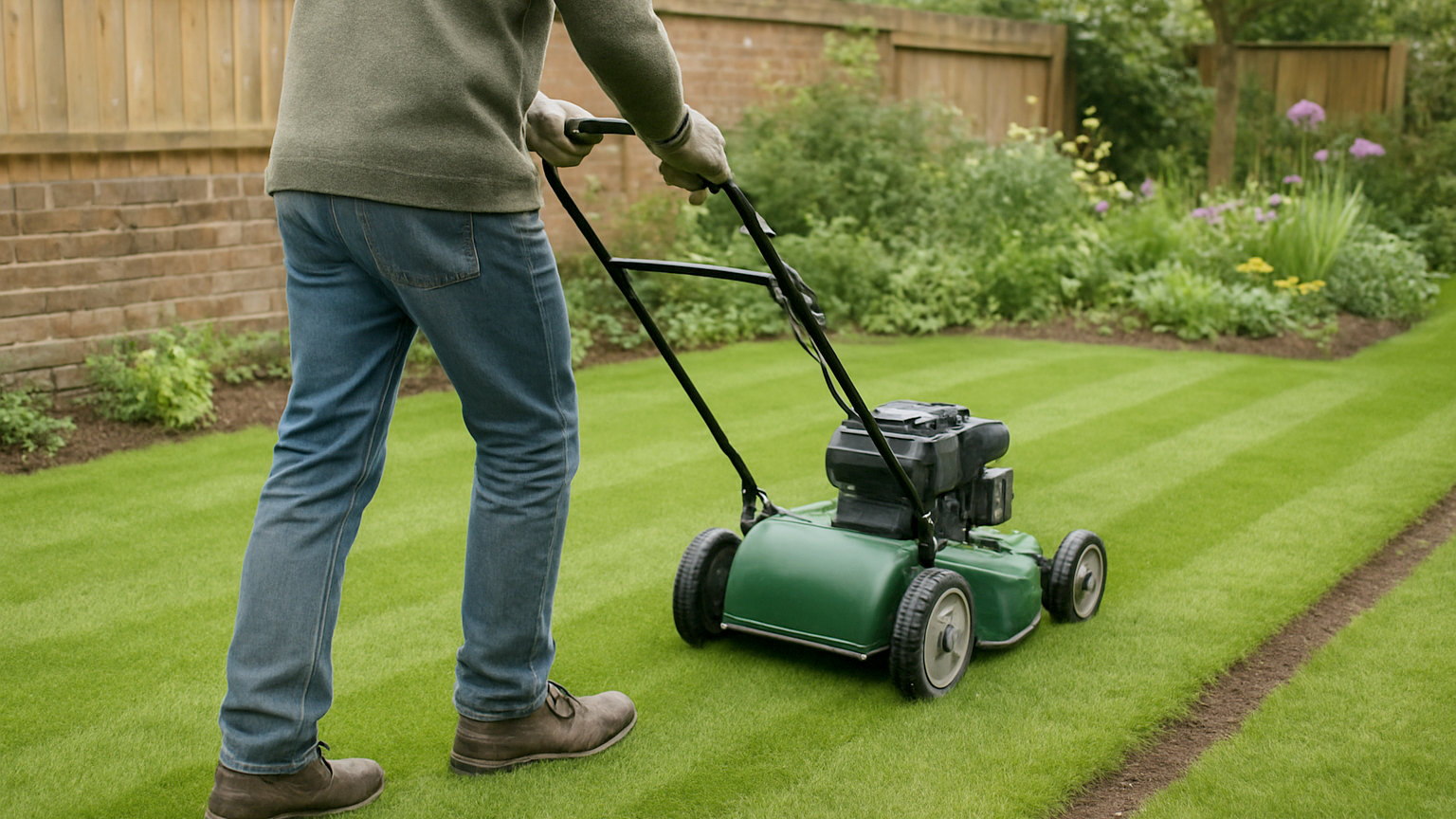
Mowing the same way every week produces two problems that build up slowly and are easy to avoid: the grass starts to lean permanently in one direction, and the wheels wear tracks into the same lines.
Why direction matters
Grass leans away from the direction of travel, pushed over by the mower. Cutting the same way every time makes that lean permanent, which is known as grain.
Grained grass is cut less cleanly, since the blades are already lying down when the mower reaches them, and the lawn develops a directional sheen rather than an even colour.
The wheels also compact two lines across the lawn week after week, producing visible tracks and, over time, genuine compaction that shows as thinner grass and more moss.
Vary it each cut
Change the direction every time you mow. The simplest system is to rotate between four directions.
Mow north to south one week, east to west the next, then one diagonal, then the other. Over a month the grass is cut from every angle and no lean develops.
Alternatively simply alternate between two perpendicular directions, which addresses most of the problem with less thought.
Vary the exact line of the wheels each time too, even when using the same overall direction.
Working efficiently
Mow the perimeter first, making one or two circuits around the edge of the lawn. This gives a headland to turn on and means you are not reversing into a border.
Then mow the main area in straight parallel runs, overlapping each pass by a few centimetres so no uncut strips are left.
Turn on the headland rather than pivoting on the grass, since turning a wheeled mower sharply on turf tears it, particularly when wet.
Work away from the socket with a corded machine so the cable trails behind, and keep it over your shoulder.
Stripes
The light and dark bands come from the grass being flattened in alternating directions by a rear roller, which reflects light differently.
Only a mower with a rear roller produces them, which usually means a cylinder mower or a rotary machine specifically fitted with one.
Straight stripes need a fixed point to aim at rather than watching the mower, exactly as with ploughing. Pick something at the far end and walk towards it.
Alternating stripe direction week to week is still worth doing, even though it means the pattern shifts.
Large lawns
Plan the route before starting rather than working it out as you go, particularly with a machine that has a limited run time.
Divide a large area into sections and complete one at a time, which makes the job feel manageable and lets you stop cleanly.
Empty the grass box before it is completely full, since an overfull box stops the machine cutting properly and leaves rows of clippings.
Awkward shapes
Mow the fiddly parts first, around trees, beds and obstacles, then do the open area in straight runs. Doing it the other way round means walking back over cut grass.
On a lawn with curved edges, follow the curve for the perimeter circuits and mow straight lines in the middle.
Slopes
With a walk-behind mower, mow across the slope rather than up and down. If you slip going downhill the machine continues towards you.
With a ride-on the advice reverses: mow up and down, since a ride-on can tip sideways.
Do not mow a wet slope, and use a hover mower or a strimmer on anything steep.
What it adds up to
Varying direction, turning on a headland rather than on the grass, overlapping passes properly and emptying the box before it fills are all small habits.
Together they produce a noticeably better lawn than the same machine used carelessly, at no extra cost in time.
Keeping a record
For anyone who wants to be systematic, noting the direction used each week takes seconds and removes the guesswork about which way to go next.
In practice, simply looking at the lawn before starting and choosing a different angle from the visible lines works perfectly well.
New lawns
Vary the direction from the very first cut on new turf or seed, and turn especially carefully, since unrooted turf tears easily and young grass pulls out.


