
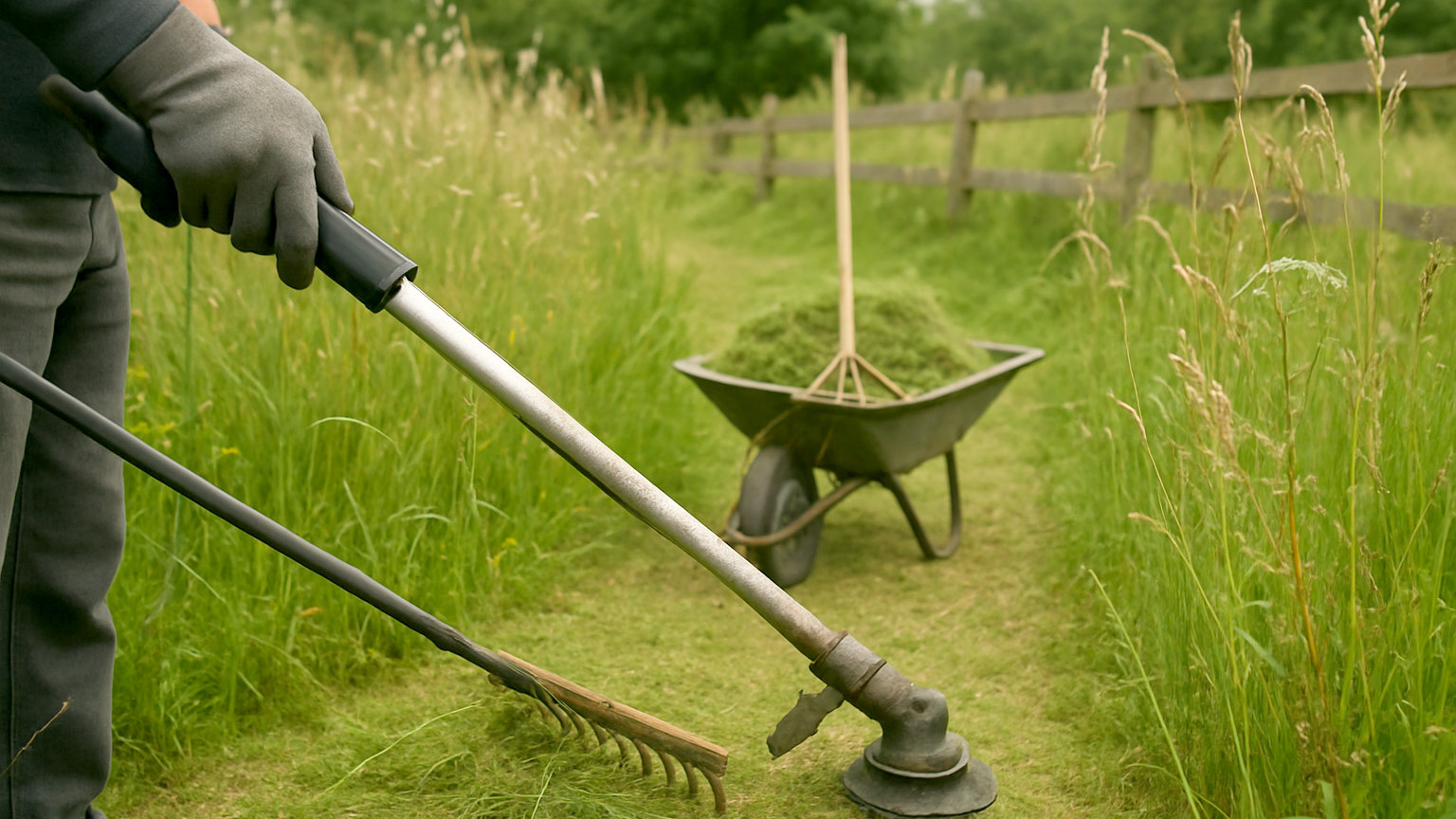
Leaving part of a lawn to grow long is the single easiest change most gardens can make for wildlife. It also needs managing, and an area that is simply abandoned becomes rank grass, brambles and docks within a few years.
Why the cuttings must be removed
The whole object is to reduce fertility. Wildflowers thrive on poor soil, and vigorous grasses dominate rich soil and smother everything else.
Leaving cuttings on the ground returns their nutrients and defeats the purpose. Removing them takes fertility out of the system, and over several years the balance shifts from grass towards flowers.
Leave the cuttings lying for a few days first, so seed drops back into the sward, then rake them off and compost them elsewhere.
This is the difference between a meadow that improves each year and one that becomes coarse grass.
When to cut
The standard regime is one main cut in late summer, from late July through September, after the flowers have set seed.
A second cut in autumn, around October, keeps the sward in check and is worth doing where growth is vigorous.
Some meadows also benefit from a cut in early spring, around March, before growth restarts, particularly where the grass is strong.
For an area of spring bulbs in grass, do not cut until at least six weeks after flowering, which usually means mid to late June.
No Mow May and beyond
Leaving grass uncut through May lets dandelions, clover, daisies and self-heal flower, providing nectar at a point when many pollinators need it.
Leaving it longer, into July or August, is considerably more valuable still, since it allows plants to set seed and gives insects a full breeding cycle.
A useful compromise is a mown path through longer grass, or short grass where the area is used and long grass where it is not. Both look deliberate rather than neglected, which matters in a front garden.
Check for wildlife first
Long grass is exactly where hedgehogs, frogs, toads, slow worms and nesting birds are.
Walk the area first and check. Cut from the centre outwards, or steadily in one direction, so animals have a route away rather than being driven into a shrinking island.
Hedgehogs curl up rather than fleeing, which makes them particularly vulnerable to a strimmer or a mower in long grass.
Avoid cutting between March and August where birds may be nesting, which is why the main cut falls in late summer.
Cutting in sections over a few weeks, rather than the whole area at once, leaves refuge throughout.
Equipment
A rotary mower on its highest setting handles grass up to about fifteen centimetres, taken in stages.
A strimmer or brushcutter deals with anything longer and is the usual tool for a meadow area. Work in a steady arc and rake up afterwards.
A scythe is genuinely effective for a larger area, quiet, and leaves the cut material lying neatly for raking. It needs sharpening frequently and some practice.
For a large area, a powered scythe or a flail mower can be hired.
Cutting in stages
Where grass is very long, cut it high first, rake off the material, then cut lower a week later. Cutting knee-high grass straight down to the ground leaves a thick mat that smothers everything beneath it.
Improving the area over time
Introduce yellow rattle, sown in autumn onto scarified bare patches. It is semi-parasitic on grass and weakens it, giving flowers room, and it is the single most effective addition to an established grass area.
Plug-plant perennials such as cowslip, knapweed, oxeye daisy and bird's-foot trefoil, which establish better than seed into existing grass.
Do not feed the area at all, and never apply lawn fertiliser anywhere near it, since even drift raises fertility and favours the grass.
What to expect
Three years before it looks like much, and steady improvement after that as fertility falls.
Expect coarse grasses, docks, nettles and thistles in the early years, which are best dug out individually rather than sprayed.
The area will look untidy in high summer just before the cut. A mown edge or a path around it makes the difference between reading as a meadow and reading as neglect.


