
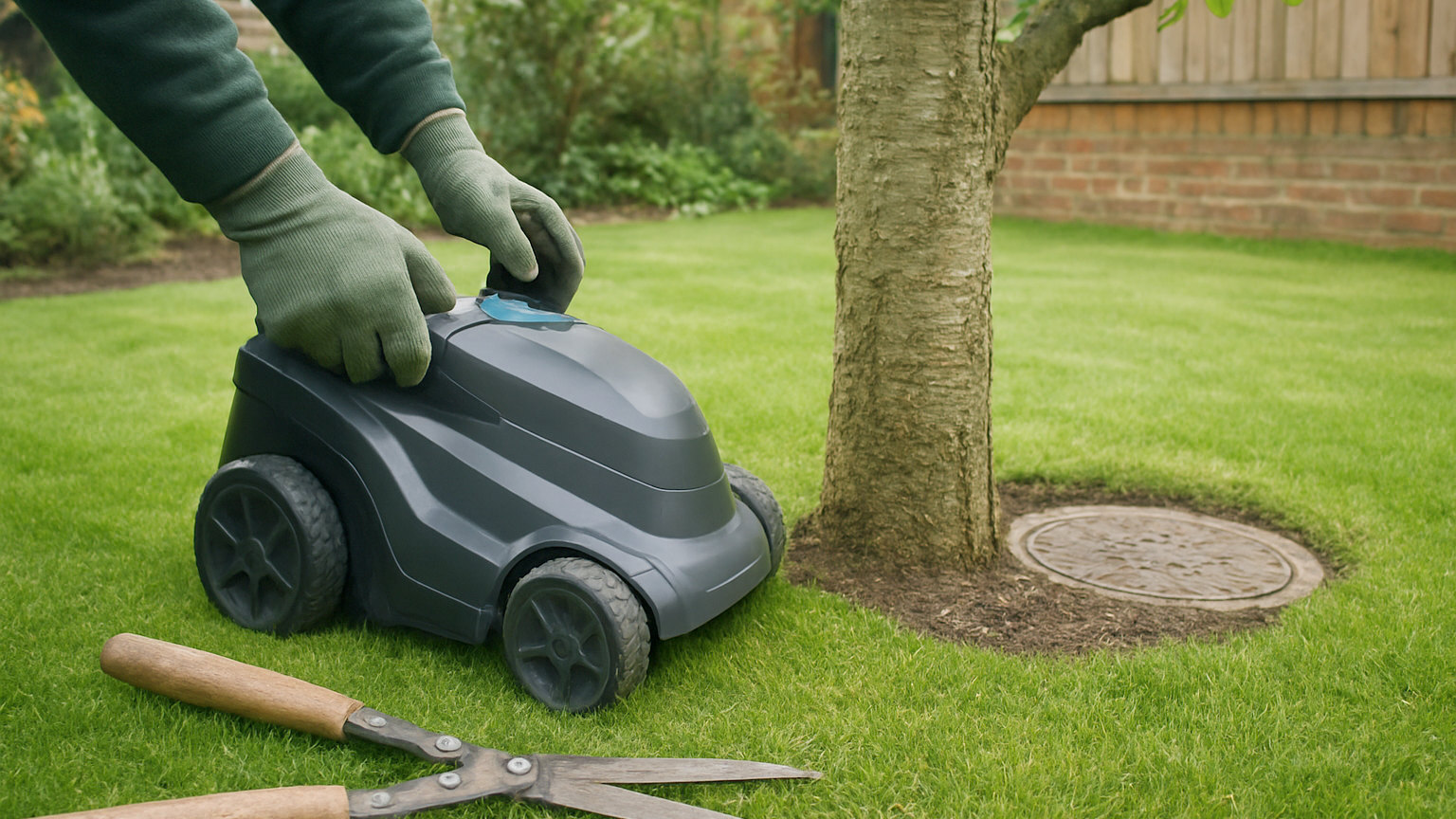
Obstacles in a lawn are where the time goes. Each tree, post, washing line and rotary drier requires slowing down, changing direction and usually a second pass with a strimmer, every week for as long as the lawn exists.
Deal with it once rather than weekly
Most obstacle problems are better solved by changing the garden than by improving the technique.
A morning's work removing an awkward feature saves ten minutes a week for twenty years, which is a considerable return.
Trees in a lawn
Keep a mulched circle at least a metre across around every tree.
This does three things. It removes the need to mow or strim near the trunk, which is what causes fatal bark damage. It removes grass competition, which slows young trees considerably. And it looks better than a ragged collar of long grass.
Edge the circle cleanly, mulch with bark or compost keeping it clear of the trunk itself, and top it up annually.
Enlarge the circle as the tree grows. Under an established tree, extending it to a proper bed with shade-tolerant planting is usually a better use of the space than struggling to grow grass there.
Posts, poles and driers
Set a paving slab or a ring of bricks flush with the lawn around the base of anything permanent: a rotary drier socket, a washing line post, a bird table, a lamp post.
The mower then runs over it and no trimming is needed.
Consider whether the feature needs to be in the lawn at all. A rotary drier on a small paved area, or a washing line running from the wall of the house, causes no mowing difficulty.
Manhole and inspection covers
Covers set slightly below the grass surface catch the mower and are dangerous to run over.
Recessed covers can be filled with turf or paving so the surface is continuous. Otherwise, set a slab flush around the cover and mow over it.
Never allow a cover to become invisible under long grass, since it must remain accessible and someone will eventually stand on it.
Beds and borders
A mowing strip of bricks or paving set flush along the edge of a border lets the mower run right to the edge, removing the need for a separate edging pass.
It also stops plants flopping onto the grass and killing it, and stops the lawn creeping into the bed.
Set the strip slightly below the grass surface so the mower does not scalp against it, and bed the units on mortar.
Simplify the shape
Fussy outlines, narrow strips and tight corners cost time at every cut.
The test is whether the mower can follow the edge without repeated reversing. If it cannot, the shape is wrong.
Turn narrow awkward strips into border or paving, round off tight corners, and replace tight wiggles with gentle sweeping curves. The garden usually looks better as well as being quicker to maintain.
Stepping stones and paths
Stepping stones set flush with the lawn surface can be mown straight over. Set proud, they damage the blade and stop the mower.
Check them each spring, since they settle and lift over time.
Technique for what remains
Mow around the obstacles first, then do the open area in straight runs. Doing it the other way round means walking back over cut grass.
Make one circuit around each obstacle before starting the main runs, which gives space to turn.
Turn on the cut headland rather than pivoting on uncut turf, which tears it.
Use a strimmer for the final trim rather than forcing the mower into a space it does not fit, and keep the strimmer well away from bark, cables and pipes.
Slopes and banks
A steep bank in a lawn is a permanent awkwardness and a safety risk.
Consider planting it with ground cover or shrubs instead, which removes the mowing entirely and holds the soil better than grass does.
Where the bank must stay as grass, mow across it rather than up and down with a walk-behind machine, and never mow it when wet.
Thinking ahead
When planting a new tree or installing anything permanent in a lawn, decide at the outset how the mower will get around it.
A mulched circle or a flush paved collar put in at the start costs almost nothing and removes an awkward job permanently.


