
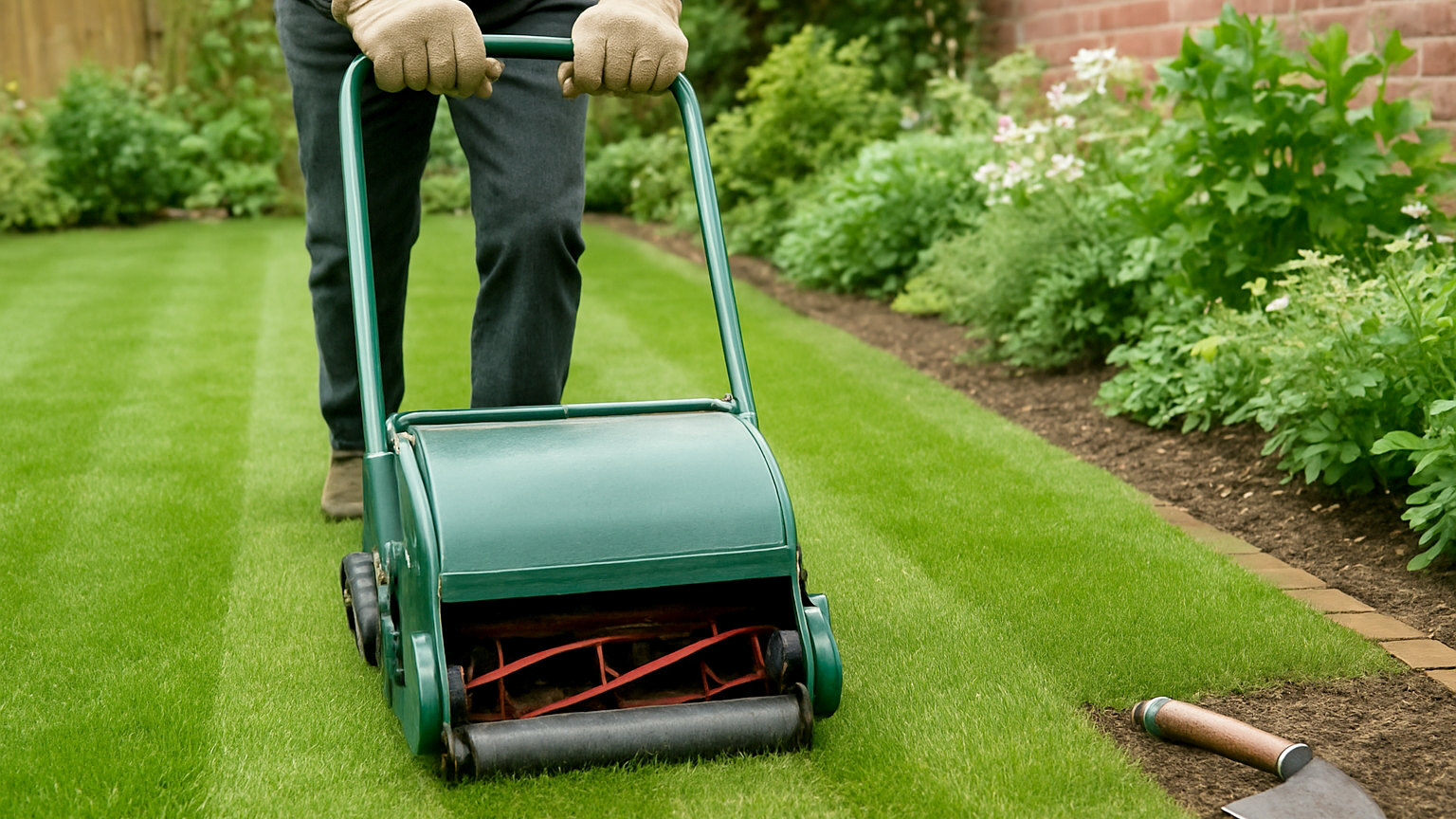
Lawn stripes are an optical effect rather than a difference in the grass. Blades bent away from you reflect light and look pale; blades bent towards you look dark. That is the whole mechanism, and it explains why you need a specific kind of mower and why the effect vanishes if you look from the other end of the garden.
You need a roller
The bending is done by a rear roller, a smooth cylinder that flattens the grass in the direction of travel as the mower passes.
Cylinder mowers with a rear roller give the crispest stripes and the finest cut. Rotary mowers with a roller instead of rear wheels produce good stripes and handle longer grass more easily. Hover mowers and standard four-wheeled rotaries will not stripe at all, since there is nothing to bend the grass consistently.
Roller kits are available for some rotary mowers and work reasonably well.
Getting the first line straight
The whole pattern depends on the first pass, and a wobble in it repeats across the entire lawn. Mow one edge of the lawn first as a headland, then set up your first straight run along the longest side.
Pick a fixed point at the far end and walk towards it, looking at that point rather than at the mower. Watching the mower is what produces curves. If you need help, run a taut string line down the lawn for the first pass.
Every subsequent pass simply follows the previous one, overlapping the wheel or roller mark by a few centimetres so no uncut strip is left.
Mowing the pattern
Work up and down in alternate directions. Each pass bends the grass the opposite way to the one beside it, which is what creates the alternating light and dark bands.
Turn on the headland at each end rather than in the middle of the lawn, and mow the headland again at the end to tidy the turning marks.
For a chequerboard, mow the whole lawn in one direction, then mow it again at ninety degrees. For diamonds, mow diagonally and then diagonally the other way. Both take twice as long and put twice the traffic on the lawn, so keep them for occasions rather than every week.
What makes stripes show up better
Longer grass stripes more clearly than short, since there is more leaf to bend. Somewhere around thirty millimetres shows the effect well.
Broad-leaved ryegrass takes a stripe better than fine fescues, which is why sports pitches stripe so dramatically. A healthy, dense lawn stripes better than a thin one, because the effect depends on a mass of leaves all lying the same way.
Stripes are most visible looking along their length and from a slight height, which is why they read best from an upstairs window.
Edging, which does more than the stripes
A crisp edge does more for the appearance of a lawn than any pattern. Cut a defined edge once a year in spring with a half-moon edging iron, using a plank as a straight guide or a hosepipe laid out for curves.
Cut vertically to about seven centimetres deep, creating a clean shoulder between lawn and border. Through the season, trim the vertical face with long-handled edging shears after mowing, and remove the trimmings.
A gravel or brick mowing strip set flush with the lawn removes the job altogether, since you can run the mower straight over it.
Keeping it up
Vary the direction of the stripes each week, running them at ninety degrees to last week's, even though the pattern is the same. Mowing in exactly the same lines every time makes grass lean permanently and creates wheel ruts.
Keep the blade sharp, since a ragged cut spoils the finish, and keep the roller clean so it does not pick up and smear wet clippings.
Stripes on a rough lawn
Uneven ground defeats striping, because a roller cannot bend grass consistently across bumps and hollows. If the lawn undulates, top dressing over two or three autumns to level it gradually will do more for the finish than any change of mower.
A note of proportion
Striping requires frequent mowing at a low-ish height on a dense, ryegrass-heavy lawn, which means more water, more feed and more work than a relaxed lawn needs. It is a legitimate thing to want, and worth being aware that it is a choice with a maintenance cost attached rather than simply a way of mowing.


