
The two cuts at the ends of the season are the ones most often got wrong, and both errors cause problems that show up months later.
When to start in spring
Go by the grass rather than the calendar. Grass starts growing when soil temperatures reach about six degrees, which in most of Britain is somewhere in March, and earlier in a mild year or a mild region.
Wait until the lawn is dry enough to walk on without leaving footprints. Mowing saturated ground compacts it and tears the turf.
There is no advantage in being first. A lawn cut too early, too low, in cold wet conditions, is set back for weeks.
The first cut: take almost nothing off
Set the mower to its highest setting and take only the tips off.
The grass has not been cut for months and has a leaf area adapted to that. Removing most of it in one go shocks the plant badly, exposes the base to cold, and produces a yellow lawn that takes a month to recover.
Use a sharp blade. Early growth is soft and a blunt blade tears it.
Collect the clippings from the first few cuts, since the grass is growing slowly and the clippings sit on the surface rather than breaking down.
Lower the height gradually over the following four or five cuts, taking a little more each time, until you reach your summer setting by about May.
Before that first cut
Rake off any accumulated leaves and debris, which have been excluding light all winter.
Brush off worm casts on a dry day rather than treading them in.
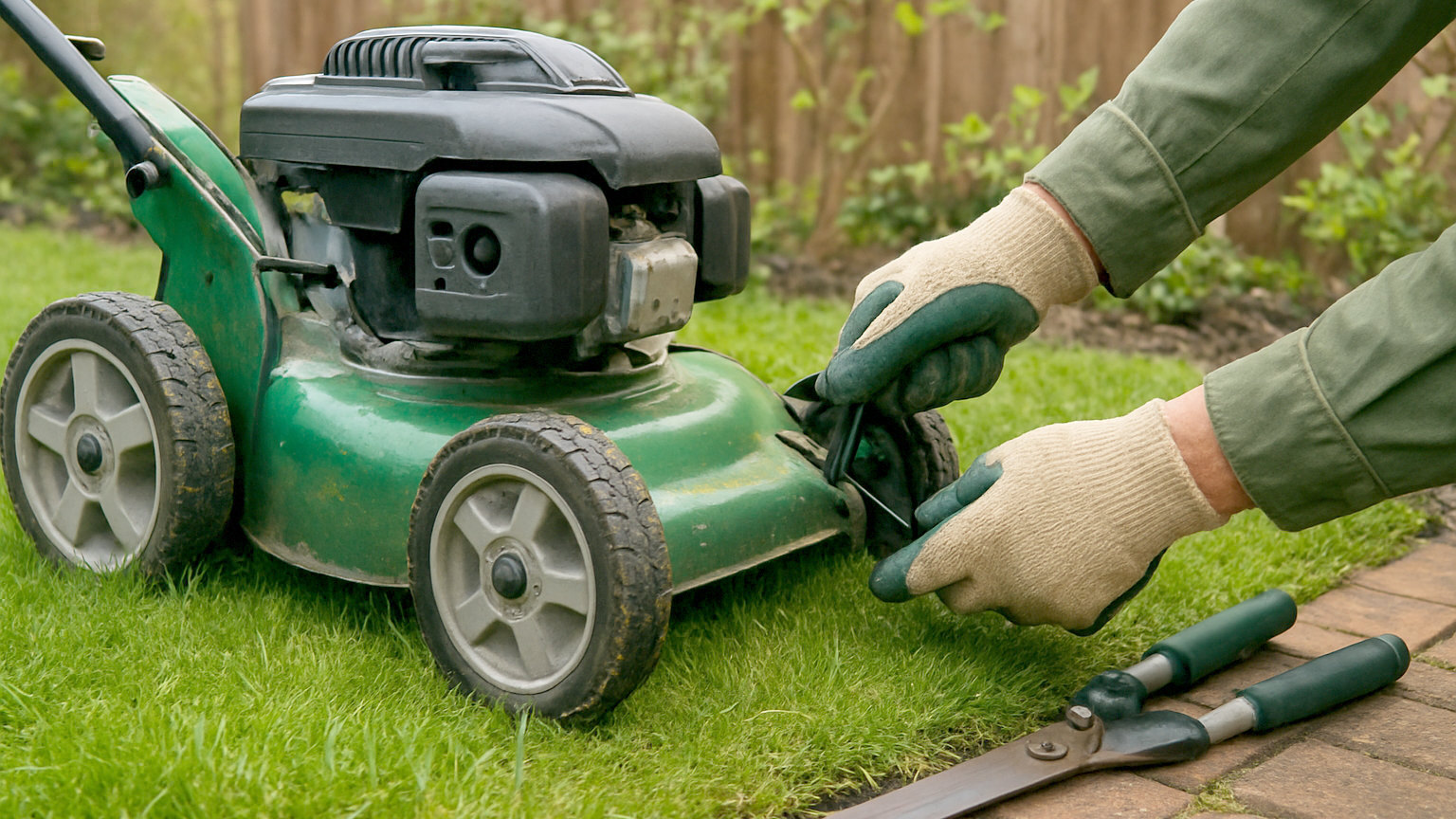
Check the mower is serviced and the blade is sharp. February is the time to do this, not the morning of the first dry Saturday in March when everyone else is at the repair shop.
Through the season
Increase to weekly mowing through the main growing period of May and June, and follow the rule of never removing more than a third of the leaf length in any one cut.
Raise the height in July and August, and stop entirely during a drought.
The last cut in autumn
Growth slows through October and usually stops around November, though in a mild winter it continues intermittently.
Reduce the frequency as growth slows rather than continuing weekly out of habit.
Raise the cutting height for the last few cuts and leave the grass longer than usual over winter, around fifty millimetres.
Longer grass protects the crowns from frost, gives more leaf area to work with during mild winter spells, and is more resilient to wear. Grass cut short going into winter is more prone to disease and slower to recover in spring.
Do not leave it excessively long either, since long grass flattens under wet snow and encourages fusarium patch over winter.
Around fifty millimetres is the target for the final cut on most lawns.
Winter mowing
Occasional topping in a mild winter does no harm and is worth doing if the grass has grown noticeably.
Only mow when the ground is firm and dry, the grass is dry, and there is no frost. Set the blade high and take very little off.
Never mow or walk on frosted grass. The frozen blades break, leaving black damaged footprints that remain visible for weeks.
Never mow waterlogged ground, which compacts it and does damage that takes a season to correct.
Clearing leaves
The most important autumn lawn job. Leaves left lying block light, hold moisture and encourage disease, and a week of neglect in a windy autumn does real damage.
A rotary mower with the box on collects leaves efficiently and shreds them at the same time, which makes excellent leaf mould and rots down far faster than whole leaves.
The pattern to remember
High in spring, lowering gradually. Regular through May and June. High again in summer heat. High again for the last cuts of autumn.
The low setting belongs to late spring and early summer only, and even then only on a lawn with the grass mixture and the level surface to take it.
A family lawn on ryegrass is better at forty millimetres all year than at twenty-five, and cutting lower does not make it finer, only thinner.


