
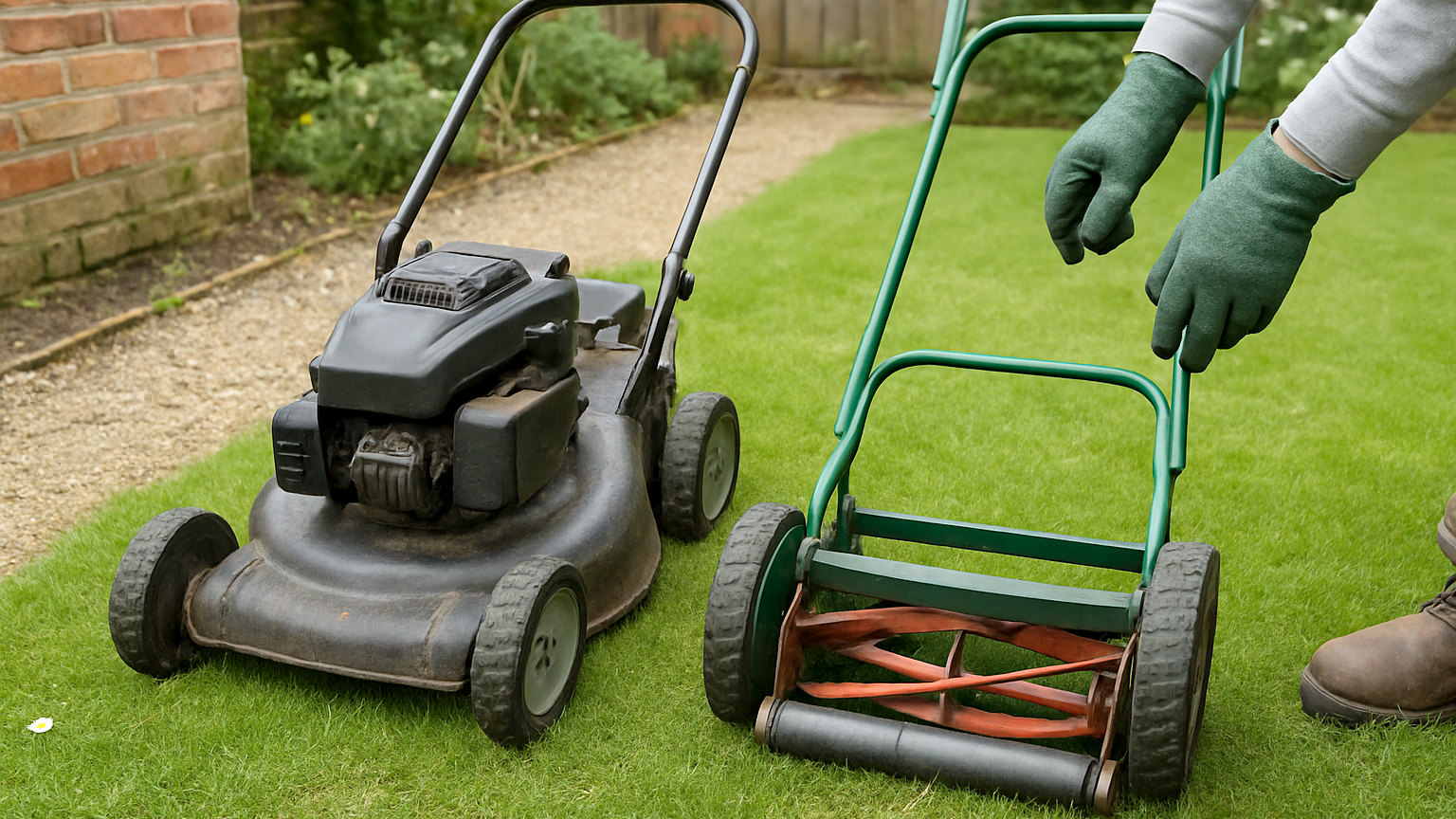
A mower that is wrong for the lawn turns a twenty-minute job into an hour of frustration every week for a decade. The decision comes down to three things: the size of the lawn, the terrain, and how fine a finish you want.
Start with the area
Measure the lawn rather than guessing, since areas are consistently underestimated.
As a rough guide, up to about a hundred square metres suits a cutting width of thirty to thirty-five centimetres. Up to five hundred wants forty to forty-five. Beyond that, look at fifty centimetres or more, and beyond about a thousand square metres a ride-on becomes worth considering.
Buying too small for the area is the commonest mistake. A narrow deck means more passes, more time and more turning, and the machine works harder than it was designed to.
Buying too large is also a real problem in a small garden, since a wide heavy mower cannot turn in a confined space or reach between borders.
Terrain
A flat, level, obstacle-free lawn suits almost anything.
Slopes need self-propulsion on anything but a small area, since pushing a mower uphill repeatedly is genuinely hard work. Rear-wheel drive gives better traction on a slope than front-wheel.
Rough or uneven ground suits a rotary mower with large rear wheels, which ride over bumps rather than scalping them.
Long grass and orchard areas need a robust rotary machine or a brushcutter rather than a fine-finish mower.
How fine a finish
A rotary mower produces a perfectly good lawn for almost every domestic situation.
A cylinder mower produces a markedly finer cut and proper stripes, and it demands a level lawn, a fine grass mixture and regular mowing. It is the choice only if the appearance genuinely matters to you.
Collection
A grass box is convenient and adds weight and bulk, and it needs emptying frequently, which on a large lawn is most of the work.
Mulching mowers chop the clippings finely and drop them back into the sward, which returns nitrogen and moisture and eliminates emptying. They work best when the grass is cut regularly and is dry.
Many machines offer both, with a mulching plug that blocks the discharge. That flexibility is worth having.
Consider where the clippings will go. A large lawn with a collection box generates a considerable volume of material every week.
Deck material
Plastic or polypropylene decks are light, cheap, do not rust and are perfectly adequate for a domestic lawn.
Steel decks are more durable and heavier, and they rust if not cleaned. Aluminium combines durability with light weight at a higher price.
For most gardens the deck material matters less than build quality generally.
Height adjustment
A single lever adjusting all four wheels together is far more convenient than four separate adjusters, and you will use it far more often as a result.
Check the range of heights available. Many cheaper machines do not cut above about fifty millimetres, which is a genuine limitation in summer and in shade, where mowing high is the single most useful thing you can do.
Practical points
Check the weight if you have to lift it, carry it up steps or store it on a shelf.
Check whether the handles fold and how much storage space it needs.
Look at the availability of blades and spares for the model, since a machine you cannot get a replacement blade for is a machine you will be replacing early.
Try pushing one in the shop if you can. Balance and handle height matter more than specifications suggest.
What to prioritise
For most gardens: a rotary mower of an appropriate width, a good height range including a high setting, single-lever adjustment, and both collection and mulching options.
Spend the money on build quality and cutting width rather than on features. A well-made simple machine outlasts a cheap complicated one by many years.
Second hand
A good used petrol mower from a reputable dealer, serviced and with a warranty, is frequently better value than a new budget machine.
Check the deck for rust and cracks, the blade for damage, and start it from cold before buying. Avoid anything for which spares are no longer available, however cheap it is.


