
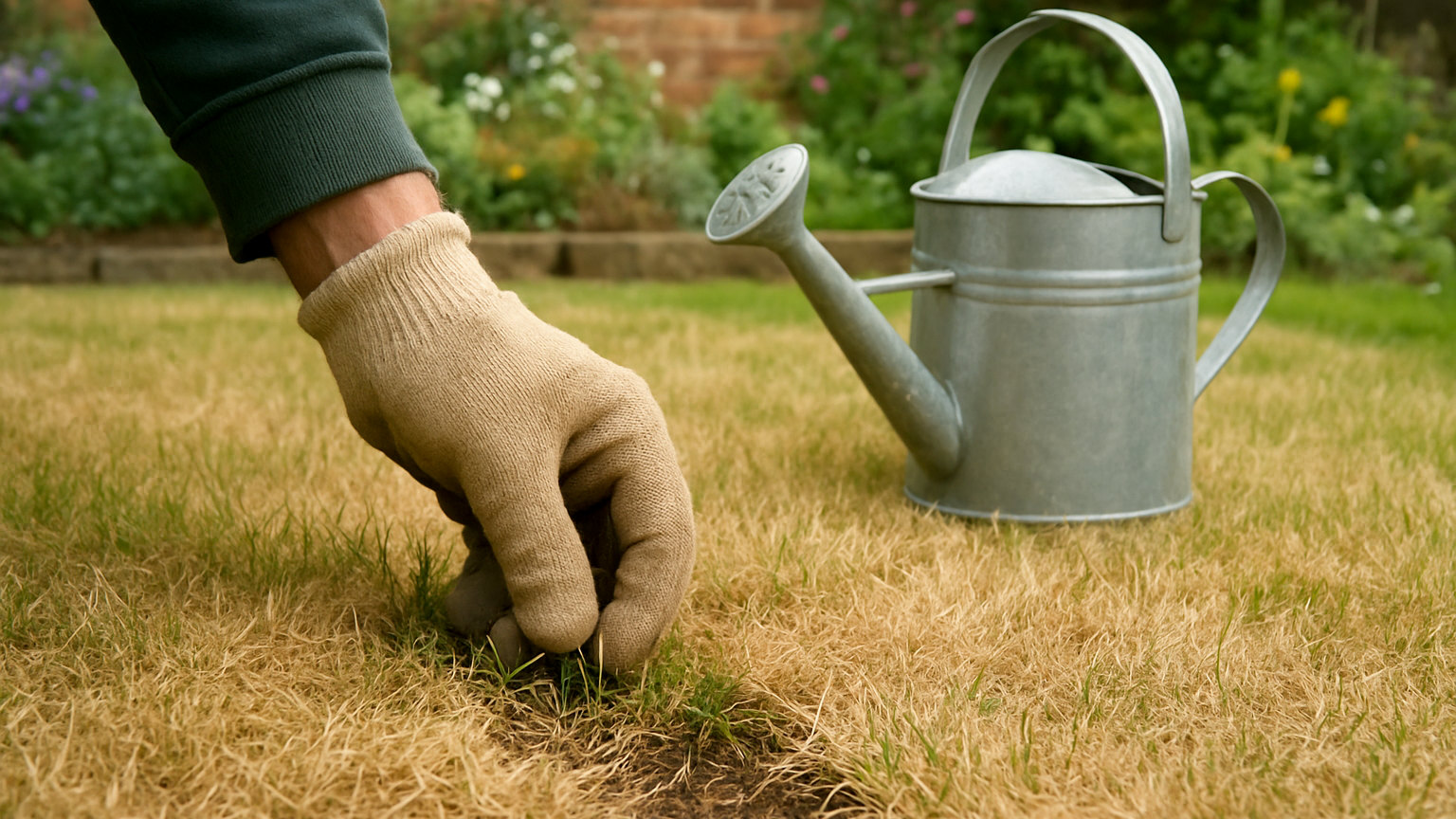
A brown lawn in August looks alarming and is almost always fine. Established grass responds to drought by going dormant, shutting down the top growth to protect the crown, and it recovers within a fortnight of decent rain.
Dormant, not dead
Grass browning off in summer is a survival mechanism rather than a sign of death. The plant withdraws resources into the crown and the roots and waits.
Established lawns tolerate several weeks of drought this way and green up rapidly once rain returns. Recovery is usually complete within two or three weeks.
This is why watering an established lawn is among the least useful things you can do with water in a garden.
Why not to water
A lawn takes an enormous quantity of water to keep green, far more than any other part of a garden, for a purely cosmetic result.
Light watering is actively harmful. It wets only the top few centimetres, encourages roots to grow upwards into the layer that dries first, and leaves the lawn less drought tolerant than if you had left it alone.
Water is far better spent on newly planted trees and shrubs, containers and food crops, all of which cannot recover from drought the way grass can.
What to do instead
Raise the mowing height. This is the single most effective thing. Cutting at fifty millimetres or more rather than twenty-five shades the soil, retains moisture and produces deeper roots.
Stop mowing altogether once growth has stopped. Cutting grass that is not growing stresses it further and removes the leaf area it needs.
Leave the clippings on the lawn, which returns moisture and nitrogen and shades the surface.
Do not feed during a drought. Fertiliser applied to a lawn that cannot take up water scorches it.
Keep traffic off a drought-stressed lawn, since worn areas recover far more slowly.
When watering is worth it
Newly sown or newly turfed lawns, which have no established root system and will genuinely die. These must be watered.
Areas repaired or overseeded within the last few months.
A fine ornamental lawn where the appearance is the point and you have accepted the maintenance that goes with it.
How to water if you do
Thoroughly and infrequently, aiming to wet the soil to a depth of ten to fifteen centimetres, which usually means the equivalent of about two centimetres of rainfall in one application.
Check by pushing a screwdriver into the ground afterwards. If it goes in easily to fifteen centimetres, the water has reached where it needs to.
Water in the early morning, which loses least to evaporation and lets the grass dry before nightfall. Evening watering leaves the surface damp overnight and encourages disease.
Once a week is ample. Daily light watering is worse than nothing.
Hosepipe bans
Restrictions usually prohibit using a hosepipe or sprinkler on a lawn, and a lawn should be the first thing you stop watering in any case.
Grey water from washing up or a bath can be used on ornamental plants provided it is free of bleach and strong detergent, and is better spent on shrubs and containers than on grass.
Water butts on every downpipe are worth fitting and should be reserved for plants that need it.
Recovery
Once rain returns, the lawn greens up on its own. Resist the urge to feed immediately, and wait until growth has visibly restarted.
Autumn is the time to make good any damage: scarify, aerate, top dress and overseed any areas that have genuinely died rather than gone dormant.
Areas that stay brown after three weeks of rain are dead rather than dormant and need reseeding.
Reducing the problem
Deeper rooting is what makes a lawn drought tolerant, and that comes from mowing high, aerating annually and top dressing to improve the soil.
Grass mixtures containing fescues and clover stay green considerably longer in dry weather than pure ryegrass, and are worth choosing on light soil or in a dry area.
Accepting a brown lawn for a few weeks each summer is an entirely reasonable position, and the alternative uses a great deal of water for appearance alone.
Many gardens now do exactly this, and a lawn that browns in August and greens in September is behaving normally rather than failing.


