
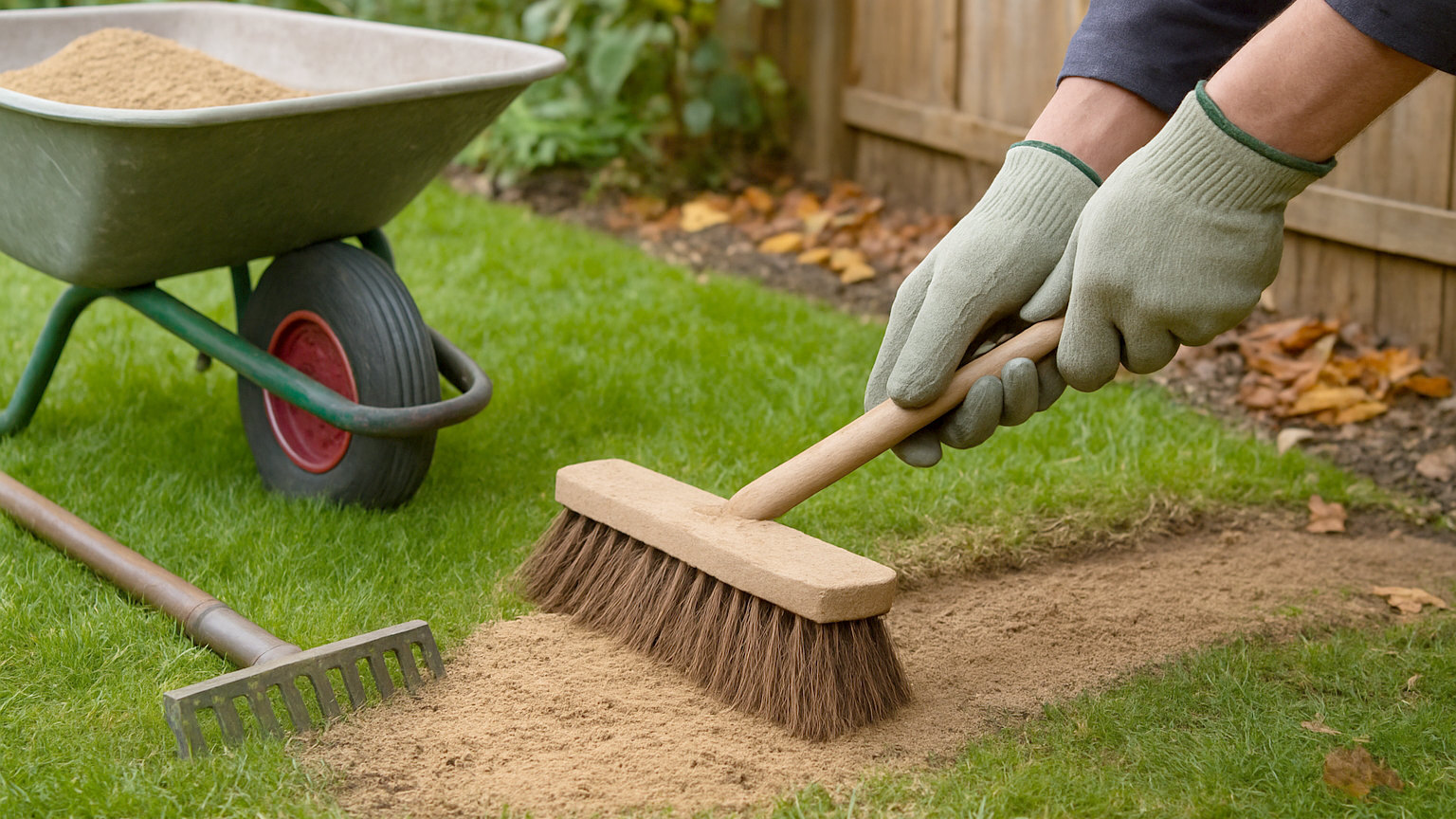
Top dressing is spreading a thin layer of sandy loam over a lawn and brushing it into the surface. It is the least glamorous lawn job and it does more for the soil beneath than anything else you can do.
What it achieves
It improves the soil profile gradually, adding sand to heavy ground for drainage or loam to sandy ground for water retention.
It fills the holes left by aeration, which is what makes that job worthwhile rather than temporary.
It levels minor hollows a few millimetres at a time, over several seasons.
It encourages new shoots from the base of the grass plants, thickening the sward, and it improves the surface for mowing.
When to do it
Early autumn, from late August through September, immediately after scarifying and aerating. That sequence is the point: the dressing fills the holes you have just made.
Spring is an acceptable alternative, in April, though autumn is better since the grass has time to grow through before winter.
Do it when the grass is dry and growing actively, and never on wet or frozen ground.
What to use
The standard is a sandy loam mixture, often quoted as roughly six parts sand, three parts loam or topsoil and one part compost.
Match the mixture to your soil. On heavy clay, use a higher proportion of sand to improve drainage. On light sandy soil, use more loam and compost to increase water retention.
Use horticultural or washed sharp sand, never builders' sand, which is too fine and contains salts.
Ready-mixed lawn top dressing is sold in bags and is convenient for a small lawn. For anything larger, buying the components in bulk is far cheaper.
The material must be dry, or it will not brush in and will smother the grass instead.
How much
About two to three kilograms per square metre, which produces a layer of only a few millimetres.
The one rule is that the grass tips must remain visible. A dressing thick enough to bury the grass smothers it and kills the lawn.
If you are levelling hollows, resist the temptation to fill them in one application. Never apply more than about a centimetre in any single dressing, and repeat annually until the level is right.
Applying it
Mow the lawn slightly shorter than usual a few days beforehand, and scarify and aerate first.
Tip the dressing out in small heaps across the lawn rather than one large pile, and spread it roughly with the back of a rake or a spade.
Then work it into the surface with a stiff brush, a besom or the back of a rake, moving in several directions until it disappears into the sward and the grass is showing through.
The lawn looks dreadful for a fortnight and then looks better than before. That is normal.
Afterwards
Overseed at the same time if the lawn is thin, since the dressing provides ideal conditions for seed to reach soil.
Apply an autumn feed, which is high in potassium and low in nitrogen.
Water if the weather is dry, and keep traffic off for a couple of weeks while the grass grows through.
Doing it annually
The benefit is cumulative. A single top dressing makes a modest difference; doing it every autumn for five years transforms the soil profile of a lawn on heavy clay.
Combined with annual aeration and scarifying, it is the core of proper lawn care and does more than any amount of feeding.
What it will not fix
Serious undulations, which need the turf lifting and the soil beneath adjusting.
Deep shade, waterlogging from a drainage problem, or a lawn that is simply the wrong grass mixture for how it is used.
Doing it on a small lawn
For anything under about fifty square metres, bagged top dressing and a stiff brush are entirely adequate and the whole job takes an afternoon.
Larger areas justify buying the components loose and mixing them, and a drag mat or a levelling lute speeds the brushing in considerably.
Worm casts
Worms bring soil to the surface as casts, which is a natural top dressing and a sign of healthy soil. Brush them off on a dry day rather than treading them in, since flattened casts smother grass and provide a seedbed for weeds.
Worms are doing much the same job as top dressing, and a lawn with plenty of them needs less help.


