
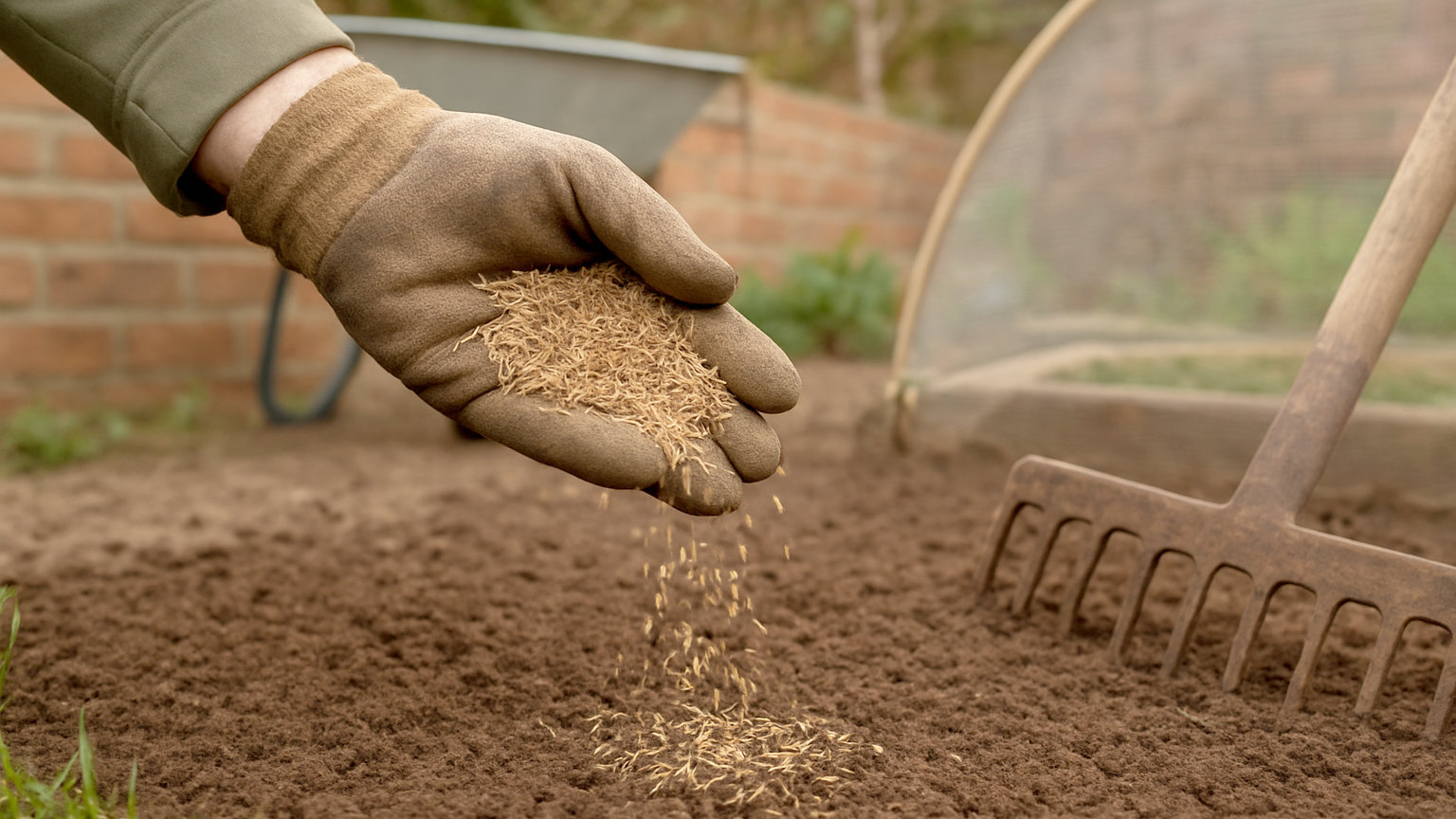
Seed costs perhaps a tenth of what turf costs for the same area, offers a far wider choice of grass mixtures, and produces a lawn better suited to your conditions. The trade is that it takes a season rather than a month.
When to sow
September is the best month by a clear margin. The soil is still warm from summer, autumn rain is reliable, and grass seed germinates quickly without competing against summer weeds or drying out.
April and May are the second choice, and a spring-sown lawn needs watering through its first summer.
Do not sow in midsummer, which requires constant watering, or when soil temperatures are below about eight degrees, since the seed will simply sit there.
Preparing the seedbed
The same preparation as for turf, and it matters just as much.
Clear all vegetation and every perennial weed root. Dig or rotavate to about twenty centimetres, removing stones, and incorporate compost if the soil is poor.
Rake level, then firm the whole area by treading on your heels in overlapping passes. Rake again, and repeat until the surface is even and firm.
Break the surface down to a fine crumbly tilth, since grass seed is small and cannot push through clods.
Leave the prepared ground for two or three weeks if you can. A flush of weed seed will germinate and can be hoed off before you sow, which saves a great deal of weeding later.
Sowing rate
Around thirty-five to fifty grams per square metre for a new lawn, following the rate on the pack.
Sowing more heavily does not produce a better lawn. Overcrowded seedlings compete, grow thin and are more prone to disease.
Mark the area into square metres with canes and string, and weigh out the correct quantity for each. Judging by eye produces thick patches and bare ones.
Sowing evenly
Sow half the quantity walking in one direction and the other half at right angles. That crosswise pattern evens out any inconsistency.
A wheeled spreader is worth hiring or borrowing for a large area.
Rake very lightly afterwards so the seed is in contact with the soil rather than sitting on top, and firm gently with the back of the rake or a light roller.
Do not bury the seed deeply, which prevents germination.
Birds
Birds take a great deal of newly sown grass seed, and a freshly raked bed is an obvious invitation.
Crisscross the area with string a few centimetres above the surface, or cover with netting until germination.
Some seed is sold pre-treated with a bird deterrent, which helps.
Watering
Keep the surface consistently moist until the grass is established, which is the opposite of the advice for an established lawn.
Newly sown seed that dries out once will not germinate, and the surface can dry within hours in warm weather. Water lightly and often, using a fine spray so the seed is not washed about.
Continue for at least three to four weeks after germination.
Germination and the first cut
Expect seedlings within seven to twenty-one days depending on temperature and mixture. Germination is often patchy at first and evens out.
Keep off the area entirely until the grass is established.
Make the first cut when the grass reaches about five to seven centimetres, taking only the tips off with a sharp blade set high. A blunt blade pulls seedlings out by the roots.
Lower the height gradually over subsequent cuts through the following weeks.
The first year
Expect some weeds, which are mostly annuals that disappear once regular mowing starts.
Do not apply weedkiller to a new lawn for at least six months, and check the product, since most are unsuitable for young grass.
Feed with a pre-seeding or new-lawn fertiliser rather than a standard one, which is too strong for fine young roots.
Seed against turf
Seed is far cheaper, offers a real choice of grass mixtures, and produces a lawn with a root system that developed in your own soil rather than in a field elsewhere.
Turf gives an instant result and can be walked on within a month. For a large area, or where budget matters, seed is usually the better decision provided you can wait a season.


