
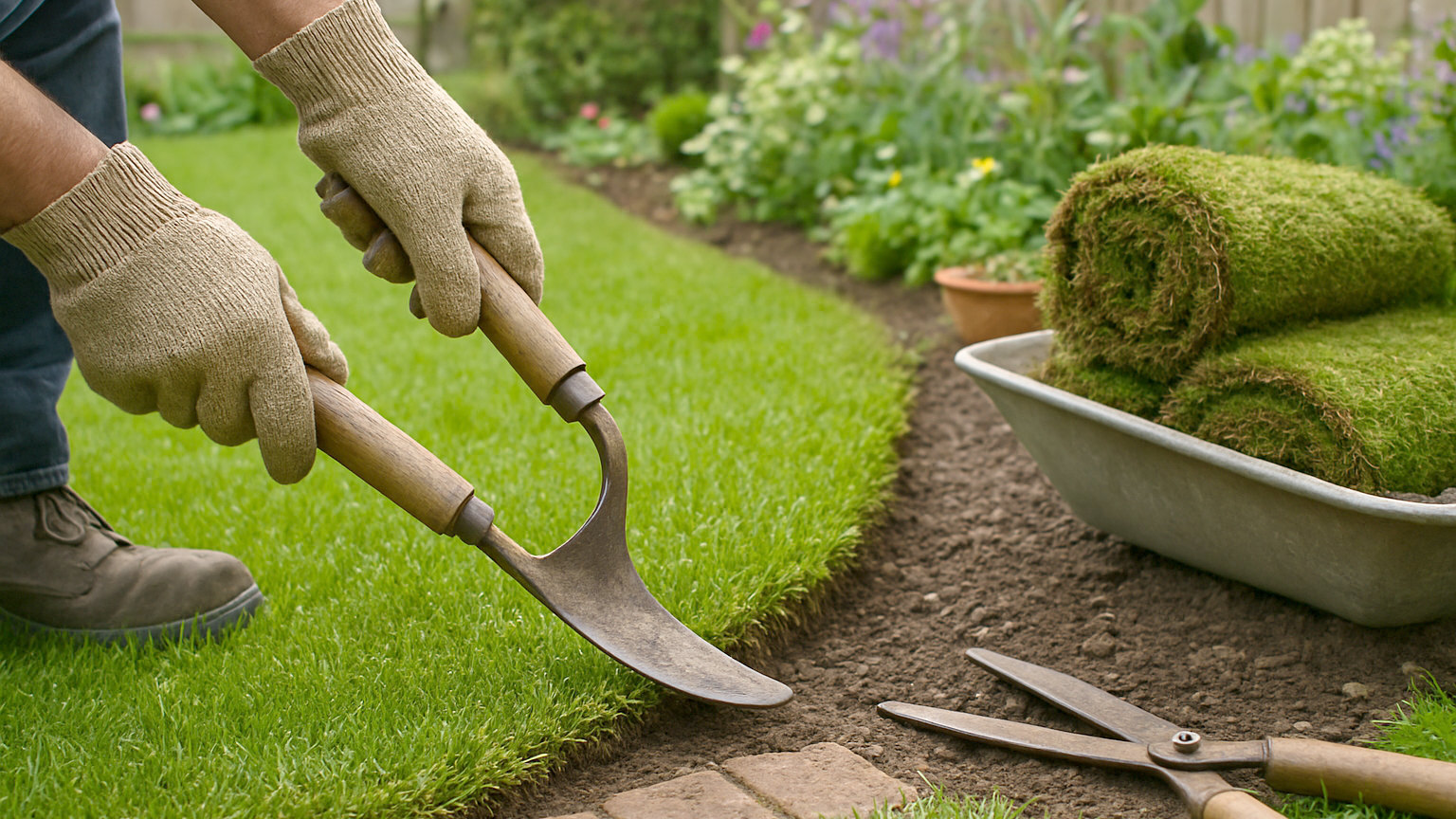
A crisp defined edge does more for the appearance of a lawn than feeding, and it costs nothing but an hour in spring. It is also the single thing that most distinguishes a maintained garden from a neglected one.
Cutting a new edge
Do it in spring, once the ground is workable and before growth is well under way.
Use a half-moon edging iron rather than a spade, which leaves a scalloped line. Keep it sharp.
For a straight edge, work to a taut string line or lay a plank on the lawn and cut against it. For a curve, lay a hosepipe on the ground and adjust it until the line looks right from the house, then cut to it.
Cut vertically to about seven centimetres deep, creating a clean shoulder between the lawn and the border. Remove the strip of turf you have cut away.
A vertical face rather than a sloping one is what gives the crisp appearance, and it lasts far longer.
Getting curves right
Gentle sweeping curves read far better than tight wiggles, which look busy and are awkward to mow around.
The test is whether a mower can follow the line without repeated reversing. If it cannot, the curve is too tight.
Lay the hosepipe out, leave it a day, and look at the line from an upstairs window and from the main viewing point before cutting anything.
Maintaining the edge
Through the season, trim the vertical face and the overhanging grass with long-handled edging shears after mowing.
Doing it every mow takes two minutes. Doing it monthly takes twenty and never looks as good.
Remove the trimmings rather than leaving them in the border, where they root and produce grass among the plants.
A powered edger or a strimmer held vertically does the job faster and less precisely, and is worth having on a long boundary.
Recutting
The edge gradually crumbles and the lawn creeps outwards. Recut it fully once a year in spring, or twice if the soil is light.
Over the years this steadily reduces the size of the lawn and enlarges the border, which is usually no bad thing at all.
Mowing strips
A row of bricks or paving set flush with the lawn surface along the edge removes the job entirely, since the mower runs over it and cuts the grass right to the edge.
It also stops border plants flopping onto the grass and killing it, and stops the lawn creeping into the border.
Set the strip slightly below the grass surface rather than proud, or the mower will scalp against it. Bed the units on mortar so they do not move.
It is a day's work and it saves an hour a month for the next twenty years, which makes it one of the better investments in a garden.
Edging materials
Metal edging strip gives a very clean line and is nearly invisible once installed. Plastic edging is cheaper and tends to lift over time.
Timber board edging suits a vegetable garden or a rectangular layout. Bricks laid on edge suit a period garden and are the traditional solution.
Any physical edging needs to sit below mower height on the lawn side.
Reshaping a lawn
Where a lawn has an awkward shape, reshaping is usually the cheapest improvement available.
Simplifying a complicated outline into one clean shape makes a garden look considerably larger and better organised, and reduces the mowing.
Removing fussy corners and narrow strips that are hard to mow is almost always an improvement. Turn them into border or hard landscaping.
Lifted turf can be relaid elsewhere, stacked upside down to rot into loam, or composted.
Edges under trees and against walls
Grass struggles right up against a wall or a tree trunk and gets damaged by the mower.
Leave a mulched or planted strip instead, which looks better, avoids bark damage and removes an awkward strip of mowing.
Tools
A half-moon edging iron for cutting, long-handled edging shears for trimming, and a sharp spade for lifting turf are the whole kit.
Keep the edging iron sharp with a file, since a blunt one tears rather than cuts and produces a ragged line that never looks right.


