
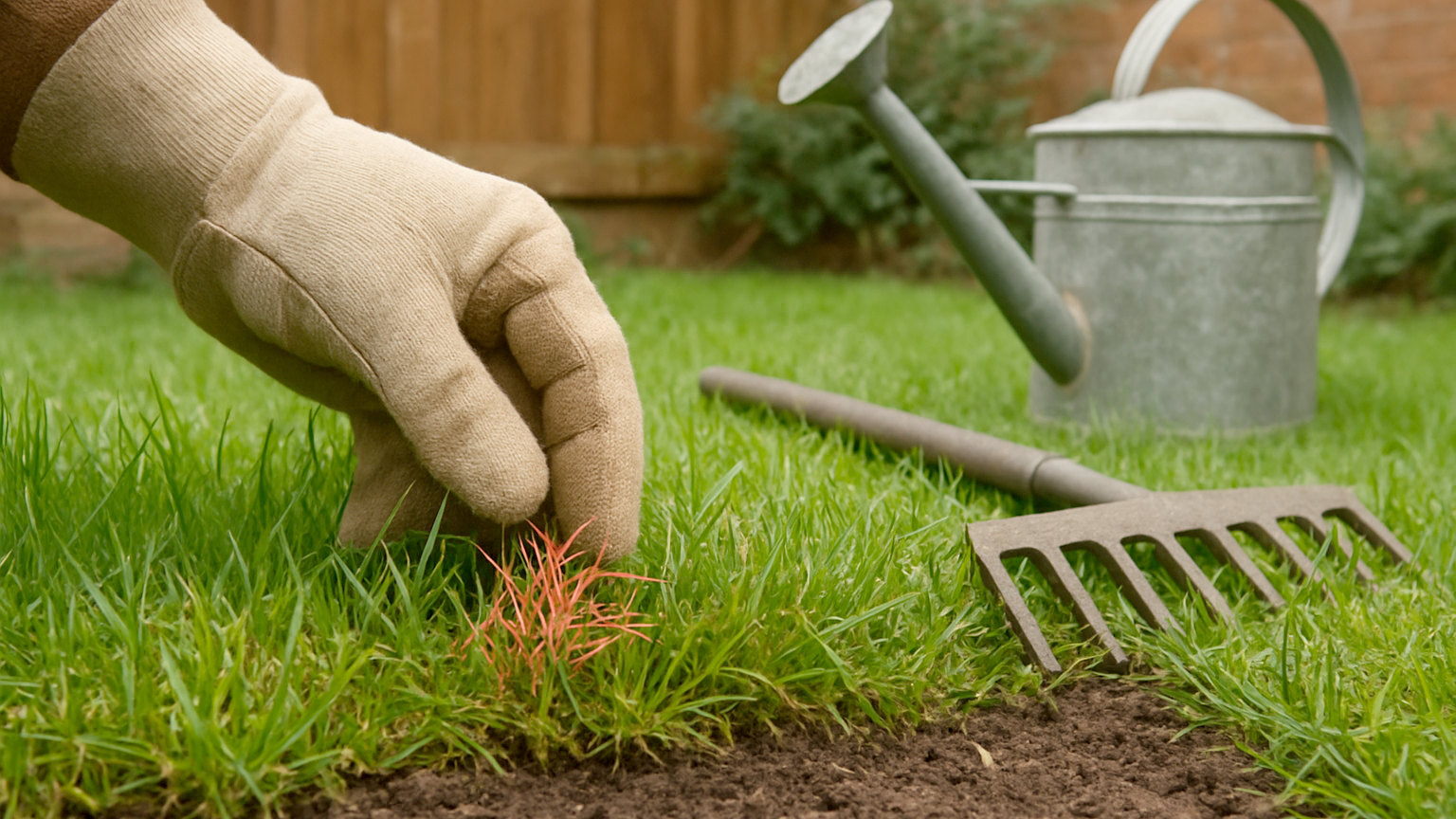
Lawn diseases are mostly symptoms of how a lawn is being managed rather than problems in themselves. Almost all of them trace back to airflow, thatch, or nitrogen applied at the wrong time.
Red thread
The commonest lawn disease in Britain. Patches of grass turn pale pinkish or straw-coloured, and close inspection shows tiny red or pink threads binding the blades together.
It appears from late spring through autumn, particularly in warm humid weather, and it looks far worse than it is. It affects the leaves rather than the roots, so the grass recovers.
Red thread indicates a lawn short of nitrogen. It is most common on underfed lawns and on fine fescue-heavy swards.
Apply a balanced feed in the growing season, improve airflow by scarifying and aerating, and collect the clippings while it is present. It usually clears within a few weeks.
Fusarium patch and snow mould
Small circular patches of yellowing grass that turn brown and may merge, sometimes with white or pinkish fungal growth visible in damp conditions, particularly at the edges of the patches.
It appears in autumn and winter, and under snow cover, and unlike red thread it can kill the grass and leave bare patches.
The usual cause is high-nitrogen feed applied too late in the season, producing soft growth going into cold damp weather.
Use an autumn feed, which is low in nitrogen and high in potassium, rather than a spring formulation. Improve drainage and airflow, brush off dew on autumn mornings, avoid walking on affected areas, and clear fallen leaves promptly.
Fairy rings
Rings or arcs of darker green grass, sometimes with a ring of dead grass, and often with toadstools appearing in autumn.
Caused by a fungus growing outwards through the soil from a central point, breaking down organic matter and releasing nitrogen, which is what produces the dark green.
Some types also make the soil water-repellent, causing the ring of dead grass.
There is no practical cure available to gardeners. Aerating the affected area to improve water penetration helps, as does feeding the surrounding lawn so the colour difference is less obvious.
Remove toadstools by brushing or mowing them off, particularly where children or pets use the lawn, since some are toxic.
Dollar spot
Small straw-coloured spots about the size of a coin, which may merge into larger patches. More common on fine fescue lawns and in late summer.
Associated with low nitrogen and heavy dew. Feed appropriately, brush off morning dew, and improve airflow.
Rust
Orange or yellow dust on the grass blades that comes off on shoes and mower wheels, most common in late summer and autumn on slow-growing, underfed or drought-stressed lawns.
Feed, water if genuinely necessary, and mow regularly, collecting the clippings. It usually disappears once growth picks up.
The general pattern
Two of these indicate too little nitrogen and one indicates too much at the wrong time, which is a useful summary of lawn feeding generally.
Feed with a high-nitrogen product in spring and early summer, and a high-potassium one in autumn. Never the other way round.
What reduces all of them
- Scarify annually to remove thatch, which holds moisture and harbours disease
- Aerate to relieve compaction and improve drainage
- Mow at the right height with a sharp blade, since torn blades admit infection
- Collect clippings when disease is present
- Clear fallen leaves promptly in autumn
- Improve airflow by cutting back overhanging shrubs
- Feed appropriately for the season
On fungicides
Lawn fungicides are no longer generally available to amateur gardeners in the UK, which makes the cultural measures the whole of the treatment.
In practice this matters less than it sounds. Most lawn diseases are cosmetic and temporary, and a well-managed lawn shrugs them off within a few weeks.
What is not a disease
Yellow patches with a dark green ring are usually dog urine rather than fungus. Spongy turf that lifts like a carpet is chafer grubs or leatherjackets. Uniform browning in August is drought dormancy.
Toadstools appearing in autumn are generally harmless, feeding on buried organic matter such as old roots or builders' debris. Brush them off where children or pets use the lawn.
Thatch
The layer of dead material between the grass and the soil underlies most disease problems. It holds moisture at the base of the plants, restricts airflow and harbours fungal spores.
Scarifying annually in early autumn is the direct remedy and does more to prevent disease than anything applied to the lawn.


