
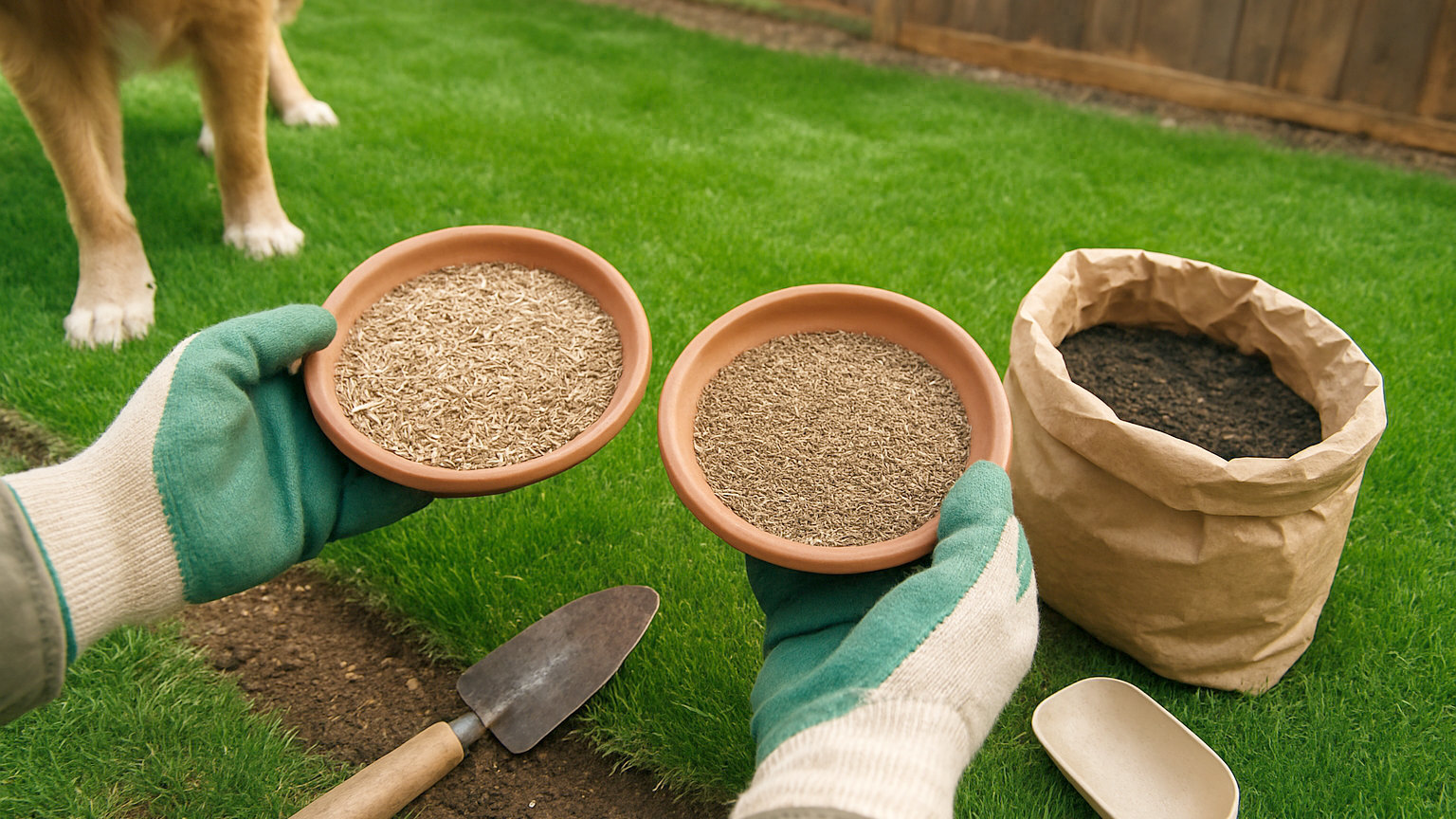
Grass seed mixtures are formulated for quite different purposes, and choosing the wrong one produces a lawn that never suits the way it is used. The decision comes down to how much wear it must take against how fine you want it to look.
The main grass types
Perennial ryegrass is broad-leaved, tough, quick to germinate and hard-wearing. It is what sports pitches and family lawns are built on. It is coarser in appearance than the fine grasses and needs more frequent mowing.
Fescues, particularly the fine-leaved and creeping red fescues, are finer, more drought tolerant and slower growing. They give a much better looking sward and take considerably less wear.
Bents are the finest of all, used on bowling greens and golf greens. They need close mowing, high maintenance and produce an exceptional finish.
Smooth-stalked meadow grass spreads by underground runners and helps a lawn repair itself, so it appears in hard-wearing mixtures.
Hard-wearing mixtures
Dominated by ryegrass, often with meadow grass and some fescue.
Choose this for a family lawn, anywhere children play, dog runs, and any lawn that takes real traffic. It recovers from damage, germinates quickly and tolerates lower mowing than fine mixtures.
It grows fast, which means more mowing, and it will never have the velvet appearance of a fine lawn.
For most gardens this is the right choice, and choosing a fine mixture for a family lawn is a common and expensive error.
Fine ornamental mixtures
Fescues and bents, with no ryegrass.
These produce a dense, fine, beautifully textured lawn that stripes superbly and looks like the pictures. They also cannot take wear, need close and frequent mowing, and demand considerably more attention.
Choose one only for a lawn that is looked at rather than used, and only if you are prepared for the maintenance.
Shade mixtures
Based on shade-tolerant fescues, often with wood meadow grass.
They perform better than a standard mixture under trees and beside walls, and they are not a solution to deep shade, where no grass will thrive.
In genuine shade, expect a thinner sward whatever you sow, mow higher to give more leaf area, and consider whether a shade-tolerant planting would serve better than grass.
Drought-tolerant mixtures
Higher proportions of fescue, which root deeply and stay green longer in dry weather.
Worth considering on sandy soil or in a dry part of the country, and increasingly sold with tall fescue included, which is deep-rooting and genuinely drought tolerant though coarser in appearance.
Clover and flowering lawns
Mixtures containing microclover are now widely available and worth considering.
Clover fixes its own nitrogen, so the lawn needs less feeding. It stays green through drought when grass browns, tolerates wear, and flowers for bees if allowed to.
The trade is a different appearance and the fact that selective lawn weedkillers will kill it, so the two approaches are incompatible.
Flowering lawn mixtures adding yarrow, self-heal and bird's-foot trefoil take this further, producing something between a lawn and a meadow.
Reading the pack
Good seed states the species and proportions in the mixture rather than simply describing the result.
Look for the percentage of ryegrass, which tells you where on the tough-to-fine spectrum it sits. Check the sowing rate, and check the pack date, since grass seed loses viability over a few years.
Matching an existing lawn
When overseeding, match the mixture to what is already there or the repair will show as a patch of different colour and texture.
If you do not know what you have, look at the leaf width. Broad glossy blades indicate ryegrass; fine needle-like ones indicate fescue.
Quantity and storage
A new lawn takes around thirty-five to fifty grams per square metre, and overseeding an existing one about twenty-five to thirty-five.
Grass seed loses viability over a few years, so buy what you need rather than a large sack, and store any surplus somewhere cool, dry and mouse-proof.
Wildflower and meadow mixes
These are a different proposition entirely, needing poor soil rather than good, and no feeding at all. Sowing a meadow mix onto fertile ground produces vigorous grass that smothers the flowers within a season.
Strip the topsoil or dilute the fertility before sowing one, and expect a different management regime of one or two cuts a year with the arisings removed.


