
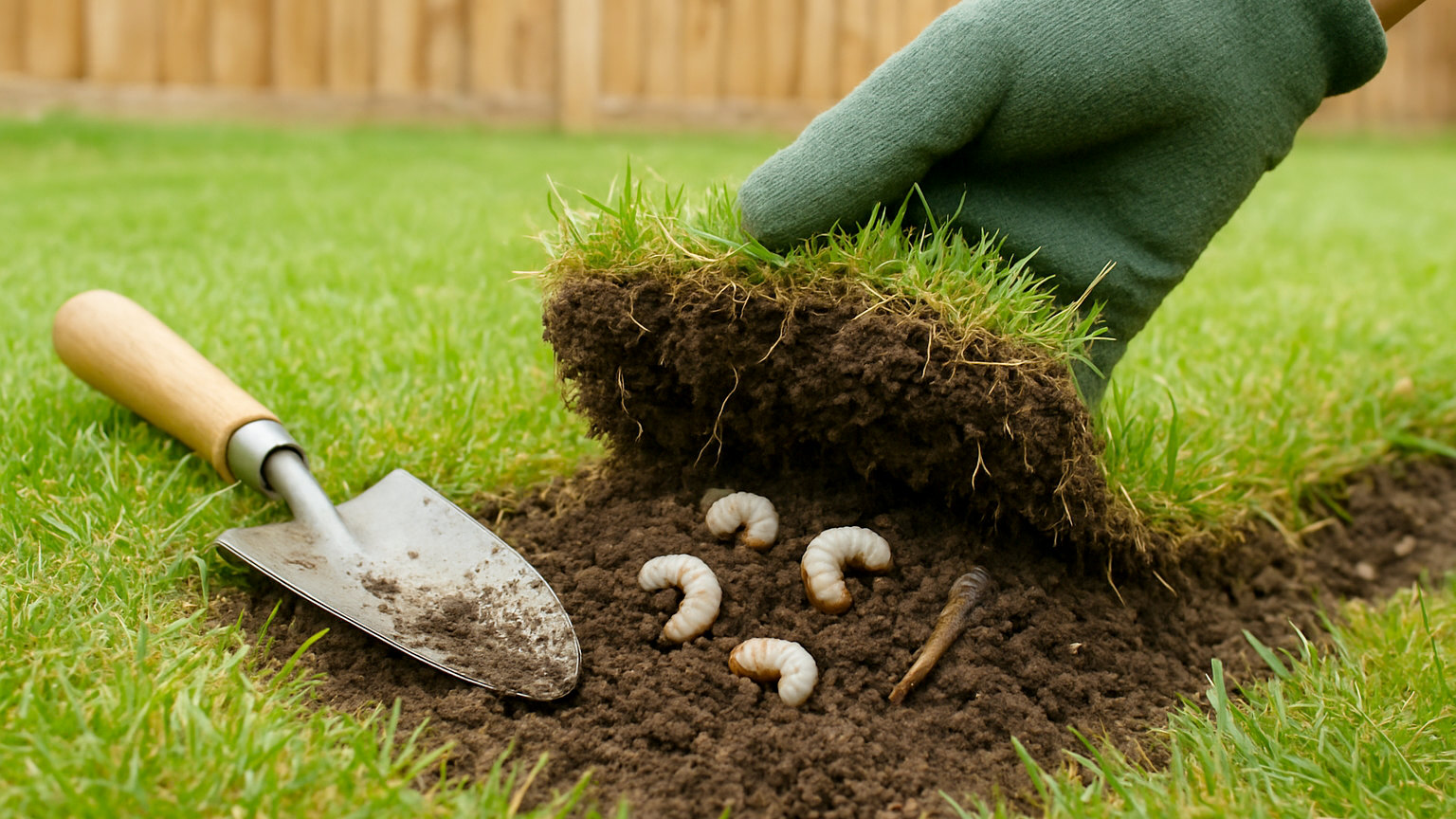
A lawn being torn up by birds, foxes or badgers has grubs in it, and the animals are after the grubs rather than the grass. The damage they do while digging is usually worse than the damage the grubs themselves cause.
Recognising the problem
Yellowing or dying patches that appear from late summer through autumn and again in spring.
Turf that lifts away like a loose carpet, with no roots holding it down, is the diagnostic sign. Grass with healthy roots resists a firm tug.
Birds, particularly crows, magpies and starlings, probing and tearing at the surface. Foxes and badgers digging holes and rolling back sections of turf overnight.
Peel back a section and look at the soil beneath. If grubs are present you will usually find several within a small area.
Telling them apart
Chafer grubs are fat, creamy white, C-shaped, with a distinct orange-brown head and three pairs of legs at the front. They reach two to three centimetres and are unmistakable once seen.
Leatherjackets are the larvae of crane flies, greyish-brown, tubular, legless and with no obvious head, up to about four centimetres. They look like tough grey grubs.
Both eat grass roots. Chafers are usually worst in late summer and autumn, leatherjackets in autumn and again in spring.
Nematodes, and the timing
Biological control with parasitic nematodes is the effective treatment available to gardeners, and the timing is narrow and matters more than anything else.
Apply in late summer or early autumn, generally from late August through September, while the grubs are small and still feeding near the surface, and while the soil is still warm.
Soil temperature must be above about twelve degrees for the standard products, and there are cold-tolerant strains for later use. A soil thermometer removes the guesswork.
Large grubs in spring are much harder to control, and a spring application is far less effective than an autumn one.
Applying them
Nematodes are living organisms with a short shelf life. Order for a specific delivery date and use them the day they arrive.
Water the lawn thoroughly before application, apply the nematodes through a watering can or hose applicator following the instructions, and water again afterwards.
Keep the lawn moist for at least a fortnight afterwards, since nematodes move through soil water and dry conditions stop them working.
Apply in the evening or on a dull day, since they are killed by ultraviolet light.
What else can be done
There are no effective chemical controls available to amateur gardeners in the UK, which makes nematodes and cultural measures the whole of the response.
A vigorous, deeply rooted lawn tolerates grub damage far better than a thin stressed one. Aerating, scarifying, top dressing and appropriate feeding all help.
Adult chafer beetles and crane flies are attracted to lay in short, thin, well-lit turf, so mowing slightly higher may reduce egg laying.
Netting or covering a badly affected area temporarily protects the turf from birds and mammals while it recovers, though it does nothing about the grubs.
Badgers
Badgers and their setts are protected by law in the UK. It is an offence to kill, injure or take a badger, or to damage or obstruct a sett.
Where badgers are digging a lawn, treating the grubs removes the attraction, which is the practical route. Electric fencing may be used, and any work near a sett requires care and possibly a licence.
Take advice from a local wildlife trust rather than acting where badgers are involved.
Repairing the damage
Firm any lifted turf back down and water it. Much of it re-roots if the grubs have been dealt with.
Reseed genuinely bare areas in early autumn, which is the ideal time for overseeding in any case, and top dress at the same time.
Keep the repaired area watered until the new grass is established.
Expect the lawn to look poor for a season and to recover the following year.
Reducing the risk
Neither pest can be prevented reliably, and a healthy lawn copes far better. Annual scarifying, aeration and top dressing produce deeper roots and a tougher sward that tolerates some root loss without dying.
Where the problem recurs annually, an autumn nematode application becomes a routine preventive job rather than a response to damage already done.


