
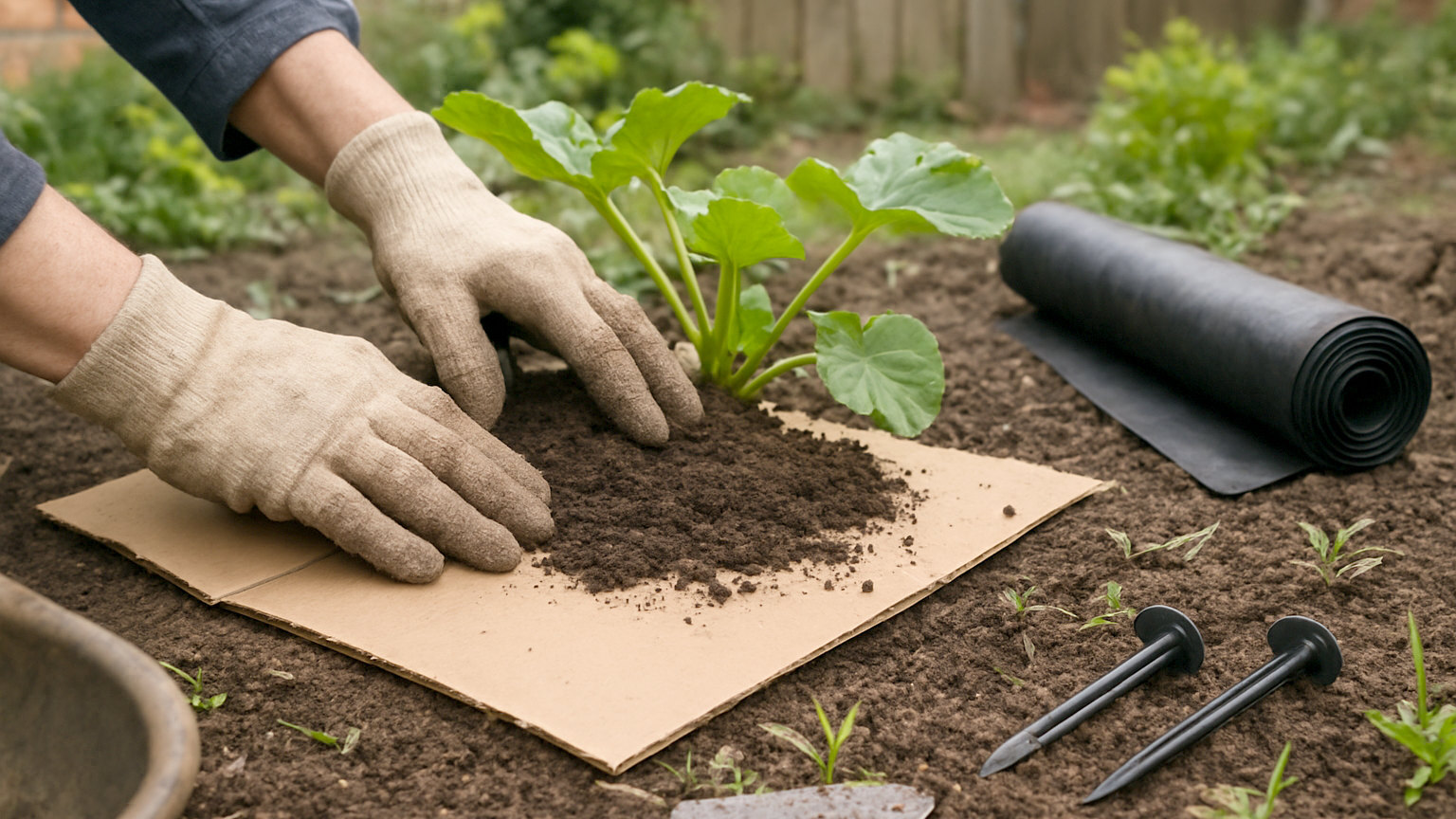
Covering the ground to suppress weeds works, and the material matters enormously. Cardboard and plastic membrane behave in completely different ways over a few years, and one of them causes problems that outlast the weeds.
Cardboard and sheet mulching
Plain cardboard laid on the ground and covered with compost or bark smothers grass and annual weeds by excluding light, then rots away within a season, leaving improved soil.
It is the standard method for creating a no-dig bed over a lawn, and it works well.
Use plain brown cardboard with tape, staples and glossy printing removed. Overlap the sheets generously with no gaps, since weeds find any chink.
Wet the cardboard thoroughly before covering, or it repels water and stays dry.
Cover with at least five to ten centimetres of compost, which is what you plant into.
You can plant through it almost immediately by cutting a cross and planting into the soil beneath, or wait a few months for it to soften.
It does not deal with established perennial weeds. Bindweed, ground elder and couch grass find their way through or around within a season, so clear those first or use a longer light exclusion.
Light exclusion for perennial weeds
For serious infestations, thick black polythene or heavy woven sheeting left in place for a full growing season, and preferably longer.
Overlap generously, weight the edges, and check them regularly, since bindweed travels to find light.
Nothing grows through, the weeds exhaust their reserves, and the soil beneath is left workable and full of worm activity.
This is slow and it is the least labour-intensive method that genuinely works.
Plastic weed membrane
Woven landscape fabric laid permanently and covered with gravel or bark. It is widely sold and widely regretted.
It works for the first few years. Then dust, leaf litter and organic debris accumulate on top, forming a layer of soil in which weeds germinate happily.
Those weeds root through the fabric, which makes them far harder to pull out than weeds in open ground.
Meanwhile the membrane prevents organic matter reaching the soil beneath, so the ground becomes compacted, impoverished and low in worm activity.
Removing it years later is a genuinely unpleasant job, since it has become entangled with roots and buried under gravel, and it shreds into fragments that persist in the soil indefinitely.
Where membrane is genuinely useful
Beneath a permanent path, drive or hard-standing, as a separation layer between sub-base and surface. This is what it was designed for.
Beneath a gravel area that will never be planted.
Temporarily, to clear ground before planting, and then removed.
Not in planted borders, where it prevents mulching, restricts plants spreading, and creates the problems above.
Mulch alone
For a planted border, a mulch of compost, bark or gravel at five to seven centimetres suppresses annual weeds effectively without any membrane.
Weed seed blowing onto the surface germinates in the loose mulch and pulls out with two fingers.
Compost and bark break down and feed the soil, and are simply topped up annually, which is a small job compared with removing failed membrane years later.
Gravel mulch lasts indefinitely and suits Mediterranean planting, alpines and anything that wants a dry crown.
Dense planting
The best long-term weed suppression of all. Weeds establish in gaps, and a border where plants have knitted together leaves nowhere for a seedling to germinate.
Ground cover plants achieve in three years what a membrane achieves badly for five and then fails at.
The decision
Cardboard and compost to convert grass to a bed. Heavy sheeting temporarily to clear perennial weeds. Membrane only under paths and unplanted gravel. Mulch and dense planting everywhere else.
Removing failed membrane
Where a border already has membrane under it and weeds growing through, the job is to rake off the covering, cut the fabric out around existing plants and remove as much as possible.
It will have fragmented and become entangled with roots, so expect to get most rather than all of it. Mulch generously afterwards to restore the soil.
It is a thoroughly unpleasant afternoon's work and it is worth doing, since the soil beneath recovers within a season or two once it can breathe and receive organic matter again.


