
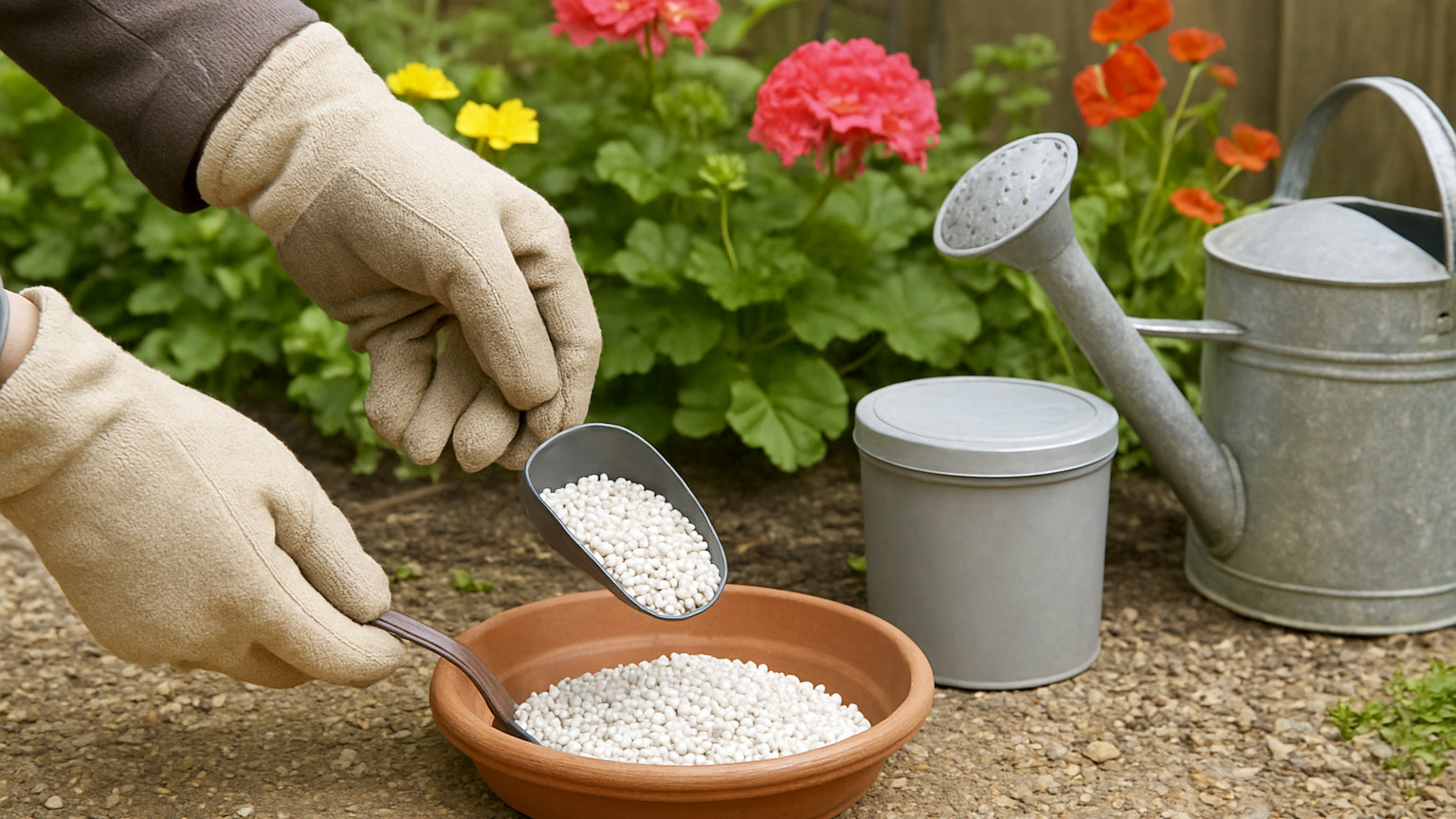
Every bag of fertiliser carries three numbers, and they are the only part of the label that reliably tells you what the product is for. Once you can read them, the choice between a shelf of products takes seconds.
The three numbers
They give the percentages by weight of nitrogen, phosphorus and potassium, always in that order.
A general fertiliser marked 7-7-7 contains seven per cent of each. A tomato feed marked 4-3-8 is comparatively high in potassium. A lawn spring feed might be 12-2-4, dominated by nitrogen.
The numbers do not add up to a hundred because the rest is carrier material and other nutrients.
What each does
Nitrogen drives leafy green growth. Plants short of it are pale and thin. Too much produces soft sappy growth, few flowers and increased vulnerability to frost and disease.
Use nitrogen-rich feeds in spring, for leafy crops, and for lawns during the growing season.
Phosphorus supports root development and establishment. Most British garden soils already contain adequate phosphorus, which is why bonemeal at planting achieves less than tradition suggests.
Potassium promotes flowering, fruiting and general hardiness. It also toughens growth against cold and disease.
Use potassium-rich feeds for anything flowering or fruiting, and for lawns in autumn.
Reading a product by its numbers
Roughly equal numbers means a balanced general fertiliser, suitable for most things and outstanding at none.
First number highest means a growth or spring feed, for foliage and lawns early in the season.
Last number highest means a flowering or fruiting feed, which is what a tomato feed is and why it suits roses, containers and flowering plants generally.
This single check tells you whether an expensive specialist product is meaningfully different from a cheap general one, and frequently it is not.
Trace elements
Beyond the three main nutrients, plants need magnesium, calcium, sulphur, iron, manganese, boron and others in small quantities.
Good fertilisers list these, and rose and ericaceous feeds usually include magnesium and iron specifically, which is why they outperform general fertiliser on those plants.
Deficiencies in trace elements are far less common than in the main three, except on very alkaline or very sandy soil.
Working out how much
Application rates are given in grams per square metre, and the correct rate matters.
Applying at double rate does not double the growth. It scorches roots and foliage, wastes money, and leaches into watercourses.
Measure the area rather than estimating, and weigh out the right quantity for a known area the first time so you learn what it looks like in your hand.
Mark out a square metre with canes and scatter the correct amount into it, which calibrates your eye for everything you apply afterwards.
Granular, soluble and slow release
Granular fertilisers are scattered and watered in, releasing over weeks. They suit borders, lawns and vegetable beds.
Soluble and liquid feeds act within days and last a short time, which suits containers and any plant needing a quick correction.
Slow or controlled release granules meter nutrients out over months, responding to temperature and moisture. They suit containers and hanging baskets, and they are more expensive.
When to apply
Onto moist soil, never dry, and water in afterwards if rain is not expected. Fertiliser on dry ground scorches.
During active growth, generally spring and early summer. Stop by about mid-August for anything woody, since late nitrogen produces soft growth that frost damages.
Never feed a plant that is struggling from drought, waterlogging or root damage, since fertiliser makes all three worse.
The practical shortlist
Most gardens need very few products: a balanced general fertiliser for spring, a high-potassium tomato feed for anything flowering or fruiting, and an annual mulch of compost.
That covers the great majority of situations, and specialist products are worth buying only where a specific plant genuinely benefits.
Storage and safety
Keep fertilisers dry and sealed, since granular products absorb moisture and set into a solid block that cannot be spread evenly.
Store them out of reach of children and animals, in the original container with the label intact, and wear gloves when handling them.
Never decant fertiliser into an unlabelled container, and particularly not into anything that has previously held food or drink.


