
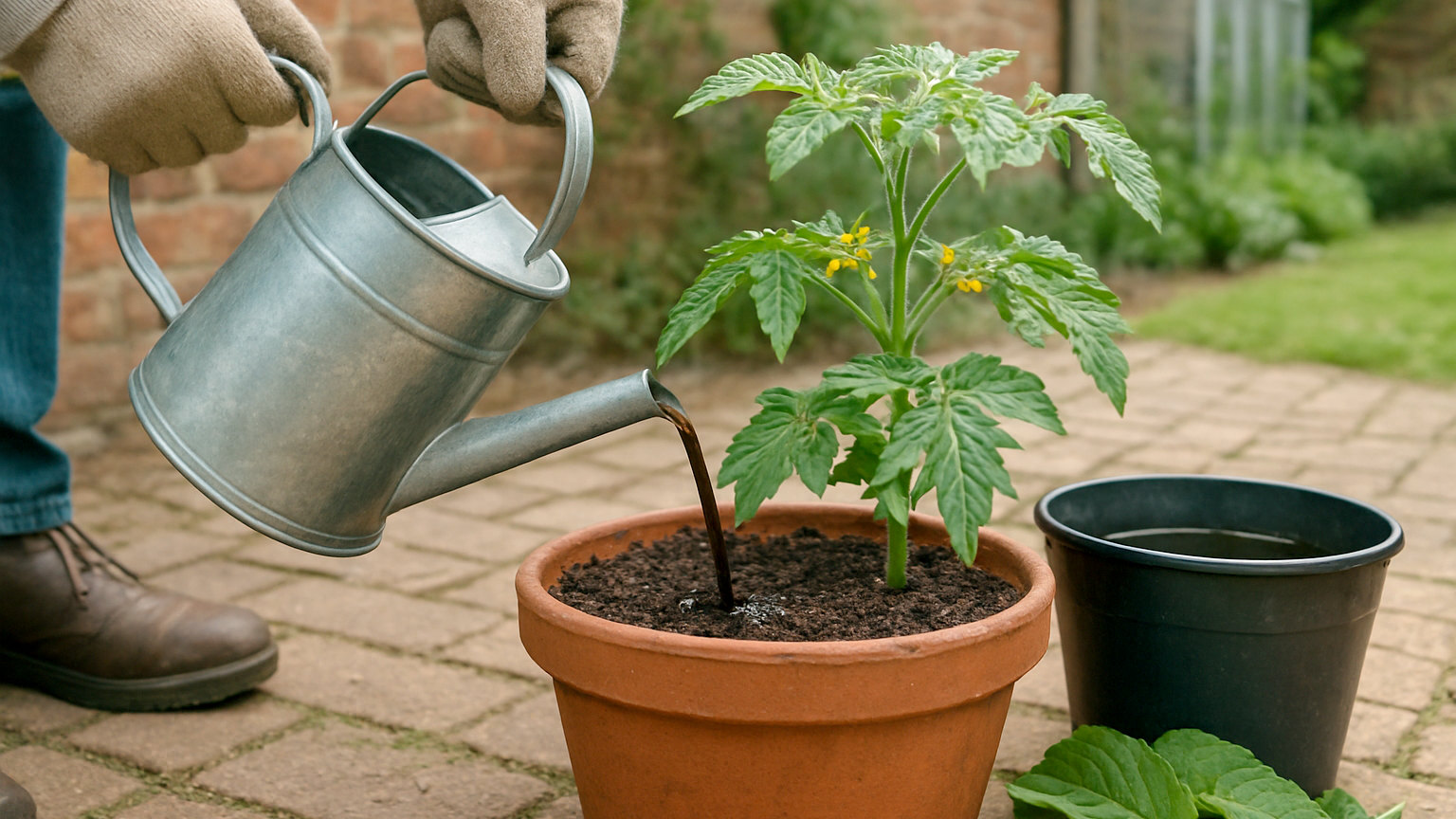
Liquid feeds are taken up within days rather than weeks, which makes them the right tool for containers, for correcting a visible problem, and for anything cropping heavily. They are also the easiest fertiliser to make yourself.
When a liquid feed is right
Containers and hanging baskets, where the compost is exhausted within about six weeks and there is no soil reserve.
Heavy croppers during the season: tomatoes, cucumbers, peppers, courgettes.
Correcting a visible deficiency quickly, where waiting for a granular feed to release is not acceptable.
Bulbs after flowering, when a high-potassium feed builds next year's display.
For borders and established plants in open ground, a mulch and a granular spring feed are generally more useful and far less work.
Comfrey feed
The best-known homemade feed, high in potassium and therefore excellent for tomatoes, peppers, and anything flowering or fruiting.
Grow the sterile variety Bocking 14, which does not set seed and will not spread. Ordinary comfrey seeds itself enthusiastically and becomes difficult to remove.
Cut the leaves two or three times a season, from late spring onwards.
The concentrated method: pack leaves into a container with a hole in the base and a weight on top, and collect the dark liquid that drips out over a few weeks. Dilute this at roughly one part to fifteen of water.
The water method: steep leaves in a covered barrel of water for four to six weeks. Dilute at about one part to ten.
Either way it smells strongly, so site the container away from the house and keep it covered.
Comfrey leaves also make an excellent mulch laid directly around plants such as potatoes and tomatoes, and they are a good compost activator when a heap has stalled.
Nettle feed
Made the same way and higher in nitrogen than potassium, which makes it a growth feed rather than a flowering one.
Use it in spring and early summer on leafy crops and young plants. Steep nettles in water for a few weeks and dilute at about one part to ten.
Cut nettles before they set seed.
Bought liquid feeds
Tomato feed is the most useful single product in a garden. It is high in potassium, and it suits roses, containers, baskets, flowering shrubs and bulbs after flowering as well as tomatoes.
General liquid feeds are roughly balanced and suit foliage plants and young growth.
Seaweed extract supplies trace elements and is often used as a tonic rather than a feed. It is worth using alongside a proper fertiliser rather than instead of one.
Applying them
Follow the dilution rate on the bottle. Feeding at double strength scorches roots rather than doubling growth.
Always apply onto damp compost or soil, never dry. Water the plant first if necessary.
Feed in the evening or early morning rather than in hot midday sun.
Weekly is the usual frequency for containers during the growing season. Little and often is better than occasional heavy doses.
Stop feeding woody plants by about mid-August, so late soft growth is not caught by frost.
Foliar feeding
Some liquid feeds can be sprayed onto the leaves for rapid uptake, which is useful for correcting deficiencies such as magnesium.
Spray in dull conditions or in the evening, never in strong sun, which scorches wet foliage. Check the product is intended for foliar use, since not all are.
Safety and practicalities
Wear gloves and wash your hands afterwards. Home-made feeds in particular are best kept away from food preparation areas.
Keep containers covered and clearly labelled, and out of reach of children and pets, since a barrel of steeping comfrey is not obviously dangerous but should not be drunk.
Do not use homemade feeds on seedlings, where the strength is unpredictable and scorching is easily done.
What liquid feeds will not do
They do not improve soil structure, and they do not last. A liquid feed is a short-term supply rather than a substitute for building the soil with organic matter.
They also do not correct a problem that is not nutritional. A plant yellowing from waterlogging, drought or root damage will not respond to feeding, and feeding makes all three worse rather than better.
Check the soil, the drainage and the roots before assuming a plant is hungry.


