
Weeds establish where grass is not growing well, so the most effective long-term control is a dense, healthy lawn rather than anything you apply. That said, some weeds are worth removing, and knowing which ones and how makes the job much shorter.
The common ones
Daisies form flat rosettes and spread by short runners. Easy to remove by hand and, in a family lawn, arguably worth keeping.
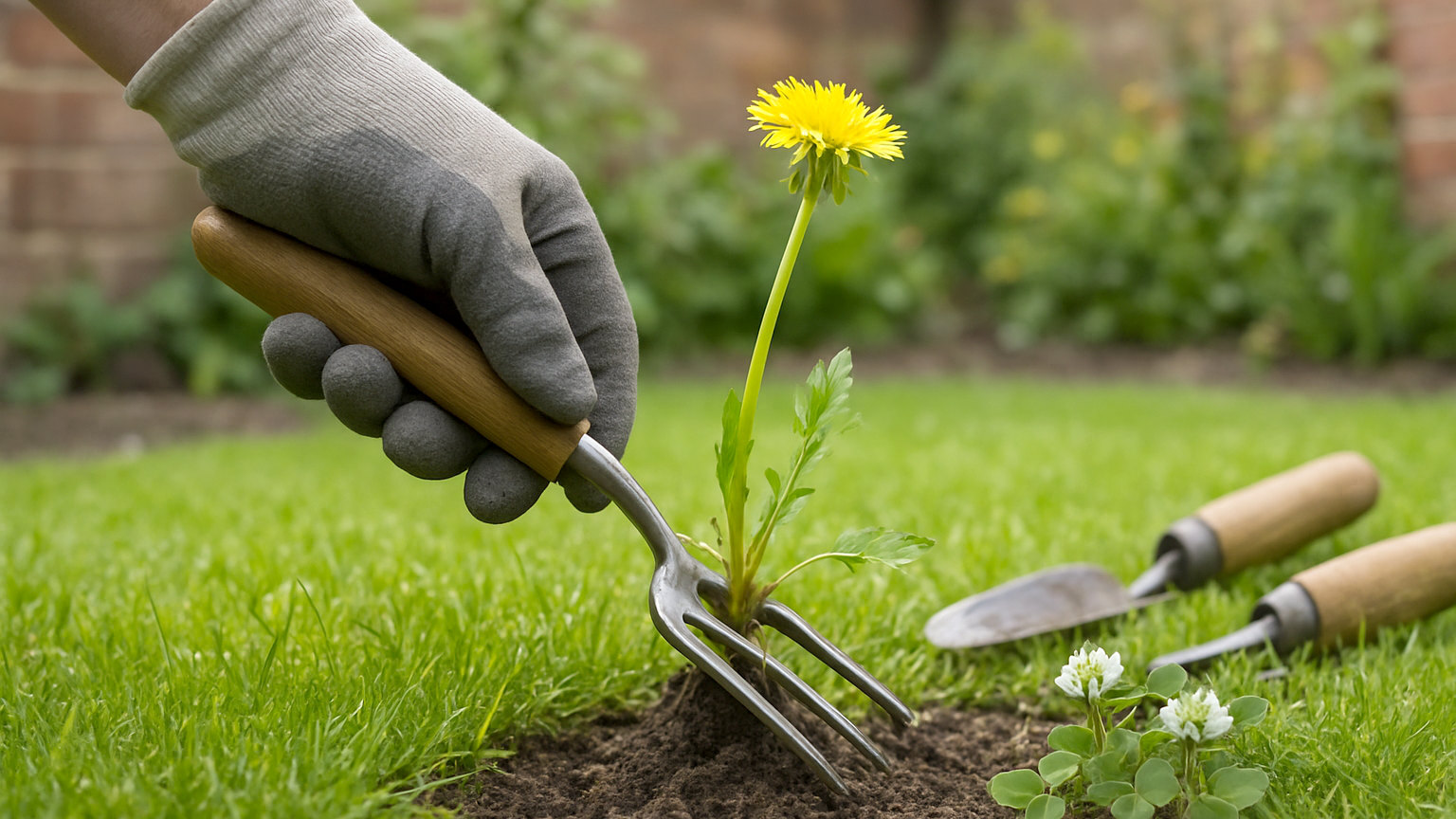
Dandelions have a deep taproot that regrows from any fragment left behind. They must be dug out whole with a long narrow tool, and the sooner the better, since the root deepens with age.
Clover spreads in low mats with three-part leaves and white flowers. It fixes its own nitrogen, stays green in drought and feeds bees, and there is a genuine case for leaving it.
Plantain makes flat rosettes of ribbed leaves that smother grass beneath them. Prise the whole crown out with a knife or weeding tool.
Creeping buttercup spreads by runners that root at intervals and thrives in damp compacted ground. Persistent, and improving drainage does more than repeated removal.
Speedwell and self-heal form low creeping mats. Both indicate a lawn that is thin and often cut too short.
What weeds tell you
Each of these prefers particular conditions, so the ones you have diagnose the lawn.
Clover and medick indicate low nitrogen. Buttercup and moss indicate compaction and poor drainage. Plantain and daisies dominate where the lawn is cut short and thin. Yarrow and speedwell suggest dry, hungry soil.
Fixing that underlying condition is more useful than treating the weed, and often removes it without further action.
Hand weeding
For a small lawn or scattered weeds, this is genuinely the best method: precise, immediate, and with nothing applied to ground children and pets use.
Do it when the soil is damp, ideally after rain, so roots come out whole. Use a long-bladed weeding knife or a daisy grubber for taprooted weeds, working the tool down alongside the root and levering the whole thing out.
Any fragment of dandelion or dock root left behind will regrow. Get the full length or expect it back within weeks. Fill the resulting hole with soil and a pinch of grass seed, otherwise the gap invites the next weed in.
Selective treatment
Selective lawn herbicides kill broad-leaved plants while leaving grasses unharmed. They work, and they are worth reserving for widespread infestations rather than the odd daisy.
Apply when weeds are growing actively, in late spring or early summer, on a dry still day with no rain forecast for a day. Spot treatment with a targeted applicator is far better than blanket spraying, since it uses a fraction of the product.
Read the label and follow it, since it is a legal instrument rather than a suggestion. Observe any period before children and pets return to the lawn, do not treat a newly sown or newly turfed lawn, and never apply near a pond or watercourse. Do not compost treated clippings for the first few cuts.
The case for tolerating some
A lawn containing clover, daisies and self-heal supports far more insect life than a pure grass sward, stays greener through drought, and needs less feeding. Clover in particular fixes nitrogen from the air, effectively feeding the lawn for you.
Letting a section grow longer and flower, cut once or twice a year, does more for pollinators than almost anything else in an average garden. Mowing a neat path through it makes the intention obvious to anyone looking.
This is a legitimate choice rather than a compromise, and it is considerably less work.
Coarse grasses and weed grasses
Selective herbicides do not touch coarse grasses such as Yorkshire fog, which form pale, wide-bladed clumps that stand out in a fine lawn. Since a grass killer would take the lawn with it, the only options are digging the clump out and reseeding, or slashing through it repeatedly with a knife before mowing to weaken it over a season.
The long-term answer
Whichever route you take, the durable fix is grass vigour. Mow high, at twenty-five to forty millimetres, so the sward shades out weed seedlings. Feed appropriately in spring and autumn. Scarify and aerate in early autumn, then overseed the gaps.
A thick lawn leaves nowhere for a weed seed to germinate, and it achieves permanently what treatment achieves for a season.


