
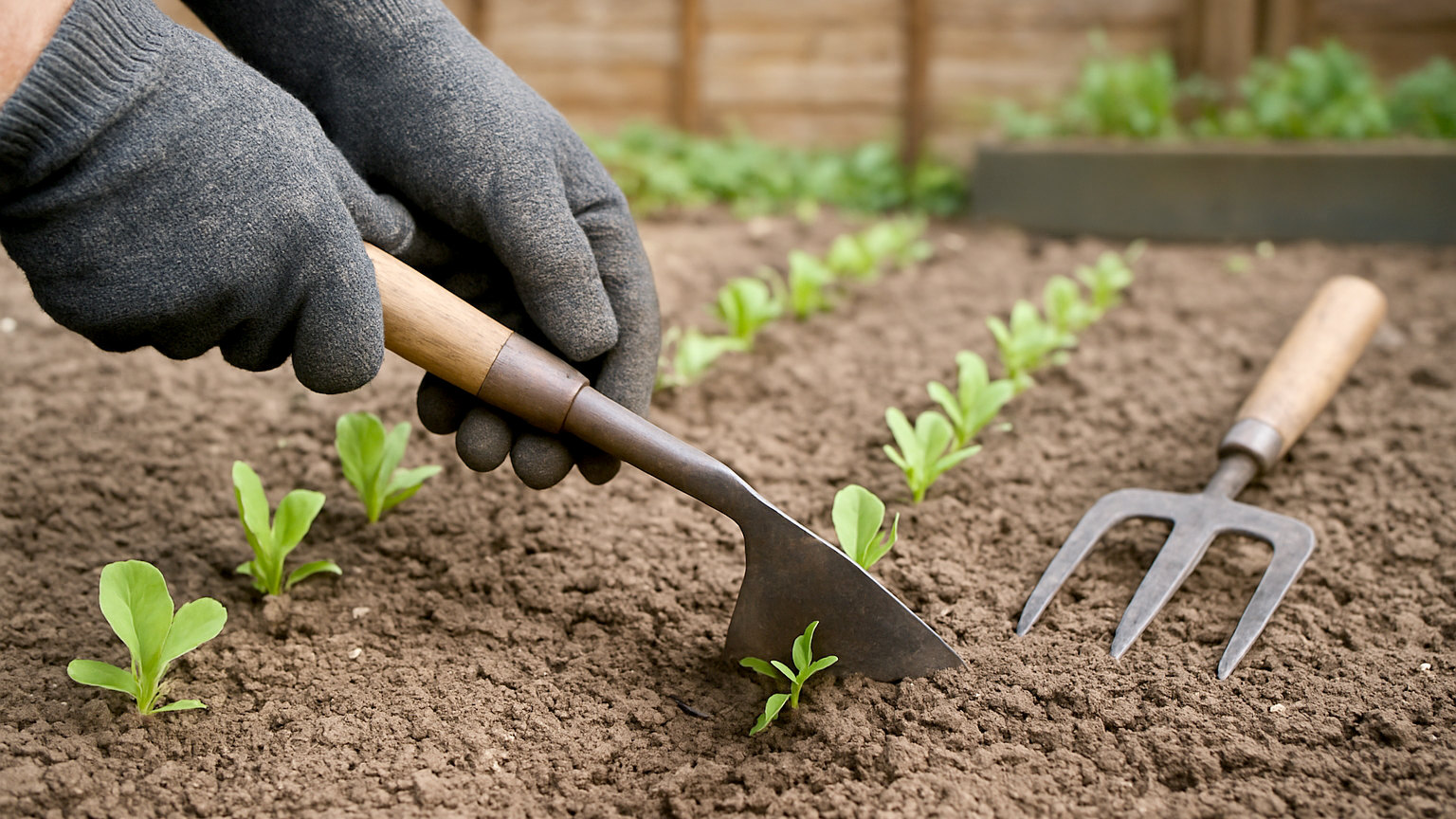
Hoeing is the most efficient weeding there is, and almost everyone does it too late. A hoe used properly on a dry day clears a border in minutes; the same border a fortnight later takes an hour on hands and knees.
Hoe when you cannot see them
The right time to hoe is before the weeds are properly visible.
Seedlings at the two-leaf stage are severed and die within hours. The same plants a fortnight later have roots that survive the cut and regrow.
The rhythm to aim for is a quick pass over open ground every week or two through the growing season, whether or not you can see anything to remove. It takes a few minutes and prevents nearly all annual weeding.
Weather matters
Hoe on a dry, preferably sunny and breezy day. Severed seedlings shrivel on the surface and can be left where they fall.
Hoe in wet weather and many of them re-root and carry on growing, so the work has to be repeated.
If you must hoe in damp conditions, rake off the debris.
Types of hoe
A Dutch or push hoe is used with a pushing and pulling action, sliding the blade just below the surface. It is the general-purpose choice and the fastest for open ground.
A draw hoe is used with a chopping and pulling action towards you, and suits heavier work, drawing drills and earthing up.
An oscillating or stirrup hoe has a hinged blade that cuts on both the push and the pull, and is very efficient on loose soil.
An onion or short-handled hoe works between closely spaced plants.
Technique
Keep the blade shallow, one to two centimetres below the surface. You are severing stems from roots, not cultivating.
Deep hoeing damages the roots of the plants you are keeping and brings buried weed seed to the surface, where it germinates. That is why some borders seem to produce endless weeds however often they are hoed.
Walk backwards so you do not tread on the ground you have just hoed.
Keep the hoe sharp. A few strokes with a file before starting makes an enormous difference, and most people have never sharpened a hoe at all.
Where hoeing does not work
Among established perennials, where the blade cannot reach without damaging roots and crowns.
On perennial weeds. Hoeing bindweed, ground elder or couch grass simply prunes them, and some regenerate from the fragments.
In a mulched border, where the mulch does the job and any seedlings pull out easily by hand.
Very close to shallow-rooted plants, where hand weeding is safer.
Hand weeding
The only option for weeds among plants, for anything with a taproot, and for perennial weeds that must be dug out entirely.
Work when the soil is damp, ideally after rain, when roots come out whole rather than snapping.
For dandelions, docks and other taprooted weeds, use a long-bladed weeding knife or a daisy grubber and work down alongside the root, levering rather than pulling.
Any fragment of dandelion or dock root left behind regrows, so get the full length.
For perennial weeds with running roots, use a fork rather than a spade, which chops the roots. Loosen the ground and trace each root out by hand.
Kneeling and comfort
Use a kneeler or knee pads, and work in short sessions rather than long ones.
A long-handled tool that lets you work standing is far kinder to the back, which is a genuine argument for hoeing over hand weeding wherever it is possible.
What to do with the weeds
Annual weeds without seed heads can be left on the surface on a dry day, or added to the compost heap.
Anything in seed, and all perennial weed roots, should go to the council green waste rather than a home heap, which does not get hot enough to kill either.
Preventing rather than removing
Mulching at five to seven centimetres suppresses annual weed seedlings by excluding light, and any that do germinate in the loose mulch pull out with two fingers.
Dense planting closes the gaps where weeds establish. A border that has knitted together needs very little weeding at all.
Avoid deep cultivation, which brings buried seed to the surface where it germinates.


