
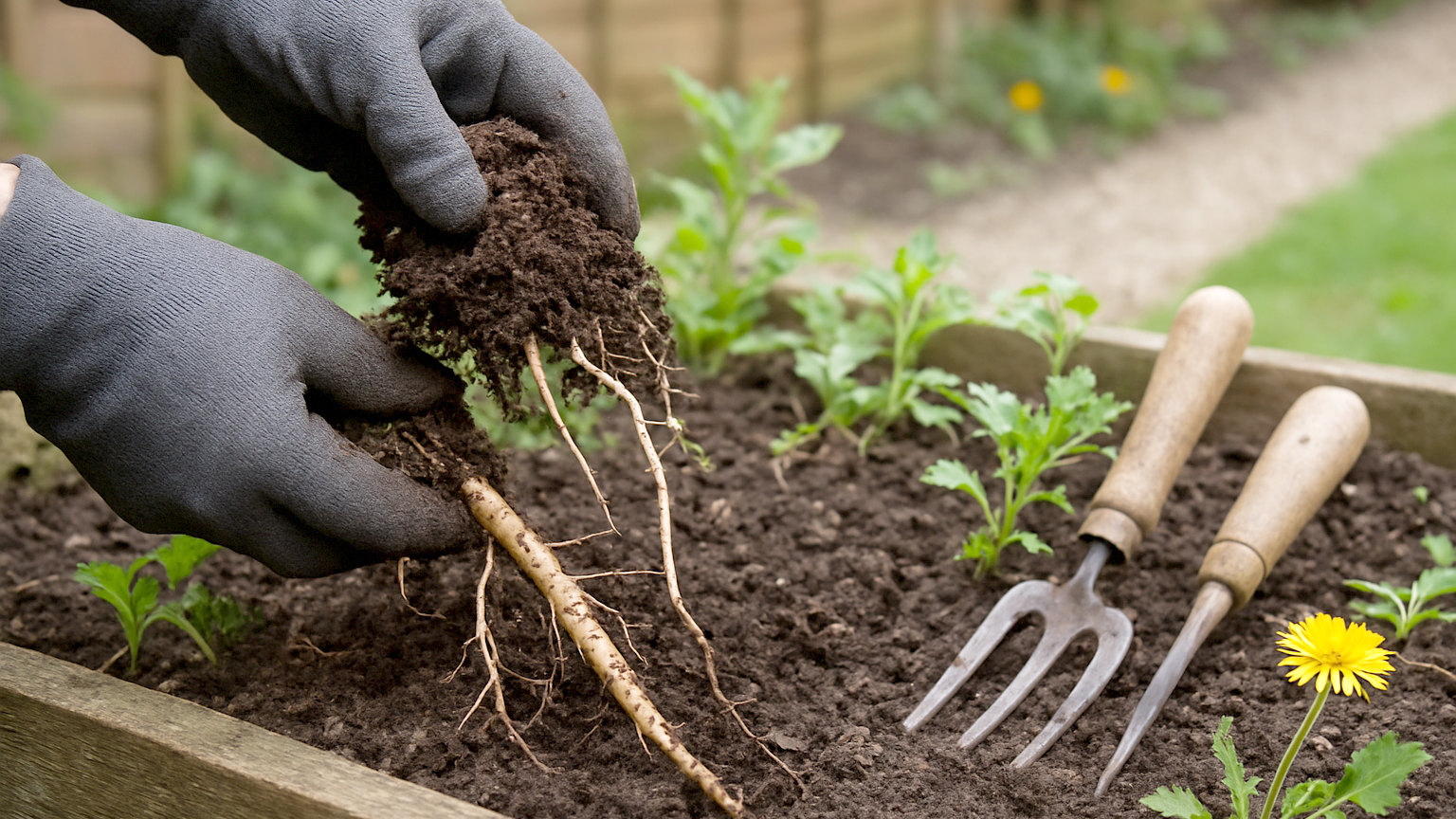
These three are among the most common perennial weeds in British gardens, and each needs a different approach because each stores its reserves differently.
Couch grass
A coarse grass spreading by white, pointed, wiry underground rhizomes that travel widely and produce shoots along their length.
It grows straight through the crowns of perennials and through hedge bases, and it is difficult to distinguish from lawn grass until it appears in a border.
Every piece of rhizome with a node can produce a new plant, so chopping it with a spade or rotavating multiplies it.
Dig with a fork, loosening the ground and tracing the rhizomes out by hand. They pull out in long strands if you work carefully, which is oddly satisfying.
Do not compost the rhizomes, which survive a home heap.
Where it has invaded a clump of perennials, lift the plants entirely in autumn or early spring, wash the soil from the roots, pick out every piece of couch, and replant into cleared ground.
Light exclusion for a full growing season also works well on couch and is less labour.
Docks
A deep, thick, yellow-centred taproot that can reach a metre down, topped by a rosette of large leaves and later a tall spike of rusty seeds.
The taproot regenerates from any piece left in the ground, so pulling the top off achieves nothing beyond a few weeks' delay.
Dig them out with a fork or a long-bladed weeding knife, working down alongside the root and levering rather than pulling. Get as much length as you can.
Work when the soil is damp, after rain, when the whole root is far more likely to come out.
Remove the seed spikes before they ripen. A single dock produces tens of thousands of seeds which remain viable in soil for decades.
If you can do only one thing, cut the seed heads off. That prevents the problem multiplying while you deal with the plants.
Dandelions
A fleshy taproot, shallower than a dock's but with the same habit of regrowing from fragments.
Use a daisy grubber or a long-bladed weeding knife, pushing down beside the root and levering it out whole.
In a lawn, remove them before they seed, since the clocks distribute seed across the whole garden and into the neighbours'.
Dandelions in a lawn indicate thin turf, since a dense sward gives seed nowhere to germinate. Feeding, overseeding and mowing at the right height reduce them more permanently than removing individual plants.
They are also among the most valuable early nectar sources available to bees, and leaving some in a lawn or a rough corner is worth doing deliberately.
Timing
Remove all three before they set seed, which is the single most effective intervention.
Dig perennial weeds out when the soil is damp and workable, in spring or autumn.
Where using a systemic weedkiller, apply when the plant has plenty of leaf and is growing strongly, so the product is carried down to the roots.
Preventing their return
Clear ground completely before planting, since all three are far harder to remove from among established plants.
Mulch cleared ground at five to seven centimetres, which suppresses germinating seedlings, and top it up annually.
Plant densely so there is no bare soil for seed to colonise.
Deal with regrowth promptly, since each shoot that appears is drawing on the reserves you are trying to exhaust, and letting it grow replenishes them.
Disposal
Taproots and rhizomes should go to council green waste, which is composted at temperatures a garden heap does not reach.
Alternatively drown them in a bucket of water for several weeks until they are thoroughly rotted, after which they can go on the heap.
Never leave dug-out roots lying on the soil surface, since many will simply re-root at the first rain.
Identifying them
Couch grass has flat pointed leaves and white wiry rhizomes with sharp tips, quite unlike the fibrous roots of ordinary lawn grass.
Docks have large oval leaves with wavy edges and a distinctive papery sheath where the leaf stalk meets the stem.
Dandelions have deeply toothed leaves in a flat rosette and exude a milky white sap when cut, which distinguishes them from several similar-looking lawn weeds.


