
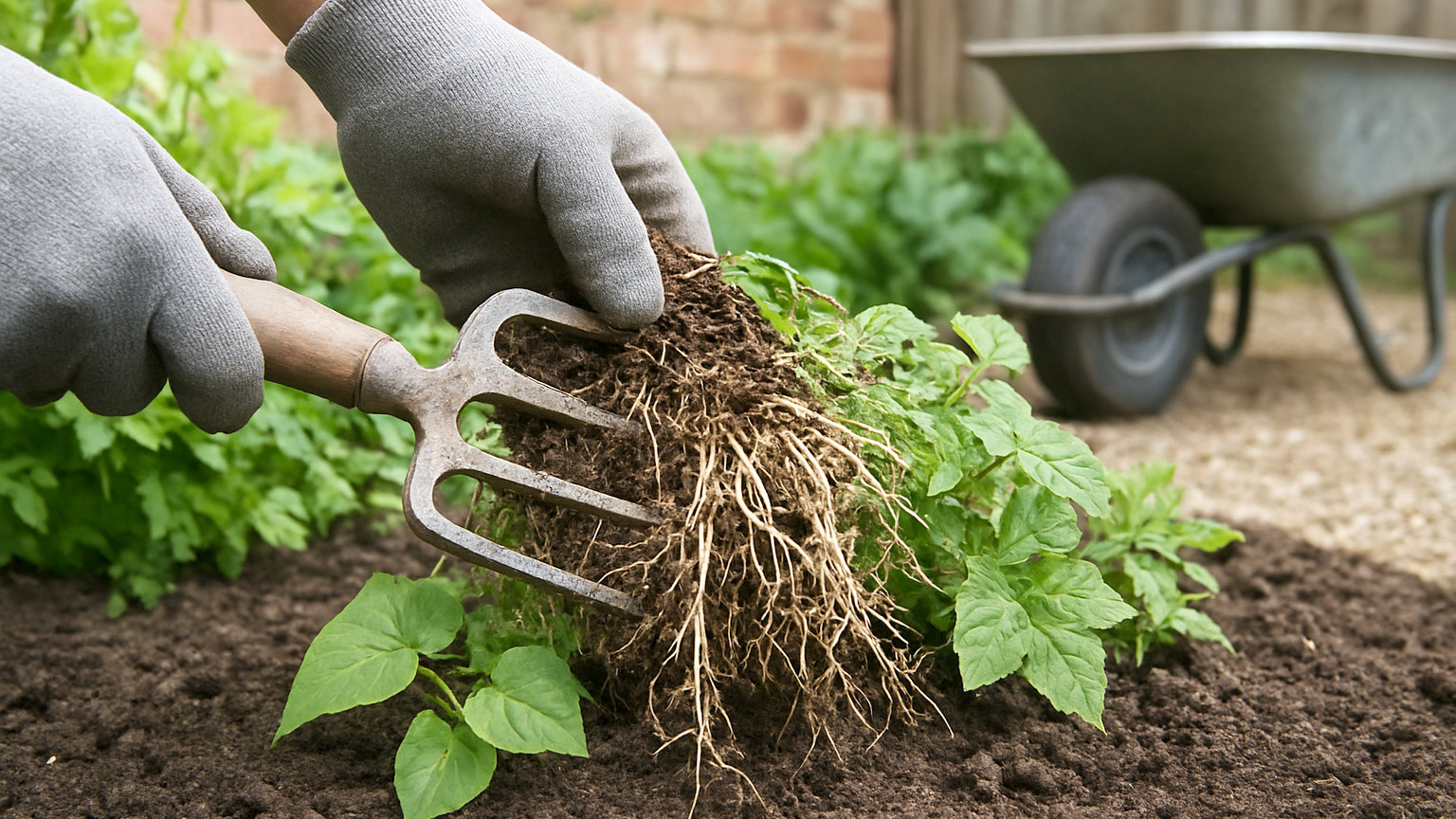
These two defeat more gardeners than anything else, and for the same reason: both regenerate from the smallest piece of root left behind. Any approach that chops them up without removing them makes the problem worse.
Bindweed
Hedge bindweed twines anticlockwise up anything it touches, with large white trumpet flowers. Field bindweed is smaller, with pink and white flowers, and scrambles rather than climbing high.
The roots are white, brittle and go down two metres or more, spreading widely underground. Every fragment of root can produce a new plant.
This is why rotavating infested ground is the worst thing you can do: it chops the roots into hundreds of pieces and plants every one.
Ground elder
Introduced by the Romans as a vegetable and a medicinal herb, and now among the most persistent garden weeds in Britain.
It spreads by white rhizomes just below the surface, forming dense mats, and it grows straight through the crowns of established perennials.
It also regenerates from fragments, though the roots are shallower than bindweed's, which makes it slightly more tractable.
Digging them out
Effective with persistence and only with persistence.
Use a fork rather than a spade, which slices roots into pieces. Loosen the ground and trace each root out by hand, following it as far as it goes.
Work slowly and accept you will miss some. The point is not to get every fragment in one session but to remove the bulk and then deal with regrowth.
Every shoot that appears afterwards is a fragment you missed. Remove each one as it appears, and the reserves in the remaining roots are steadily exhausted.
This takes a full season and often two. It does work.
Excluding light
The alternative where digging is impractical, and it needs a full growing season.
Cover the area with thick black polythene, heavy cardboard covered with mulch, or old carpet where permitted. Overlap generously, weight the edges, and leave no gaps.
Leave it in place for at least a full growing season, and preferably longer for bindweed.
Nothing grows through it, the plants exhaust their reserves trying, and the soil beneath is left workable and full of worms.
Check the edges regularly, since bindweed will travel some distance to find light.
Clear before you plant
This is the point that matters most. Bindweed or ground elder growing up through an established clump of perennials cannot realistically be removed without lifting everything.
Clear the ground completely before planting a new border, even if it costs a season. A border planted over either is a permanent battle.
Where they have already invaded a planting, the effective route is to lift the plants entirely in autumn or early spring, wash the soil off their roots, pick out every fragment of weed root, and replant into cleared ground. It is drastic and it works.
Where they come through a fence
Both travel from neighbouring gardens and from hedge bases.
A physical barrier of thick polythene or a root barrier membrane, sunk vertically to at least sixty centimetres along the boundary, slows bindweed considerably.
Talk to the neighbour, since tackling one side only means the problem returns indefinitely.
Weedkillers
Systemic products are absorbed by the leaves and moved to the roots, which is what makes them effective against deep-rooted perennials.
Apply when the plant is growing strongly with plenty of leaf, usually early summer, and expect to repeat.
A useful technique for bindweed among plants is to insert a cane, let the bindweed twine up it away from everything else, then treat only that growth.
If you use a product, read the label and follow it exactly, since it is a legal document. Never apply near water, and never spray in wind.
Living with it
On a large or shared boundary, total eradication may not be realistic. Regular removal of top growth weakens the plants and keeps them in check, which for many gardens is the practical position.
Ground elder is also edible, and the young spring leaves were the reason it was introduced in the first place. Eating it does not control it, and it is a small consolation for the work involved.
Be certain of the identification before eating anything from a garden, since several similar-looking plants in the same family are poisonous.


