
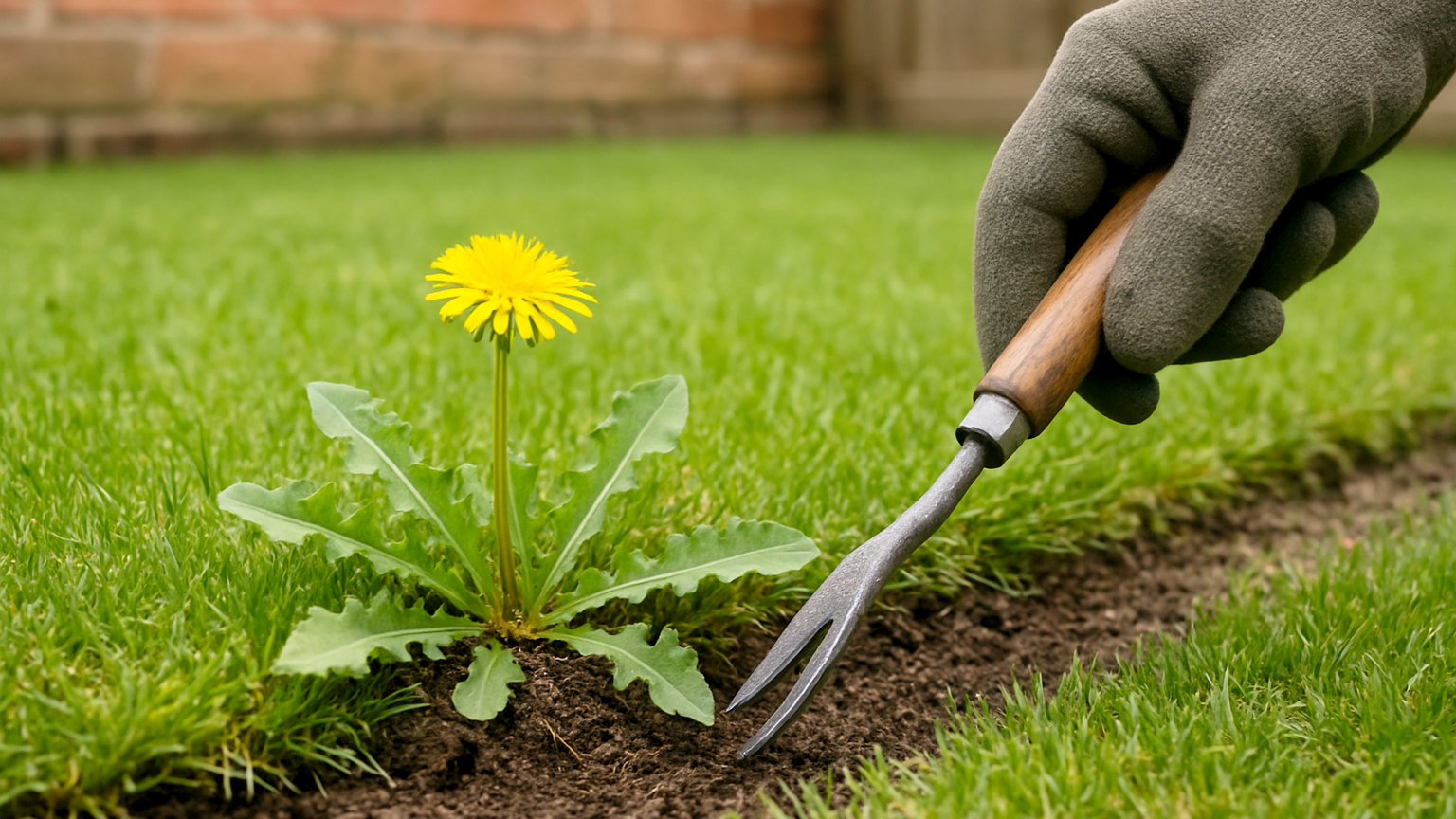
Lawn weeds are a symptom rather than the problem. They establish where grass is thin, stressed or unsuited to the conditions, and improving the grass is more effective than removing them repeatedly.
What weeds indicate
Moss: shade, poor drainage, compaction, low fertility, or mowing too short. All five are worth checking, since moss is almost always a symptom.
Plantains and knotweed: compaction and heavy wear.
Creeping buttercup: wet, poorly drained ground.
Clover: low nitrogen, since clover fixes its own and outcompetes hungry grass.
Daisies and dandelions: thin open turf with gaps to colonise.
Yarrow: dry, poor, sandy soil.
Speedwell and mind-your-own-business: damp shaded conditions.
Address the underlying condition and the weed becomes far less competitive.
Improving the grass
The most effective long-term approach.
Mow higher. Cutting short weakens grass, exposes soil and lets weeds in. Most lawns are cut far too short.
Mow regularly, removing no more than a third of the height at a time.
Feed appropriately, with a spring or summer feed and an autumn one, since well-fed grass crowds weeds out.
Aerate compacted areas, particularly where plantains and moss are prevalent.
Scarify in early autumn to remove thatch and moss.
Overseed thin and bare areas in early autumn, which fills the gaps weeds would occupy.
Improve drainage where the ground is wet.
Water in prolonged drought, or accept dormancy and let the grass recover in autumn.
Removing weeds by hand
Practical for scattered weeds and satisfying.
Use a daisy grubber or a narrow tool, working when the soil is moist so roots come out whole.
Dandelions, plantains and docks all have tap roots that regrow from fragments, so remove them entirely.
Fill and reseed the resulting hole, or the gap simply admits the next weed.
Selective weedkillers
Products formulated to kill broad-leaved plants without harming grass.
Apply when weeds are growing actively, usually late spring or early autumn, in calm settled weather with no rain forecast.
The label is a legal document and using a product other than in accordance with it is an offence.
Observe the instructions on keeping children and pets off treated areas.
Do not compost the first few cuts of clippings after treatment, and check the label for how many, since hormone residues persist and damage sensitive plants such as tomatoes and beans.
Avoid spray drift onto borders, since these products damage almost everything broad-leaved.
Do not use them if you value the clover, daisies and other flowers.
Moss
Killing moss without addressing the cause achieves nothing, since it returns within a season.
Deal with the shade, drainage, compaction, fertility or mowing height first.
Where shade is permanent and heavy, grass will not thrive at all, and the honest answer is to plant something else or accept a mossy surface, which many people find perfectly acceptable.
Tolerating weeds
Worth considering seriously.
Clover stays green in drought, fixes nitrogen, feeds bees and is increasingly included in lawn seed mixtures deliberately.
Daisies, selfheal and bird's-foot trefoil support pollinators and look well.
Leaving part of a lawn unmown, or mowing less often, produces flowers and supports a great deal of wildlife at no cost.
A perfect weed-free sward requires considerable input and offers very little to anything except the appearance.
A proportionate approach
Mow higher, feed twice a year, scarify and overseed in autumn, remove the weeds you dislike by hand, and tolerate the rest.
That produces a good lawn with modest effort and no chemicals at all.
Weeds arriving from elsewhere
Dandelion, daisy and plantain seed blows in constantly, and there is no preventing it.
A dense well-fed sward gives it nowhere to germinate, which is the only durable defence.
Bare patches from wear, drought, pets or scalping are where weeds establish, so repairing them promptly matters more than removing the weeds that follow.
Timing
Early autumn is the best time for scarifying, aerating, overseeding and topdressing together, when the soil is warm and moist.
Spring is the second-best moment for most of it.
Avoid feeding or seeding in midsummer drought or in cold wet winter conditions, when the grass cannot respond.
Wear and shade
Grass will not thrive in heavy shade or under constant heavy wear, and weeds will always fill the gap.
Consider a path, planting or a different surface where a lawn is losing that battle permanently.


