
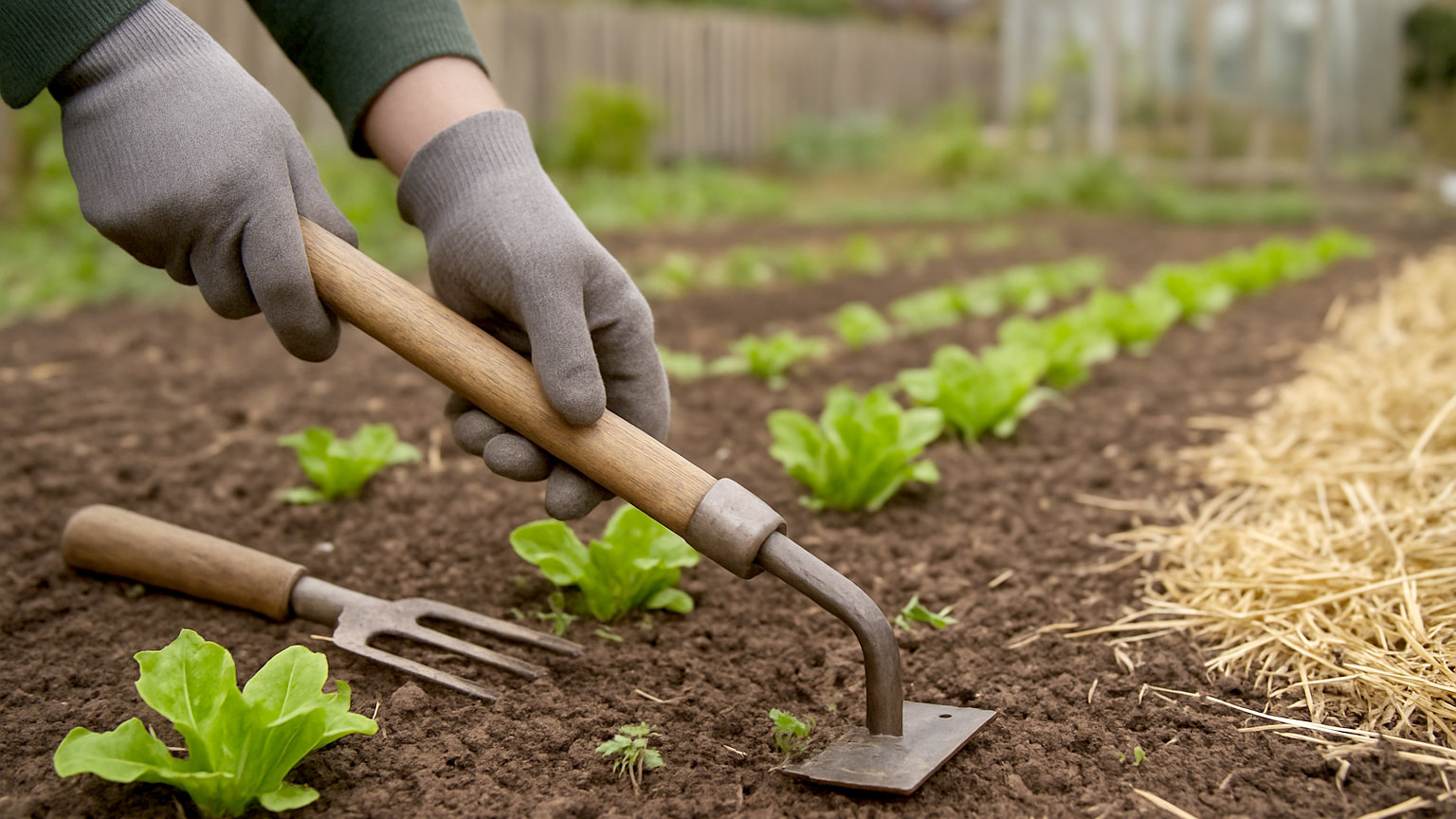
Most garden weeding can be done entirely without chemicals, and the difference between it being a light routine and an endless chore is almost all in the timing.
Hoeing
The most efficient weeding method there is, and the most commonly done badly.
Keep the blade shallow, one to two centimetres below the surface. You are severing stems from roots, not cultivating.
Deep hoeing damages the roots of plants you are keeping and brings buried weed seed to the surface where it germinates.
Hoe on a dry sunny day, so severed seedlings shrivel and can be left where they fall.
Hoe before you can properly see the weeds. Seedlings at the two-leaf stage die immediately; the same plants a fortnight later have roots and regrow.
Keep the blade sharp with a file. A few strokes before starting transforms the tool.
Walk backwards so you are not treading on hoed ground.
A Dutch hoe for open ground, an onion hoe for close work between plants.
Never hoe ground containing perennial rhizomes, which chops and multiplies them.
Hand weeding
For perennials, for weeds among close planting, and for anything with a tap root.
Weed when the soil is moist, since roots come out whole rather than snapping.
Use a fork rather than pulling, which leaves the root behind.
A hand fork, a daisy grubber or a long narrow tool for tap roots.
Work systematically along a bed rather than picking at the obvious ones.
Ten minutes a week beats three hours a month, because everything is caught small.
Covering the ground
The most effective long-term approach, since it prevents germination rather than dealing with the consequences.
Mulch five to seven centimetres deep on moist weed-free soil, which excludes light from the seed bank.
Plant densely so the ground is shaded and there is nowhere for a seedling to establish. A border where plants have knitted together needs almost no weeding.
Ground cover beneath shrubs, which eliminates the bare soil that grows weeds.
Green manures on empty vegetable ground over winter, which occupy the space and improve the soil.
Light exclusion for clearance
For perennial weeds on a clear area.
Cover with thick opaque material, weighted at every edge, for a full growing season or longer.
The plants exhaust their reserves attempting to reach light.
Effective for bindweed, ground elder and couch, and slow.
Heat
Flame weeders do not burn the weed but rupture the cells with a brief pass of heat. The plant wilts within hours.
Effective on seedlings, useless on established perennials, and it needs repeating as new flushes germinate.
Best on paths, gravel and hard surfaces, and a genuine fire risk near dry vegetation, fences and buildings. Never use in dry conditions near anything combustible.
Boiling water kills seedlings in paving joints effectively and costs nothing. Take care carrying it.
Neither method affects the seed bank, so repeat treatments are needed.
Timing through the year
Late winter: clear ground and mulch before growth starts.
Spring: the critical period, hoeing regularly as flushes germinate.
Early summer: keep on top of it, and never let anything flower.
Late summer: remove anything about to seed, which is the priority over anything else.
Autumn: clear and mulch, and tackle perennials while the ground is workable.
What to prioritise
If time is short, remove flowering weeds before seedlings, since preventing seed is worth far more than removing plants.
Deal with perennials before annuals, since they get worse and annuals do not.
Weed newly planted areas first, since established plants compete for themselves.
The realistic picture
A garden managed this way is never weed free, and it is easily kept tidy with a modest routine.
The heavy work is at the start, clearing perennials thoroughly before planting. After that it is minutes rather than hours.
Disposal
Annual weeds without seed can go on the compost heap.
Weeds in flower or seed should not, since a domestic heap rarely reaches a temperature that kills seed.
Perennial roots and rhizomes must be dried until thoroughly dead on a hard surface, drowned in water for several weeks, or sent for municipal composting where the temperature reached kills them.
Listed invasive species are a separate matter entirely and are controlled waste.


