
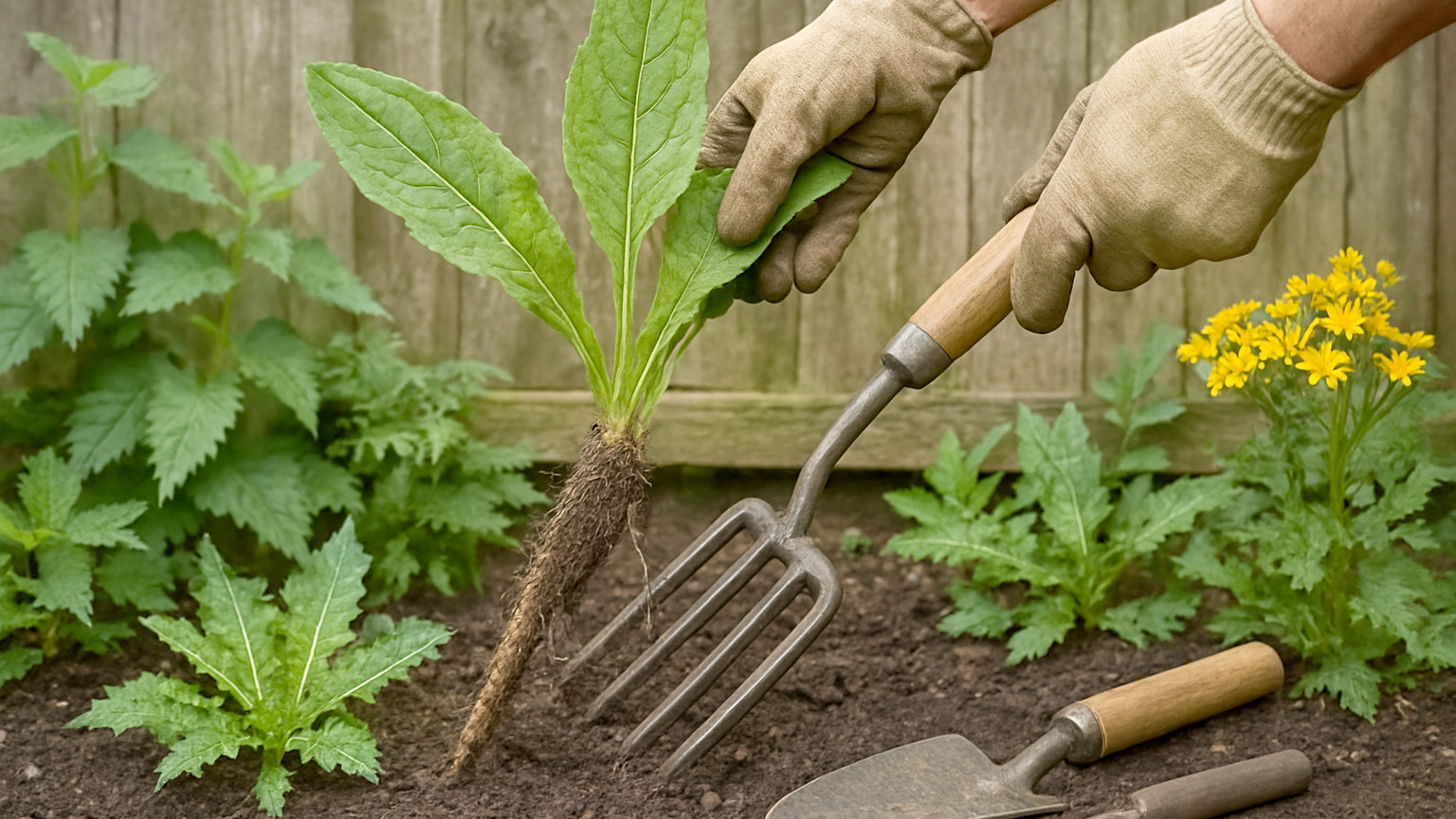
These three dominate neglected ground and each needs a different approach, determined entirely by how the root system works.
Nettles
Yellow spreading roots running just below the surface, easy to see and relatively easy to lift.
They indicate fertile soil high in nitrogen and phosphate, often where manure, compost or rubbish has been dumped.
Removal: loosen with a fork and lift the yellow root mat, which comes away in sheets from loose soil. Work when the ground is moist, wear gloves and long sleeves.
Any root left behind regrows, so go over the ground again after a few weeks.
Repeated cutting weakens them over a season or two where digging is impractical.
Wildlife value: nettles are the food plant of peacock, small tortoiseshell, red admiral and comma caterpillars, which depend on them almost entirely.
A patch in a sunny corner, cut back in parts through the season to provide fresh growth, is genuinely worth keeping.
They also make an excellent high-nitrogen liquid feed: steep in water for a few weeks, dilute heavily and use on leafy crops.
Docks
Broad-leaved and curled docks both have a very deep, thick tap root, which is the whole difficulty.
The root snaps readily and regrows from what remains, so shallow pulling achieves nothing.
Removal: dig deeply with a fork or use a long narrow tool, following the root down and removing it entire. Damp soil makes this far easier.
A dock knife or an old bread knife works well for slicing down alongside the root.
Where the whole root cannot be removed, repeated removal of every leaf as it appears exhausts the plant over a season or two.
Prevent seeding above all. A single dock produces many thousands of seeds, which remain viable in soil for decades. Cut the flowering spikes before the seed ripens even if you cannot dig the plant.
Docks indicate fertile, often compacted or heavy ground.
Creeping thistle
Spreads by deep, extensive, brittle underground roots rather than by a tap root.
This is why pulling the tops achieves so little, and why cultivation spreads it.
Removal: repeated cutting is more effective than digging, since digging fragments the roots. Cut or pull every shoot as it appears, consistently, through the season.
Over two or three seasons of never allowing leaf growth, the root reserves are exhausted.
Light exclusion for a full season works on a clear area.
Spear thistle, by contrast, is a biennial with a tap root, and is removed by digging it out before it flowers in the second year.
The legal position on injurious weeds
Five species are listed as injurious weeds under the Weeds Act: common ragwort, spear thistle, creeping thistle, curled dock and broad-leaved dock.
Having them on your land is not in itself an offence.
However, the relevant authority can require an occupier to prevent their spread where they threaten agricultural land or grazing.
The practical implication is for gardens adjoining farmland and grazing, where allowing thistles and docks to seed freely may become an issue.
Ragwort
Yellow daisy-like flowers on tall stems, common on rough ground.
It is toxic to horses, ponies and cattle, and the toxins accumulate in the liver. It remains toxic when dried in hay, which is where much of the risk lies.
Specific guidance covers control where land is used for grazing or forage production.
Wear gloves when handling it, remove it before it flowers, and dispose of it appropriately rather than leaving cut material where stock can reach it.
Note that ragwort is an important nectar source for many insects and is the food plant of the cinnabar moth, so on land far from grazing there is a balance to consider.
General approach
All three colonise ground that is not being managed.
Clear thoroughly, then plant densely or mulch, since bare fertile ground will simply be recolonised.
All three also indicate something about the soil, which is worth noting: high fertility, compaction or neglect, and addressing that reduces the problem.
Protective clothing
Wear gloves and long sleeves for all three.
Nettle stings are unpleasant rather than dangerous, thistle spines cause painful puncture wounds that can become infected, and ragwort should be handled with gloves.
Keep tetanus vaccination current, since garden wounds contaminated with soil are the classic route for infection.


