
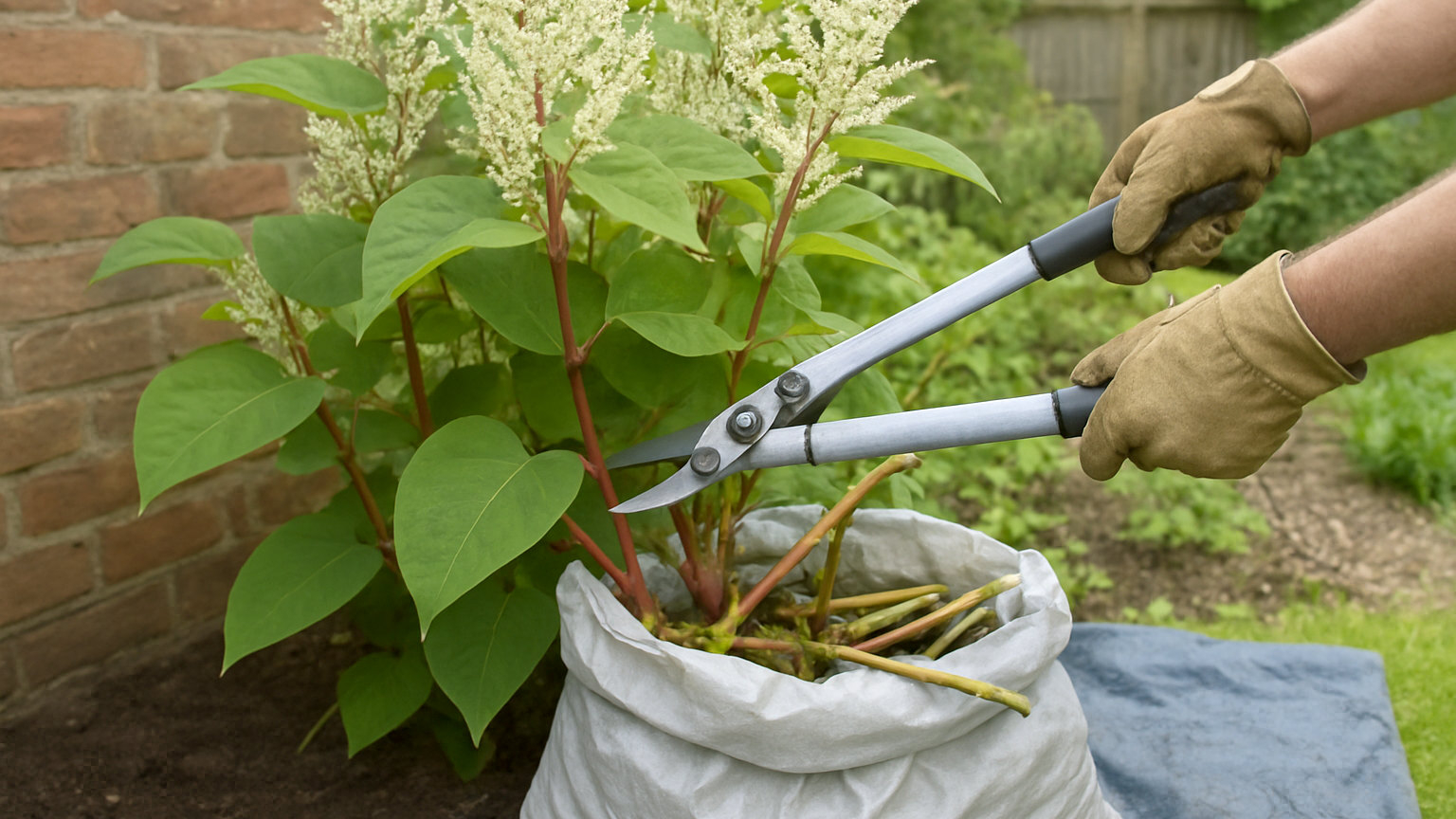
Japanese knotweed carries legal obligations that no other garden weed does, and getting it wrong can be expensive. The essential points are that having it is not an offence, allowing it to spread is, and the material you cut is legally controlled waste.
Identifying it
Bamboo-like hollow stems, green with distinctive purple or red speckling, growing to two or three metres in a season. Leaves are shield or heart-shaped with a flat base, up to about fourteen centimetres long, arranged alternately along the stem in a clear zigzag pattern.
Creamy white flower spikes appear in late summer. In winter the canes die back to brown, brittle stems that remain standing.
Growth in spring is rapid and unmistakable, with red-purple asparagus-like shoots emerging and extending very quickly.
Several plants are mistaken for it, including bindweed, houttuynia, Russian vine, bamboo and dogwood. Get an identification confirmed before acting, since the response and the cost differ enormously.
What the law actually says
It is not illegal to have Japanese knotweed growing on your land, and you are not obliged to remove it.
It is an offence under the Wildlife and Countryside Act 1981 to plant or otherwise cause Japanese knotweed to grow in the wild. Allowing it to spread onto neighbouring land can also give rise to a private nuisance claim, and local authorities have powers under anti-social behaviour legislation where it affects the amenity of an area.
Under the Environmental Protection Act 1990, Japanese knotweed and any soil containing its roots are classified as controlled waste. That means it must be disposed of at a licensed facility by a registered waste carrier.
What you must not do
- Do not put it in your household or green waste bin
- Do not compost it
- Do not take it to an ordinary tip
- Do not move soil containing it around your garden or off site
- Do not strim, mow or flail it, which scatters fragments that each grow into new plants
- Do not dig it out casually, since a fragment of rhizome the size of a fingernail can produce a new plant
Selling a house
When selling a property in England and Wales, the standard TA6 property information form asks specifically about Japanese knotweed, and answering dishonestly can lead to a claim for misrepresentation.
Its presence affects mortgage lending. Many lenders will decline or require evidence of a professional treatment plan with an insurance-backed guarantee, and buyers frequently withdraw. This is the main reason people take it seriously.
Treatment
Professional treatment is strongly advised, both because it is effective and because the resulting management plan and guarantee are what lenders and buyers want to see.
Herbicide treatment, typically applied over several seasons, is the usual approach and is slower but far less disruptive than excavation. Full excavation and removal is quicker and considerably more expensive, and generates a large volume of controlled waste.
Treating it yourself is possible in principle with a systemic glyphosate product applied repeatedly over several years, following the label exactly. In practice, without documentation from a recognised contractor you may find the property is still difficult to sell.
Choose a contractor who is a member of a recognised trade body and who provides an insurance-backed guarantee.
If it is coming from next door
Raise it with the neighbour first, in writing, keeping a record. Many people do not know what it is.
If that fails, the local authority may be able to act, and a private nuisance claim is possible where knotweed from adjoining land has affected your property. Take legal advice before starting anything formal.
Why it is so persistent
Knotweed spreads through an extensive underground rhizome system that can extend several metres from the visible growth and to a depth of two metres or more. It does not set viable seed in the UK, so every plant here spreads vegetatively, which is precisely why fragments and contaminated soil matter so much.
Other invasive species
Similar restrictions apply to giant hogweed, whose sap causes severe skin burns and blistering in sunlight and which should never be touched or strimmed, and to Himalayan balsam. Several invasive aquatic plants are banned from sale.
This is general information
Nothing here is legal advice, and the position differs across the United Kingdom. For a confirmed infestation, particularly where a sale or a neighbour is involved, take professional advice.


